Tag

Satellite Communications

All articles tagged with #satellite communications

Rocket Lab's $8B Iridium Deal Signals a Bold Leap into Satellite Communications
business6 days ago

Rocket Lab's $8B Iridium Deal Signals a Bold Leap into Satellite Communications

Rocket Lab (RKLB) plans to acquire Iridium Communications (IRDM) for about $8 billion in a half-cash, half-stock deal, aiming to combine rocket-launch services with satellite-based mobile communications to compete with SpaceX’s Starlink and expand margins. The move could unlock significant long-term upside, but it comes with high risk: Rocket Lab is still unprofitable, the stock is volatile, and the acquisition’s closing and integration (expected in H1 2027) will drive the near-term trajectory. In Q1, Rocket Lab posted revenue growth of about 63.5% to $200.3 million, while reporting a per-share loss of $0.02; Iridium posted a net profit of roughly $114.4 million last year, and Rocket Lab’s own net loss was about $198.2 million, underscoring the substantial execution risk alongside potential synergy-driven gains.


Rocket Lab to buy Iridium’s 66-satellite network for $8B, aiming to challenge SpaceX
science12 days ago

Rocket Lab to buy Iridium’s 66-satellite network for $8B, aiming to challenge SpaceX

Rocket Lab will acquire Iridium Communications for $8 billion, combining Rocket Lab’s launch and spacecraft manufacturing with Iridium’s 66-satellite global network to compete with SpaceX, serving about 2.5 million subscribers and enabling next‑generation satellites with direct-to-device services that could bolster U.S. national security and emergency-response capabilities.

Rocket Lab seals $8B Iridium deal to forge a space-services powerhouse
business12 days ago

Rocket Lab seals $8B Iridium deal to forge a space-services powerhouse

Rocket Lab announced it is acquiring Iridium for about $8 billion in cash and stock, combining Rocket Lab’s launch capabilities with Iridium’s profitable 80-satellite L-band network to accelerate space-based services (IoT, navigation/PNT, aviation, maritime, and security). CEO Peter Beck says the deal creates a self-launching space powerhouse and aims to outpace rivals like SpaceX and Blue Origin, while Rocket Lab continues developing the Neutron rocket; Iridium’s network and spectrum underpin the expansion, though Neutron’s debut remains uncertain.

Rocket Lab to Acquire Iridium, Creating a Fully Integrated Space Services Powerhouse
business12 days ago

Rocket Lab to Acquire Iridium, Creating a Fully Integrated Space Services Powerhouse

Rocket Lab will acquire Iridium for about $8 billion enterprise value, paying $54 per Iridium share in cash and stock, uniting Rocket Lab's launch and manufacturing with Iridium's global L-band network to form an end-to-end space company offering satellite services, IoT, D2D, PNT, and national-security capabilities, with closing expected in mid-2027 subject to approvals and financing; the deal expands recurring revenue and vertical integration in the space economy.

Ukraine targets Russia’s gas hub and satellite centers in nighttime strikes
world17 days ago

Ukraine targets Russia’s gas hub and satellite centers in nighttime strikes

Ukrainian forces conducted overnight strikes on Russia, hitting the Orenburg Gas Processing Plant—one of the world’s largest gas complexes and a helium producer—and two military satellite-communications centers near Dubna and in the Vladimir region, as part of Kyiv’s campaign to disrupt energy facilities and military infrastructure with long-range weapons.

New anti-jamming satellite antenna slashes power use by 95%
military1 month ago

New anti-jamming satellite antenna slashes power use by 95%

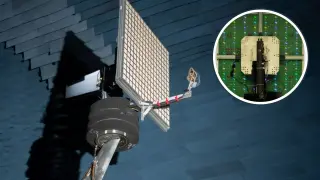
MIT Lincoln Laboratory is developing a lightweight scanning reflectarray antenna (HoNi BAJR) for proliferated low-Earth orbit to protect military satellite links from electronic attacks, delivering advanced beamforming with about 95% less power and a smaller footprint; calibration remains a key challenge as researchers test wide-angle scanning and multi-user beams for future spacecraft constellations.

technology2 months ago

SpaceX deploys ViaSat-3 F3 on Falcon Heavy, boosting APAC capacity beyond 1 Tbps

SpaceX launched the 6-ton ViaSat-3 F3 satellite on a Falcon Heavy from Kennedy Space Center. After a multi-burn ascent, the satellite deployed into a geosynchronous transfer orbit as the two side boosters returned for landing and the center core was not recovered. The third and final ViaSat-3 vessel will take about two months to raise to its final position at 155.58°E, delivering more than 1 Tbps of capacity for the Asia-Pacific region using flexible phased-array beams.

Amazon buys Globalstar to expand Leo with direct-to-device satellite coverage
technology2 months ago

Amazon buys Globalstar to expand Leo with direct-to-device satellite coverage

Amazon will acquire Globalstar to fuse its Leo satellite network with Globalstar’s spectrum and MSS capabilities, enabling next‑gen Direct‑to‑Device satellite services; separately, Amazon and Apple will extend satellite connectivity to iPhone and Apple Watch, including Emergency SOS via satellite. The move aims to deliver broader, more resilient global coverage, with D2D rollout starting in 2028 and the merger closing anticipated in 2027 pending regulatory approvals.

Geostationary 2-Watt Laser Delivers 1Gbps Ground Link, Outpaces Starlink
technology3 months ago

Geostationary 2-Watt Laser Delivers 1Gbps Ground Link, Outpaces Starlink

Chinese researchers demonstrated a 1 Gbps optical downlink from a geostationary satellite about 36,000 km away using a 2-watt laser and a ground receiver built to correct atmospheric distortion, achieving higher speeds than Starlink and showing how adaptive optics plus multi-plane light conversion can recover usable data through turbulence.

Europe rolls out sovereign encrypted satellite network to curb US dependency
technology5 months ago

Europe rolls out sovereign encrypted satellite network to curb US dependency

EU officials announced GOVSATCOM now provides secure, encrypted satellite communications for member states' military and government users, aiming to reduce reliance on US systems like Starlink; expansion via the IRIS2 multi-orbit constellation is planned for 2029, alongside a proposed €131 billion space/defense budget to boost interoperability and a virtual European Space Command.

Apple Watch Ultra 3 and SE 3: New Features and Best Picks
technology9 months ago

Apple Watch Ultra 3 and SE 3: New Features and Best Picks

The Apple Watch Ultra 3 introduces satellite communication capabilities for emergency SOS, messaging, and location sharing, supporting users in remote areas. It features a larger display, improved battery life, 5G support, and health features, with satellite services included for two years. The device's satellite functions are similar to those on the iPhone 14 and are designed to enhance safety and connectivity in off-grid situations.

Space Force awards Boeing $2.8B contract for strategic communications
technology1 year ago

Space Force awards Boeing $2.8B contract for strategic communications

The U.S. Space Force awarded Boeing a $2.8 billion contract to develop the Evolved Strategic Satellite Communications (ESS) system, replacing the older satellite constellation with more resilient and cyber-capable satellites, as part of a broader strategy to deliver faster, cost-effective, and lower-risk satellite communication capabilities, including the cancellation of the PTS-R program.