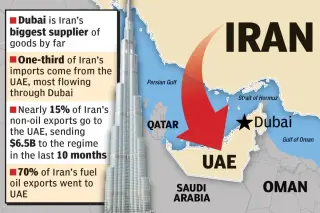
The United Arab Emirates suspended all trade with Iran, cutting off roughly $6 billion in cash and disrupting Iran’s $21.3 billion bilateral trade network, potentially crippling Tehran by choking dollar access and imports as U.S.-led sanctions intensify.
The United Arab Emirates said it would suspend all trade and financial transactions with Iran until further notice after accusing Tehran of firing ballistic missiles toward the UAE. Reported missile strikes triggered nationwide warnings and evacuations, though Iran denies the attacks. The move compounds Iran’s economic isolation amid sanctions and underscores the UAE’s role as a regional trade hub, with analysts warning the embargo could harm both economies and regional stability in the Gulf.
The UAE announced a complete halt of trade and financial transactions with Iran after accusing Tehran of missile attacks near the UAE, heightening economic pressure to deter Iran’s bid for control of the Strait of Hormuz; ISW-CTP warn that Iran’s leadership may accept costs if they advance core objectives, while UAE-US alignment signals longer‑term regional hostility. In Iraq, Iranian-backed militias resist disarmament and Tehran Presses Baghdad to limit conflict, with officials in Baghdad engaging Tehran to safeguard influence over oil transit. Iran also reshuffles judiciary leadership amid unrest concerns. Overall, the updates depict intensified competition over Hormuz, deeper regional alignments, and ongoing economic and security pressure among Gulf states and Iraq.
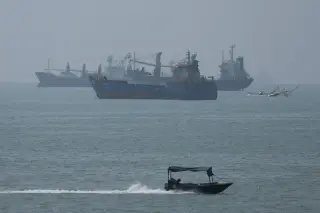
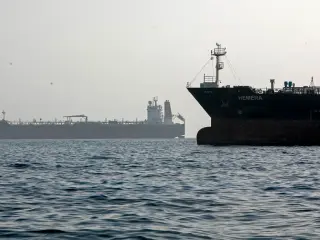
Iranian officials reportedly weighed hitting U.S. military assets in Europe (including Bulgaria and Cyprus) if the war widens, as U.S.-Iran tensions remain high; the UAE paused all trade with Iran after missiles were launched toward its waters. Washington says no talks are planned and negotiations are stalled, while shipping through the Strait of Hormuz remains unusually quiet and an earlier cargo-ship attack killed one person.
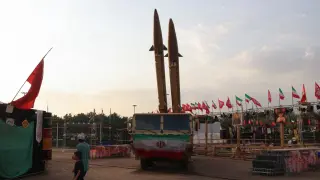
The UAE says Iran launched two ballistic missiles toward its territory; the first fell outside UAE waters and the second within, with neither hitting land. It marked the first missile alert in months after earlier false alarms, amid renewed regional tensions following a collapsed framework deal and Iran’s resumed strikes against neighbors.
The United Arab Emirates suspended all trade, commercial exchanges, and financial transactions with Iran after accusing Tehran of firing two ballistic missiles toward the UAE; the missiles were said to have targeted maritime traffic, with one falling outside UAE waters and the other inside. Iran denies involvement. The move heightens regional tensions and risks to security and commerce.
The United Arab Emirates extradited Irish crime boss Daniel Kinahan to Ireland under a UAE–Ireland extradition treaty, with Kinahan expected to appear before Dublin’s Special Criminal Court to face charges of leading a transnational organised crime group involved in drugs, money laundering and violent crime.
Daniel Kinahan, the Irish businessman suspected of leading the Kinahan Organised Crime Group, is due to land in Dublin after an extradition from Dubai. He’s expected to be charged immediately on arrival and brought before the three-judge Special Criminal Court, as Irish authorities coordinate a large security operation and highlight transnational cooperation with the UAE.
The United Arab Emirates handed Daniel Kinahan, long linked to a global criminal network and named by the U.S. as a Kinahan Organized Crime Group leader with a $5 million reward, to Irish authorities after a Dubai court ruling under an extradition agreement; Kinahan is set to be charged with directing organized crime when he appears in Dublin, with Irish police having conducted years of investigations, and Kinahan having lived openly in Dubai for about a decade.
With Iran–linked attacks disrupting traffic through the Strait of Hormuz, Gulf oil producers are rushing to build pipelines and a new port to bypass the chokepoint. The UAE’s 252-mile West-East Pipeline and Iraq’s Basra–Haditha line could move substantial Gulf crude overland, and Goldman Sachs projects bypass capacity of up to 7.3 million barrels per day by 2028, potentially diverting about 45% of pre‑war Persian Gulf exports by 2027. Saudi Arabia is weighing a Red Sea pipeline expansion, while Dubai eyeing a new Arabian Sea port to further reduce Hormuz dependence; nonetheless, Hormuz will remain a major conduit for 7–9 million barrels per day amid regional instability such as Houthi threats near Bab el‑Mandeb.
The US-Iran memorandum signals a new regional order that the Gulf states are quickly adapting to: Iran remains a major neighbor, and Riyadh, Abu Dhabi and Doha are prioritizing economic stability and openness to foreign investment over trying to topple Tehran, effectively sidelining Israel. The war’s outcome shows US limits and Tehran resilience, prompting Gulf states to pursue détente with Iran and cautious normalization with Israel, while blaming Israel for past costs and questioning the viability of military confrontations in the region.
France is in talks with the United Arab Emirates to collaborate on upgrading its Rafale fighters after Germany pulled the plug on the Franco-German FCAS project, with the UAE potentially funding and ordering Rafale jets and contributing to the program’s development. The move comes as Paris reassesses how to finance a future fighter for the 2040s without Germany, while a Franco-German tank program remains delayed; India’s Rafale deal and Sweden’s Saab are also in play as alternatives are explored.
A British human-rights lawyer says Zeynab Javadli, ex-wife of Sheikh Saeed bin Maktoum bin Rashid Al Maktoum, has disappeared after contact was lost; her Dubai home was found empty with changed locks, and she and her three daughters have not been seen. The long-running custody dispute is cited by her supporters, while authorities have not commented; the case echoes the Latifa episode and has prompted calls for international verification of her welfare and whereabouts.
A Wall Street Journal report says the UAE launched dozens of air strikes against Iran from the outset of the US-Israel campaign, coordinating with Washington and Tel Aviv and hitting energy facilities such as the Asaluyeh complex; the disclosure implies Abu Dhabi acted as a third participant earlier than publicly acknowledged, provoking Iranian retaliation, Gulf tensions, and significant economic disruption in the UAE, including flight cancellations and a multi-billion dip in Dubai/Abu Dhabi stock markets.
Human Rights Watch documents a UAE-backed operation that recruited, trained, and deployed Colombian PMCs to Sudan to support the RSF, with transit through UAE bases and hubs in Libya, Somalia, and Chad, and continued presence around El Fasher. By 2024-2025, hundreds of Colombian contractors fought alongside RSF forces and helped train recruits, including alleged child soldiers; the report highlights diverted UAE-sold equipment and bases, suggesting potential aiding-and-abetting war crimes and urging UN/EU/US investigations and sanctions. UAE denies involvement, but HRW calls for accountability and a broader arms embargo enforcement.