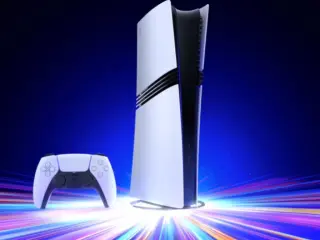
Sony’s PS5 Pro system software beta now enables the PSSR 2.0 upscaler by default for all PS5 Pro games, delivering sharper visuals and steadier frame rates without having to manually enable the setting. The feature remains in beta, can be disabled in Settings, and there’s no firm rollout date for a full release.
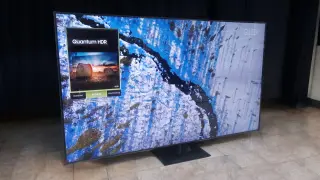
The article argues that the smart TV processor is often the most important spec, affecting upscaling, image quality, noise reduction, and even gaming and app performance. It recommends prioritizing brand-name processors (LG Alpha, Samsung NQ, Sony) and testing in-store for smooth menus and fast app loading, while also checking reviews for real-world upscaling performance.
A tech-site review benchmarks Ubisoft’s Assassin’s Creed Black Flag Resynced across 35 GPUs, testing DirectX 12 with two ray-tracing modes (RTGI and extended reflections) and evaluating upscaling options (DLSS, FSR, XeSS) plus frame generation and VRAM usage to map hardware requirements for an optimal experience.
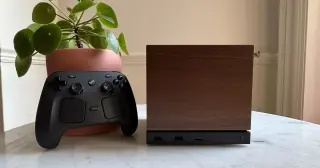
Valve updated the Steam Machine page to replace the earlier claim of '4K gaming at 60 FPS with FSR' with 'Up to 4K gaming with FSR 4.1,' a change made without notice amid heightened scrutiny of the device; observers say the machine effectively targets 1080p with upscaling and that some titles may still require lowering settings to maintain smooth framerates, with Valve not explaining the rationale for the update.
Digital Foundry previews Fuse Games’ Star Wars: Galactic Racer, a UE5-based arcade racer emphasizing physics-driven destruction, thermal terrain effects, and a four-vehicle archetype roster. The game uses photogrammetry and Nanite for high-fidelity environments, with Lumen lighting on PS5/PS5 Pro and Series X, and screen-space reflections for performance. It targets 60fps on base PS5 and Series X, with dynamic TSR upscaling (PS5 Pro uses PSSR) and a broad upscaling toolkit (DLSS 4.5, XeSS, FSR 4). PC configurations including RTX 4090 can push high frame rates (around 150fps with frame generation and ray reconstruction), while Series S prioritizes lightmass probes for balance. Notably, collisions trigger Burnout-style takedowns, and environmental heat and cold influence vehicle performance. An early look suggests a promising blend of nostalgia and modern tech ahead of the October 6 launch, with ongoing polish planned.
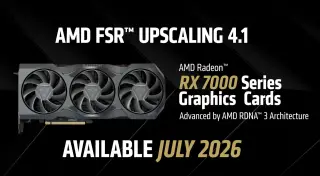
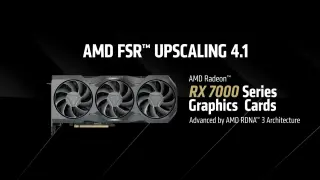
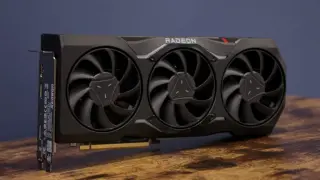
AMD launches FSR 4.1 for Radeon RX 7000-series GPUs, promising better image quality and smoother gameplay. It’s developing lightweight ML models to bring FSR 4.1 to RDNA 3 APUs and plans RDNA 2 support in early 2027. FSR 4.1 is already in 300+ games, with Doom: The Dark Ages Revelations and Assassin’s Creed Black Flag Resynced due in July.
At Computex 2026, AMD says FSR 4.1 will reach RDNA3 RX 7000 GPUs in July, delivering RDNA4-level quality with a differently structured model that converts FP8 to INT8 for RDNA3; RDNA2 support is planned for 2027 after extensive optimization, using a multi-tier training pipeline on Instinct MI accelerators, Radeon Pro workstations with ROCm, and broad PC configuration testing to ensure wide compatibility.
Ars Technica’s review argues the RX 9070 GRE is a downgraded take on AMD’s RX 9070, with 3,072 shader cores, a 192-bit bus, and 12GB RAM at the same $549 MSRP; at 1440p it sits 10–20% slower than the regular 9070 and often trails the RTX 5070, while 4K performance with ray tracing is spotty, making memory and bandwidth the bottlenecks; overall, the GRE feels like GPU shrinkflation and not good value compared with spending a bit more on the non-GRE RX 9070 or considering Nvidia alternatives.
Digital Foundry’s analysis shows 007 First Light on PS5 Pro delivers a true upgrade: 60fps with much sharper visuals thanks to PSSR2 upscaling, while the base PS5 runs 60fps in Performance at 720p and 30fps in Quality at 1080p, with FSR 3.1.5 artifacts; the Pro version offers a cleaner image at the higher cost.
AMD says FSR 4.1 will arrive on older Radeon RX GPUs, starting with RDNA 3 this July and extending to RX 7000-series and older cards with optimized memory use and fewer artifacts, aiming for 300+ supported games at launch; RDNA 2 GPUs will get it in early 2027.
AMD will bring FSR 4.1 to older RDNA3/3.5 GPUs starting July (RX 7000 series and integrated 890M/8060S), with early 2027 rollout to RDNA2 GPUs (RX 6000, Steam Deck GPU, 680M) and potential PlayStation 5/Xbox Series X|S support later. Because older chips run FSR 4 on INT8 rather than FP8, performance may see a noticeable hit and image quality may vary, with early estimates around a 10–20% slowdown versus FSR 3.1 on comparable hardware. Games that support FSR 4 will work via the Radeon driver, and FSR 3.1 titles can be forced to use FSR 4, broadening compatibility beyond RDNA4 hardware.
AMD will broaden FSR 4.1 support beyond its latest RDNA 4 cards, bringing it to RDNA3-based Radeon 7000 GPUs in July and to RDNA2-based Radeon 6000 GPUs in 2027 via a phased rollout. The upgrade promises better motion detail, RT denoising, and a more capable Ultra Performance mode, with initial titles including Forza Horizon 6, Death Stranding 2, and Crimson Desert as benchmarks for the new features.
Digital Foundry critiques Lego Batman: Legacy of the Dark Knight’s PC specs sheet for listing a 1080p 30fps base with frame generation, which would imply a native ~15fps and heavy upscaling; argues this misleads players, calls for a clearer native target (ideally ~60fps) and more transparent hardware requirements even when frame-boosting tech is used, and notes the marketing misstep while planning to test real-world performance on PC and consoles.
Digital Foundry’s analysis shows Pragmata looks notably better on PS5 Pro, thanks to the PS5 Pro’s PSSR2 upscaling which takes an 864p internal image and upscales it to 2160p, delivering a sizable image-quality boost over the base PS5 (which uses 1080p/60fps with FSR1). A 120fps Frame Rate mode is available on Pro (though it targets 1440p), VRR can help, and ray-traced reflections are still somewhat limited. In short, Pragmata benefits significantly from PS5 Pro’s optimizations, making the Pro version the stronger option visually and performance-wise.
Digital Foundry finds Pragmata looks significantly sharper on PS5 Pro thanks to PSSR2 upscaling (864p internal upscaled to 2160p) and can run at up to 120fps in Frame Rate mode. Base PS5 versions show lower image quality and some ray-tracing compromises, with PS5 Pro delivering the more polished experience.