
Tag

X Ray Diffraction

All articles tagged with #x ray diffraction

Cuprate Superconductors Revealed as Patchwork of Structures, Not Uniform Crystals
science13 days ago

Cuprate Superconductors Revealed as Patchwork of Structures, Not Uniform Crystals

Researchers have overturned a 40-year assumption that cuprate superconductors possess a uniform internal crystal structure. Using 3D X-ray diffraction, scientists found that these materials are actually composed of a patchwork of different atomic arrangements separated by wide boundaries. This discovery suggests that previous theoretical models were oversimplified and may help explain why certain superconductors perform better than others.

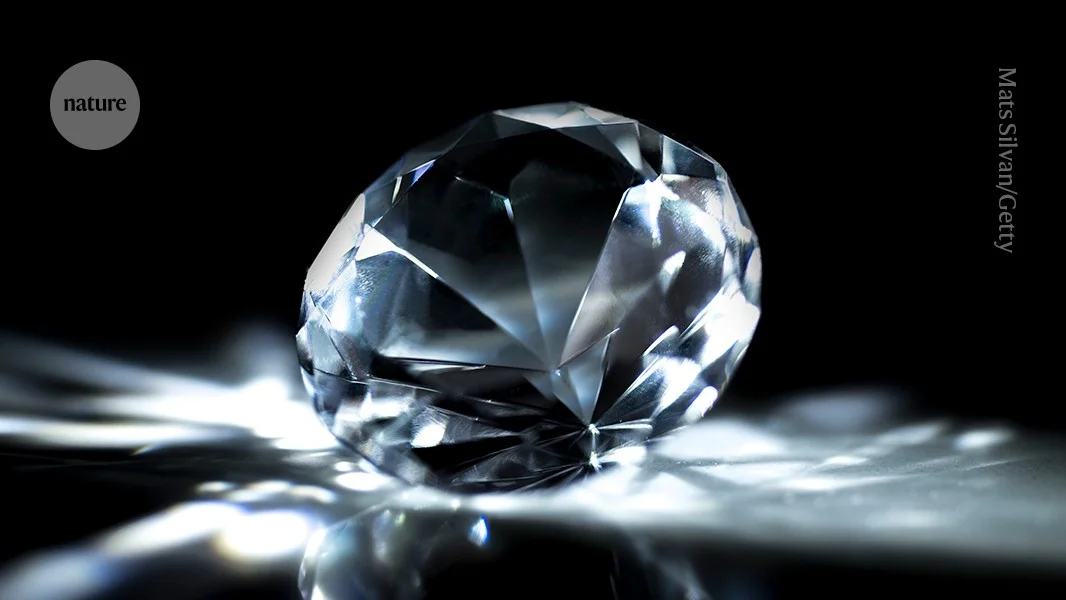
LLNL Laser Experiments Correct Diamond Melting Curves for Fusion and Planetary Science
science20 days ago

LLNL Laser Experiments Correct Diamond Melting Curves for Fusion and Planetary Science

Researchers at Lawrence Livermore National Laboratory (LLNL) have corrected long-standing errors in diamond melting temperature estimates by using laser-driven shock experiments. By blasting diamond samples and tracking the process with X-ray diffraction, they found previous theoretical and experimental data were off by hundreds of degrees. This updated data is critical for improving inertial confinement fusion (ICF) efficiency at the National Ignition Facility (NIF) and for modeling carbon behavior in ice giants like Neptune. While the findings do not impact magnetic confinement fusion for power generation, they significantly enhance our understanding of diamond under extreme planetary pressures.

Strongest evidence yet that hexagonal diamond is real and potentially harder than cubic diamond
science7 months ago

Strongest evidence yet that hexagonal diamond is real and potentially harder than cubic diamond

Chinese researchers report millimeter-sized samples of hexagonal diamond (lonsdaleite) produced by compressing graphite at ~20 GPa and 1300–1900 °C, with X-ray diffraction peaks that conclusively confirm the hexagonal structure; tests show the material is stiffer, more oxidation resistant, and slightly harder than conventional cubic diamond, marking the strongest evidence to date in decades-long debates and offering potential uses in tools, thermal management, and quantum sensing.

"Theoretical Phase of Matter Proven to Exist in Reality"
science2 years ago

"Theoretical Phase of Matter Proven to Exist in Reality"

Scientists have experimentally confirmed the existence of the Bragg glass phase, a previously theoretical phase of matter, in a real material called PdxErTe3. This discovery sheds light on material behavior and demonstrates new techniques for probing atomic structures, using X-ray diffraction and machine learning data analysis. The Bragg glass phase represents a significant step in understanding elusive phases of matter and opens the door for future discoveries in material science.

"Machine Learning Unveils Elusive Bragg Glass Phase in Materials Science"
physics2 years ago

"Machine Learning Unveils Elusive Bragg Glass Phase in Materials Science"

Physicists at Cornell University have used a new machine learning data analysis tool to detect the elusive Bragg glass phase in the systematically disordered charge density wave (CDW) material, PdxErTe3, settling a long-standing question about its existence in real materials. The discovery, published in Nature Physics, was made possible by analyzing large volumes of X-ray data and using the machine learning tool X-ray Temperature Clustering (X-TEC) to identify subtle signatures of the Bragg glass phase, significantly advancing our understanding of the complex interplay between disorder and fluctuations in materials.

Reevaluating Rosalind Franklin's Impact on the Discovery of DNA's Structure.
science3 years ago

Reevaluating Rosalind Franklin's Impact on the Discovery of DNA's Structure.

Two scientists have uncovered more details about Rosalind Franklin's contribution to the discovery of DNA's double helix in an overlooked letter and an unpublished news article from the 1950s. Franklin conducted many careful measurements of her X-ray diffraction images, recording her data in an informal report. On making its way into the hands of Watson and Crick, the observations were used – without permission – to validate their theoretical model of DNA. Franklin wasn't a naive outsider following her own path. The discovery of DNA's structure was the product of two teams who often cross-checked their work.

Revisiting Rosalind Franklin's Contribution to DNA Discovery.
science3 years ago

Revisiting Rosalind Franklin's Contribution to DNA Discovery.

Researchers argue that the popular narrative of Rosalind Franklin's X-ray diffraction image, Photo 51, being illicitly shown to James Watson, revealing to him that DNA has a double helix and allowing him and his colleague Francis Crick to deduce the structure and claim the glory, is far from the key to the puzzle. Instead, the success of Watson and Crick was down to trial and error with calculations and cardboard models, with the importance of Photo 51 augmented by Watson in his 1968 book, The Double Helix, to add drama to the tale of the discovery.