Colon-on-a-chip uncovers stromal drivers, hormonal influences, and cancer risk in IBD
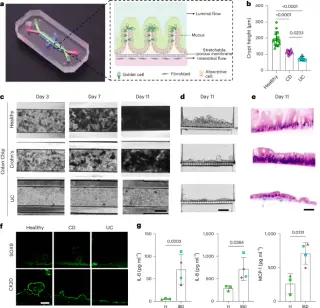
A colon-on-a-chip platform using patient-derived epithelium and fibroblasts reproduces healthy and IBD-like tissue, showing IBD fibroblasts drive barrier dysfunction, mucus changes, and inflammation. Peristalsis-like mechanical cues amplify fibrosis and inflammatory signaling in IBD chips, while female hormones exacerbate fibrosis and inflammation specifically in IBD tissues. Tissue-recombinant experiments confirm the stroma as the key driver of barrier breach and cytokine production. When exposed to the carcinogen ENU, IBD chips exhibit greater inflammation, loss of E-cadherin, nuclear β-catenin, and early cancer markers, along with copy-number changes, indicating heightened cancer-initiation risk. The model enables patient-specific studies and tests of stromal-focused therapies and sex-hormone effects on disease progression and cancer risk.