Tag

Gwas

All articles tagged with #gwas

Genome-wide analysis links 74 anxiety-associated loci, 39 of them novel
science6 days ago

Genome-wide analysis links 74 anxiety-associated loci, 39 of them novel

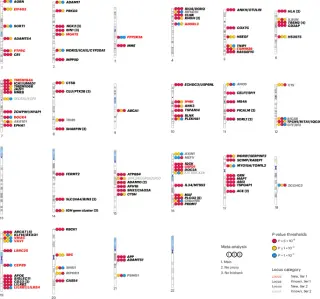
A GWAS of 693,869 individuals found 74 loci tied to anxiety symptom severity—the most in a single study, with 39 novel associations. By treating anxiety as a dimensional trait rather than a binary diagnosis, the study preserved more genetic signal and revealed a highly polygenic architecture with many small effects, including strong signals near brain-expressed genes PCLO and SORCS3. Some loci overlap genetically with heart disease, gut disorders, and migraines, suggesting shared biology. Common variants explain about 6% of anxiety-severity variation, and polygenic scores account for up to ~3% in individuals, far from predictive power, but the map provides concrete targets for biology-driven drug development and future functional studies.

Genetics link infant temperament to later behavior across diverse populations
science9 days ago

Genetics link infant temperament to later behavior across diverse populations

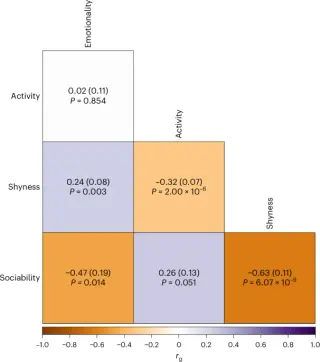
This GWAS meta-analysis across European and multi-ancestry cohorts (up to ~78k infants) identifies ten loci associated with four temperament traits in the first three years: emotionality, activity, shyness, and sociability. SNP heritability ranges from ~3% to ~15%, two loci colocalize with adult cortex eQTLs (RHEBL1 and MR1), and genetic correlations link early temperament to adult neuroticism, ADHD, autism and extraversion. Findings replicate across ancestry groups, and polygenic scores explain modest variance, with within-family analyses supporting genetic influences on temperament.

Genome-wide study links anxiety severity to gut-brain axis and shared genetics with heart disease
science1 month ago

Genome-wide study links anxiety severity to gut-brain axis and shared genetics with heart disease

A large, continuous-spectrum GWAS of anxiety symptoms (693,869 European-ancestry participants) identified 74 genetic loci (39 new) and revealed notable genetic overlap with irritable bowel syndrome (r≈0.57) and modest overlaps with coronary artery disease and migraine. The study estimates about 6% of anxiety symptom variation is explained by common variants, with the rest shaped by environment and gene–environment interactions; researchers caution that correlations do not imply causation and emphasize methodological advances (dimensional analysis) and the need for more diverse datasets. It complements clinically diagnosed anxiety genetics work and highlights gut–brain axis as a key area for future research.

Single-cell atlas links IBD risk to cell-type specific gene regulation
science1 month ago

Single-cell atlas links IBD risk to cell-type specific gene regulation

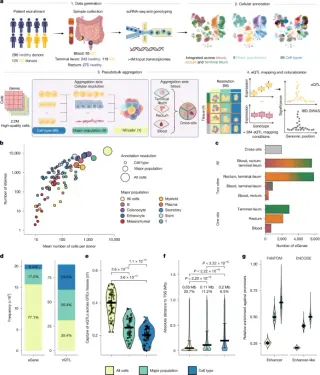
Researchers built IBDverse, the largest single-cell eQTL atlas for inflammatory bowel disease, mapping cis-eQTL effects across blood and gut tissues in about 400 individuals to link genetic risk to specific cell types. They find cell-type eQTLs are more distal, enhancer-rich, and far more likely to colocalize with IBD GWAS signals than bulk-tissue eQTLs, nominating effector genes such as MAML2 and ZMIZ1 in dendritic cells and MYC and RASGRP1 in colonocytes. Notch pathway regulators in dendritic cells and Wnt-driven epithelial renewal in colonocytes emerge as key mechanisms, tying regulatory variation to barrier dysfunction and inflammation. The study also highlights therapeutic angles—including PRKCB inhibitors and targets like ITGA4/JAK2—and provides a framework for interpreting GWAS loci via cell-type–resolved eQTL mapping in complex diseases.

Consensus GWAS uncovers 91 ADRD risk loci and ties polygenic risk to Alzheimer’s pathology
science1 month ago

Consensus GWAS uncovers 91 ADRD risk loci and ties polygenic risk to Alzheimer’s pathology

A European-ancestry meta-analysis of ADRD GWAS (128,681 cases/proxy; 849,833 controls) identified 91 genome-wide loci, including 16 new ones, with 56 loci influencing clinically diagnosed Alzheimer’s disease (18 tier-2 loci needing external validation). Excluding APOE, polygenic scores were linked to AD pathology: in top-decile individuals, Braak stage >4 and moderate/severe neuritic plaques at death were about 2× more likely, though overall predictive power is modest (roughly 4% of variance explained; small AUC gains). Results held across main, no-proxy, and no-biobank analyses and showed microglia enrichment and pathways tied to tau, amyloid, lipids, and immunity; genetic correlations connected ADRD with Lewy body dementia, ALS, PD and educational attainment. The authors call for larger well-characterized neuropathology datasets to clarify locus effects on AD pathology versus other dementias and provide further external validation for certain loci and no-proxy/no-biobank statistics for broader use.

Massive GWAS maps 249 circulating metabolites to thousands of genetic signals in 619,372 individuals
genomics1 month ago

Massive GWAS maps 249 circulating metabolites to thousands of genetic signals in 619,372 individuals

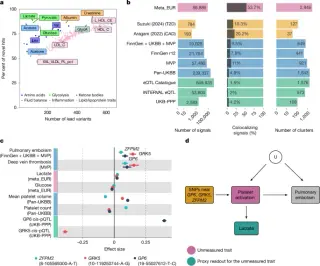
A large GWAS meta-analysis of 249 circulating metabolic traits in the Estonian Biobank and UK Biobank (up to 619,372 individuals) identifies 88,127 locus–trait associations across 8,398 loci. Using fine mapping, phenome‑wide colocalization, and cis‑Mendelian randomization, the study highlights the value of low‑frequency variants (MAF 0.1–1%) in explaining heritability and points to causal links between metabolic traits and diseases such as CAD and T2D. Notably, 19.4% of confidently fine‑mapped variants are low‑frequency missense or splice variants, enriching interpretability. The work also uncovers three lactate‑related loci (GP6, GRK5, ZFPM2) where higher plasma lactate associates with pulmonary embolism risk, potentially reflecting platelet activation rather than a direct causal effect. Overall, integrating low‑frequency variation improves mapping precision and biological insight into metabolism and disease.

"Comprehensive Analysis of Circulating Metabolic Biomarkers Across the Genome"
science-and-research2 years ago

"Comprehensive Analysis of Circulating Metabolic Biomarkers Across the Genome"

A genome-wide association study involving 233 circulating metabolic traits in over 136,000 participants from 33 cohorts has identified more than 400 independent loci and assigned probable causal genes at two-thirds of these. The study highlights the importance of sample and participant characteristics on genetic associations and demonstrates substantial genetic pleiotropy for multiple metabolic pathways. Ancestry-stratified analyses show positive correlations across ethnic groups, and associations were strongly related to sample size. The study provides a foundational resource for examining the role of metabolism across diverse diseases and emphasizes the need for careful consideration of sample type and fasting status in interpreting results.

Uncovering Genetic Markers Driving Type 2 Diabetes Heterogeneity
health-genetics2 years ago

Uncovering Genetic Markers Driving Type 2 Diabetes Heterogeneity

A study on type 2 diabetes (T2D) pathophysiology reveals genetic heterogeneity in T2D development and complications. The research, involving over 2.5 million individuals of diverse ancestry, identified 1,289 T2D association signals and classified them into eight mechanistic clusters based on their cardiometabolic profiles. The study also uncovered ancestry-correlated heterogeneity in allelic effects at T2D association signals, with differences in mean BMI in T2D cases and controls across ancestry groups playing a role. Additionally, the study tested the association of cluster-specific polygenic scores with T2D-related vascular outcomes, providing insights into the genetic drivers of T2D heterogeneity.

"Exploring the Genetic Overlap Between Gestational Diabetes and Type 2 Diabetes"
health-and-medicine2 years ago

"Exploring the Genetic Overlap Between Gestational Diabetes and Type 2 Diabetes"

A comprehensive genome-wide association study (GWAS) on Finnish women has nearly tripled the known genetic loci associated with gestational diabetes mellitus (GDM), identifying 13 distinct chromosomal regions and confirming a partially distinct genetic etiology from type 2 diabetes (T2D). The study found that while GDM shares some genetic predispositions with T2D, it also has unique genetic risk factors predominantly related to gestation. This research enhances the understanding of GDM's genetic underpinnings and suggests potential physiological mechanisms of glycemic control that are specific to pregnancy.

Uncovering the Biology and Public Health Impact of Cannabis Use Disorder through Multi-Ancestry Study
health2 years ago

Uncovering the Biology and Public Health Impact of Cannabis Use Disorder through Multi-Ancestry Study

A multi-ancestry genome-wide association study has identified 22 independent genome-wide significant loci associated with cannabis use disorder (CanUD) in European ancestry populations, as well as additional loci in African, Admixed American, and East Asian ancestries. The study also revealed genetic correlations between CanUD and various psychiatric and substance use disorder traits, as well as causal relationships with chronic pain, lung cancer, and schizophrenia. Additionally, transcriptome-wide association studies identified genes associated with CanUD in adult and fetal brain tissue, with fetal brain tissue showing greater enrichment for SNP-based heritability. The findings provide insights into the biology of CanUD and have implications for public health.

Identifying Candidate Genes for Insulin Action and Dysglycemia.
genetics3 years ago

Identifying Candidate Genes for Insulin Action and Dysglycemia.

A genome-wide association study (GWAS) and functional characterization have identified candidate genes for insulin-stimulated glucose uptake, a key factor in the development of insulin resistance and type 2 diabetes. The study analyzed data from over 50,000 individuals and identified 42 genetic loci associated with glucose uptake. The study also identified several candidate genes, including TBC1D4, which has previously been linked to insulin resistance. The GWAS summary statistics and data from the Fenland cohort are available for researchers, and all data used in genetic risk score association analyses are available from the UK Biobank.

Genetic Scores Predict Multi-Omic Traits in Humans.
genetics3 years ago

Genetic Scores Predict Multi-Omic Traits in Humans.

Researchers have developed an atlas of genetic scores to predict multi-omic traits using machine learning and GWAS data. The genetic-score models are publicly accessible through the OmicsPred portal, and the original codes used to train the models are available on GitHub. The atlas could help identify genetic risk factors for various diseases and aid in personalized medicine.