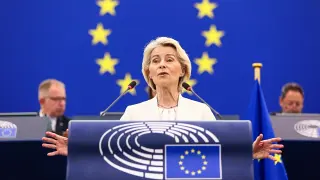
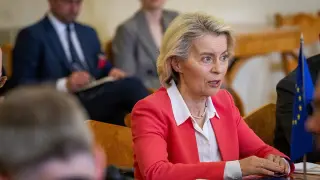
European Commission President Ursula von der Leyen has proposed a new EU crisis decision-making forum and an emergency consultation mechanism to address hybrid threats, reigniting tensions with NATO over overlapping defense roles.
European Commission President Ursula von der Leyen delivered her annual State of the Union address in Strasbourg, proposing a new 'associate membership' status for Canada, a European Security Council, and an emergency protocol for hybrid attacks. She also announced initiatives on climate resilience, digital safety, and migration management, framing Europe's response to global instability as a path toward greater sovereignty.
EU defense and foreign ministers met in Wicklow, Ireland, to address escalating security threats and Ukraine’s financial needs. Key issues include pressure on Greece and Spain to transfer Patriot interceptor missiles, debates over using frozen Russian assets for aid, and a new high-level defense group led by Kaja Kallas. Sweden called the current situation the most serious since WWII, while Berlin is expected to blame Russia for a drone incident at Leipzig airport.
Germany’s cabinet approved a reform to empower the foreign intelligence service (BND) with offensive and operational powers—such as sabotage, cyber operations and more aggressive espionage—along with relaxed data-protection rules and increased funding, aiming to counter Russia’s hybrid threats and reduce dependence on U.S. intelligence sharing. The changes must pass Parliament and could take effect by 2027, in response to security challenges highlighted by incidents like the Leipzig drone attack.
EU leaders say the Baltic drone incursions are part of a deliberate Russian hybrid strategy to destabilize Europe, not isolated incidents, prompting political fallout and civilian safety advisories. They promise a stronger EU‑NATO response with a drone wall and upgraded counter‑drone defenses funded by up to €800 billion in defence spending and SAFE loans, plus closer cooperation to deter Moscow and support Ukraine.
Gen. Grynkewich, NATO’s Europe commander, warned at a Swedish security conference that Russia and China are expanding Arctic cooperation with joint patrols and bathymetric surveys aimed at countering NATO, not for peaceful purposes. As ice retreats and routes open, the Arctic is becoming a strategic front line for competition and hybrid threats—airspace violations, satellite interference, and threats to underwater infrastructure. NATO plans to boost Arctic intelligence, mobility, and forces, consolidating operations under Joint Force Command Norfolk and expanding alliance presence, including Sweden, with seven of eight Arctic nations in NATO.
Finnish police seized the ship 'Fitburg' sailing from Russia to Israel on suspicion of sabotaging an undersea telecom cable from Helsinki to Estonia, amid rising concerns over hybrid threats from Russia following recent incidents in the Baltic Sea region. The ship's crew was detained, and investigations are ongoing into whether the damage was deliberate, as tensions and security alerts increase in Europe.
Finland seized a Russian-flagged cargo ship suspected of sabotaging an undersea telecom cable between Helsinki and Estonia, amid rising concerns over hybrid threats from Russia, including cyberattacks and infrastructure sabotage, in the Baltic Sea region.
Estonia's spy chief states that Russia currently has no intention to attack Baltic countries or NATO, noting that Russia has adjusted its behavior in response to Western and NATO actions, and emphasizing the importance of maintaining strong defense and alliances to ensure regional security amidst ongoing tensions and hybrid threats.
NATO is preparing to respond to Russian GPS jamming incidents, including one that affected European Commission President Ursula von der Leyen's plane in Bulgaria, as part of broader hybrid warfare tactics by Russia across Europe, which threaten civilian and military infrastructure. The alliance considers these actions a serious escalation and is working to counter them, amid ongoing tensions following Russia's invasion of Ukraine.
The North Atlantic Council condemns Russia's malicious cyber activities targeting NATO allies and Ukraine, emphasizing the threat to security and calling for Russia to cease such destabilizing actions. NATO affirms its commitment to a secure cyberspace, supports countermeasures, and urges all states to uphold international obligations in cyberspace, while preparing to respond to cyber threats in coordination with international partners.
Latvia has deployed its army to assist in guarding its border with Belarus as the number of illegal crossing attempts continues to rise. The move comes amid concerns of hybrid threats and increased involvement of Belarusian authorities in organizing the flow of illegal immigrants. Latvia, along with neighboring EU members Lithuania and Poland, has been on high alert since the arrival of Russian mercenaries in Belarus. Poland is also planning to deploy additional troops to its border with Belarus.