Tag

Medical Implants

All articles tagged with #medical implants

ETH Zurich Implant Uses Electricity to Convert Blood Sugar Into Harmless Byproduct
science-and-health28 days ago

ETH Zurich Implant Uses Electricity to Convert Blood Sugar Into Harmless Byproduct

A new experimental implant developed by ETH Zurich researchers offers a drug-free approach to managing type 2 diabetes and obesity. The device uses a controlled electrochemical reaction to convert excess blood glucose into gluconate, a harmless byproduct excreted by the kidneys. In mouse trials, the implant, paired with a continuous glucose monitor and smartphone control, stabilized blood sugar levels and resulted in a 10% average weight loss over six weeks. While promising, experts emphasize that the technology remains in the proof-of-concept stage and requires further testing in larger animals and humans to ensure safety and efficacy at human scales.

HKU Researchers Reveal Ultrathin Diamond Membranes Can Generate Electricity
science-and-technology2 months ago

HKU Researchers Reveal Ultrathin Diamond Membranes Can Generate Electricity

A team at the University of Hong Kong has demonstrated that ultrathin, flexible diamond membranes can produce a measurable electrical voltage when bent, overturning a century-old scientific consensus that diamond is non-piezoelectric. By using edge exfoliation to create flexible polycrystalline diamond sheets, researchers observed stable voltage signals during mechanical deformation. The study, published in Science Advances, attributes this effect to charge polarization at grain boundaries within the material. This discovery suggests new applications for self-powered medical implants and micro energy systems, as diamond is biocompatible and chemically stable.

A Full Circuit Woven Into a Hair-Thin Fiber Signals a New Era for Wearable Tech
technology9 months ago

A Full Circuit Woven Into a Hair-Thin Fiber Signals a New Era for Wearable Tech

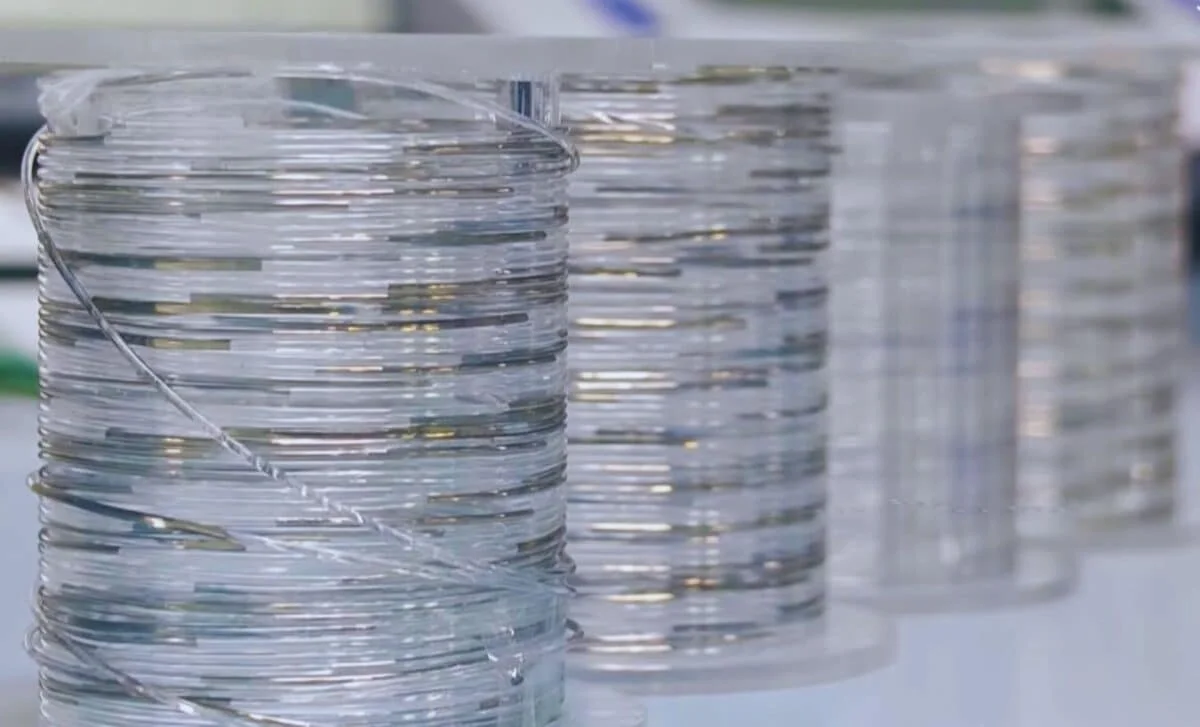
Researchers from Fudan University embedded a complete circuit inside a 50-micrometer fiber by printing transistors on a flexible elastomer film and spiraling it into the fiber, creating fiber-integrated circuits (FIC) capable of performing analog and digital processing. With about 100,000 transistors per centimeter, the ultra-thin fiber withstands extreme bending, twisting, washing, and even heavy loads, and its fabrication is compatible with standard semiconductor tooling. The breakthrough could enable interactive clothing, tactile interfaces, VR gloves, and medical implants (including brain and cardiovascular applications), marking a major advance in wearable electronics as reported in Nature.

MIT's Hydrogel 'Invisibility Cloak' Prevents Implant Scarring
medical-research2 years ago

MIT's Hydrogel 'Invisibility Cloak' Prevents Implant Scarring

MIT engineers have developed a hydrogel adhesive coating for medical implants that prevents fibrosis, or scar tissue formation, which can interfere with device function. This adhesive binds the devices to tissue, preventing the immune system from attacking them. The approach has shown success in animal models and could be used for various implants, including pacemakers and drug delivery devices. The research, published in Nature, was funded by the NIH and NSF.

"Metal-Woven Shirt and Smart Tattoos: Advancements in Wearable Health Technology"
technology3 years ago

"Metal-Woven Shirt and Smart Tattoos: Advancements in Wearable Health Technology"

A shirt woven with bands of metal textiles could improve communication for medical implants. Some implants, such as glucose monitoring sensors, require data from other parts of the body but wireless connectivity is challenging. Signals transmitted inside the body are quickly absorbed and can't travel far, while external relay systems add more hardware. The metal textiles in the shirt act as data channels, allowing for easier communication between implants and other devices.

Advancements in Organic Bioelectronic Devices Propel Precision Therapeutics
technology3 years ago

Advancements in Organic Bioelectronic Devices Propel Precision Therapeutics

Researchers at Columbia Engineering have developed the first fully organic bioelectronic device that can acquire and transmit neurophysiologic brain signals while providing power for device operation. The device, about 100 times smaller than a human hair, is based on an organic transistor architecture that is biocompatible, flexible, and stable in the long term. It incorporates a vertical channel and a miniaturized water conduit, demonstrating high electrical performance, low-voltage operation, and long-term stability. The device has the potential to revolutionize medical implants and improve diagnostics and treatment for patients with neurological disorders.

"Revolutionary Heart Valve Technology: Growing and Controlling Blood Flow in Minutes"
healthtech3 years ago

"Revolutionary Heart Valve Technology: Growing and Controlling Blood Flow in Minutes"

Harvard researchers have developed a synthetic heart valve called FibraValve that can be manufactured in minutes using a spun-fiber method. The valve's delicate flaps can be shaped on a microscopic level and can be colonized by the patient's living cells, developing with them as they mature. The valve uses a new custom polymer material called PLCL that can last inside a patient's body for about six months. The long-term vision is for the resulting organic tissue to develop with human children as they mature, potentially voiding the need for risky replacement surgeries as their bodies grow.