Tag

Kilonova

All articles tagged with #kilonova

Two Long Gamma-Ray Bursts Traced to Collapsing Neutron Stars
science12 days ago

Two Long Gamma-Ray Bursts Traced to Collapsing Neutron Stars

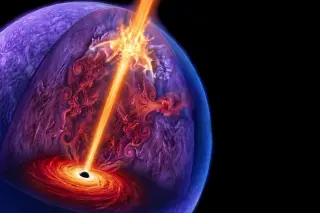
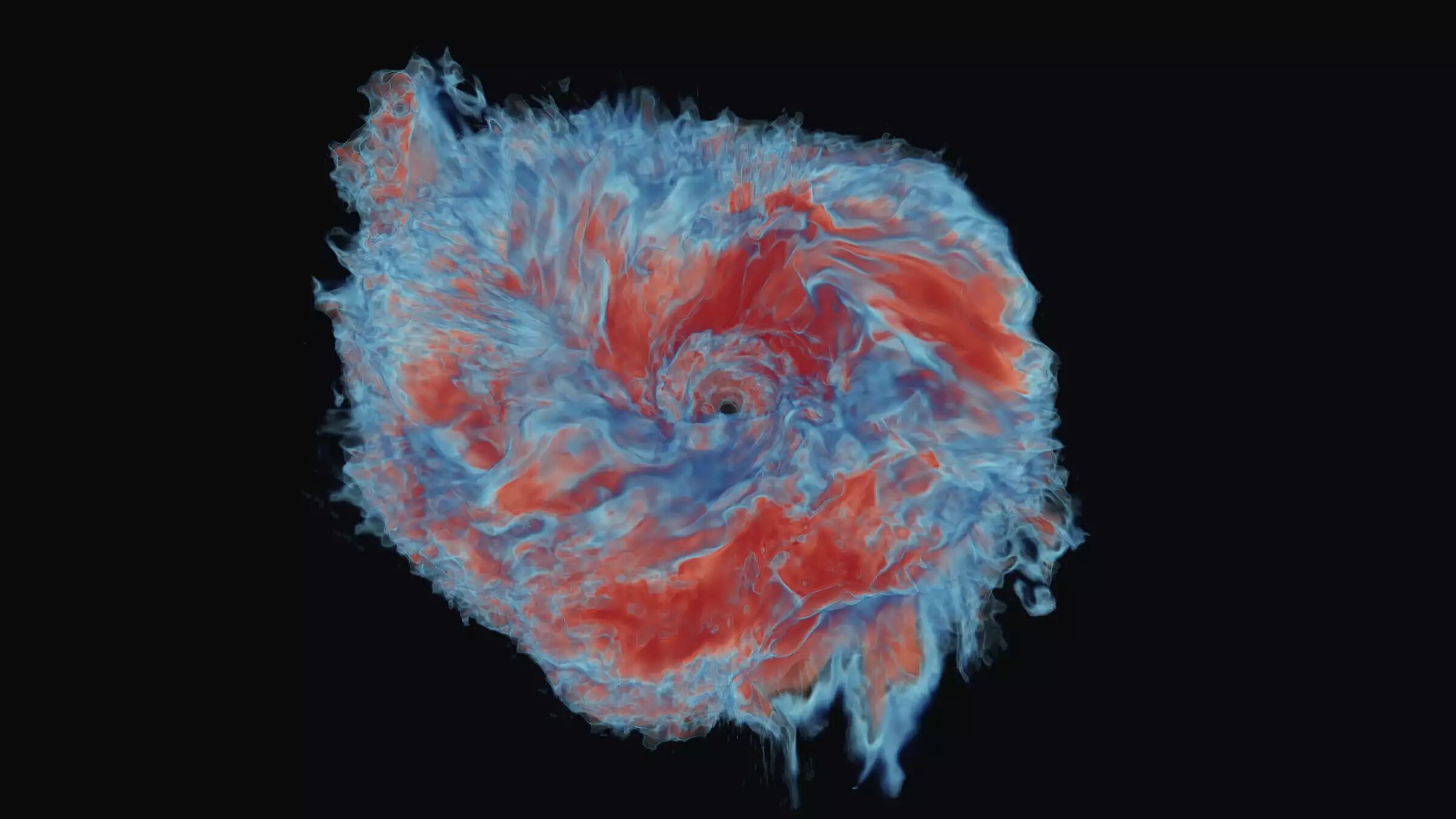
Los Alamos researchers analyzed two long-duration gamma-ray bursts detected by Fermi and concluded they originated from neutron stars collapsing into black holes (collapsars) rather than mergers, prompting a reevaluation of long GRB origins. Using NASA data and the Chicoma supercomputer, the study supports a collapsar-based explanation and suggests kilonova-driven heavy-element synthesis may be more varied than previously thought; upcoming gravitational-wave observations could further clarify the links between GRBs, kilonovae, and heavy-element production.

Earthquakes, Gravastars, and Century-Long Butterflies: A Surprising Science Roundup
science21 days ago

Earthquakes, Gravastars, and Century-Long Butterflies: A Surprising Science Roundup

The week’s science digest covers (1) a core-reflected seismic wave from the 2011 Tohoku-Oki quake that triggered a dual-boundary megathrust slip and moved Japan about 6 millimeters, (2) a theoretical gravastar model as an alternative to black holes with a de Sitter interior, (3) detection of plutonium-244 in a ferromanganese crust pointing to a distant kilonova r-process event, and (4) an unexpected 25-fold range in lifespan among Heliconius butterflies linked to pollen feeding, illustrating the uncanny diversity of life and cosmic events.

Earth’s gold traces back to ancient neutron-star mergers
science1 month ago

Earth’s gold traces back to ancient neutron-star mergers

Scientists say that most heavy elements like gold were forged in neutron-star mergers via rapid neutron capture, not in ordinary supernovae. The 2017 GW170817 event provided real-time evidence of this process, with gold and other heavy elements ejected in a kilonova and later incorporated into new stars and planets. The gold in our wedding bands, teeth fillings, and heirlooms began its long journey long before the Sun formed, in cosmic collisions that happened billions of years ago.

Cosmic kilonovae forge Earth's gold, GW170817 confirms
science1 month ago

Cosmic kilonovae forge Earth's gold, GW170817 confirms

The 2017 GW170817 neutron‑star collision proved that heavy elements like gold are produced by rapid neutron‑capture (r‑process) in such mergers, ejecting about 6% of a solar mass of material (roughly 20,000 Earth masses) including ~200 Earth masses of gold and ~500 Earth masses of platinum. This material was dispersed through the galaxy before the Solar System formed, explaining why Earth’s gold traces back to ancient stellar explosions. While neutron‑star mergers clearly produce gold, newer analyses suggest they may not account for all galactic heavy elements, with other sources potentially contributing.

NASA supercomputer reveals magnetic chaos before neutron-star merger
science5 months ago

NASA supercomputer reveals magnetic chaos before neutron-star merger

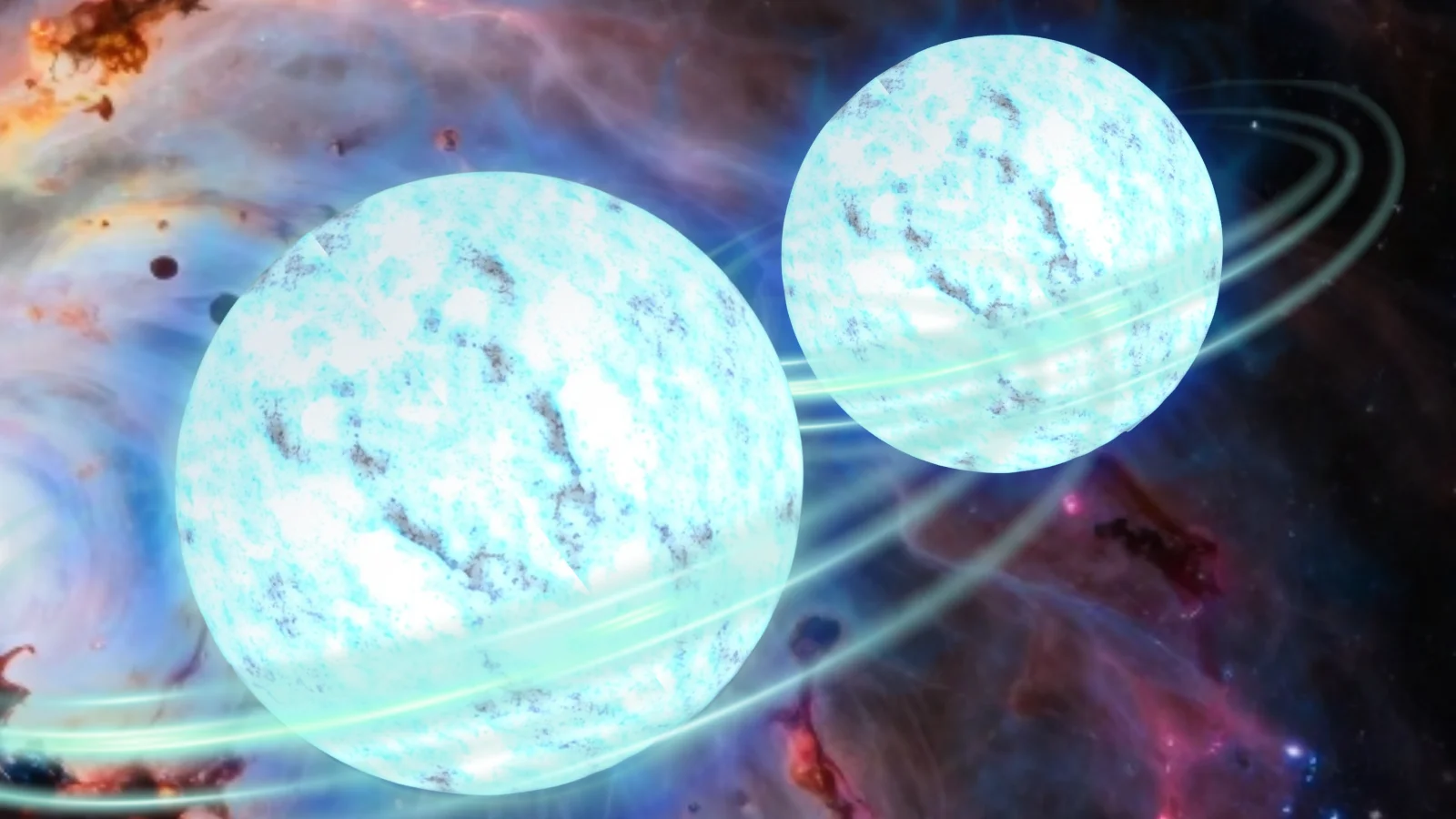
A NASA Goddard-led study used the NASA Pleiades supercomputer to simulate the final orbits of a binary neutron-star system, showing magnetospheres continually reconnecting as the stars spiral in. The simulations indicate high-energy gamma-ray emission is largely trapped by electron-positron pair production, while lower-energy gamma-rays and X-rays may escape depending on the observer's viewpoint. The work helps predict pre-merger signals for future gamma-ray telescopes and gravitational-wave detectors like LISA.

Neutron Star Collisions: Cosmic Explosions and Element Creation
science1 year ago

Neutron Star Collisions: Cosmic Explosions and Element Creation

In 2017, scientists observed a kilonova explosion from colliding neutron stars, providing insights into the creation of heavy elements like strontium and yttrium. This event, similar to the Big Bang, involved a hot, expanding fireball where particles combined to form atoms, akin to the Universe's Epoch of Recombination. By analyzing data from multiple telescopes, researchers have detailed the kilonova's evolution, confirming its role as a source of heavy elements and offering a miniature model for studying early Universe processes.

"Neutron Star Mergers: Unveiling the Cosmic Gold Foundry"
astronomy2 years ago

"Neutron Star Mergers: Unveiling the Cosmic Gold Foundry"

A study published in Nature reveals that the bright gamma-ray burst GRB 230307A was caused by the merging of two neutron stars, not from a collapsing massive star as previously believed. This finding challenges existing theories about the origins of gamma-ray bursts and provides insight into the creation of heavy elements in the universe. The study, which analyzed data from the Hubble Space Telescope and the James Webb Space Telescope, suggests that further research on the formation of these elements could enhance our understanding of the universe's origins.

"James Webb Telescope Discovers Cosmic Gold Forge in Neutron Star Merger"
astronomy2 years ago

"James Webb Telescope Discovers Cosmic Gold Forge in Neutron Star Merger"

The James Webb Space Telescope and Hubble have observed a super-long gamma-ray burst resulting from the collision of two dense neutron stars, producing pure gold and other heavy elements. This discovery challenges conventional understanding of gamma-ray bursts and sheds light on the formation of heavy elements in the universe, providing valuable insights into nucleosynthesis and the origins of the cosmos.

"James Webb Space Telescope Discovers Thrilling Evidence of Neutron Star Mergers Creating Gold in the Cosmos"
astronomy2 years ago

"James Webb Space Telescope Discovers Thrilling Evidence of Neutron Star Mergers Creating Gold in the Cosmos"

The James Webb Space Telescope and Hubble Space Telescope observed a gamma-ray burst (GRB) originating from the collision of two neutron stars, confirming that these mergers create elements like gold. This discovery challenges previous theories about the origins of long GRBs and sheds light on the process of nucleosynthesis, where heavier elements are forged. The research, published in Nature, provides new insights into the cosmic alchemy of neutron star mergers and the creation of heavy elements in the universe.

"Threat of a Nearby Kilonova Explosion: Earth's Life at Risk"
astronomy2 years ago

"Threat of a Nearby Kilonova Explosion: Earth's Life at Risk"

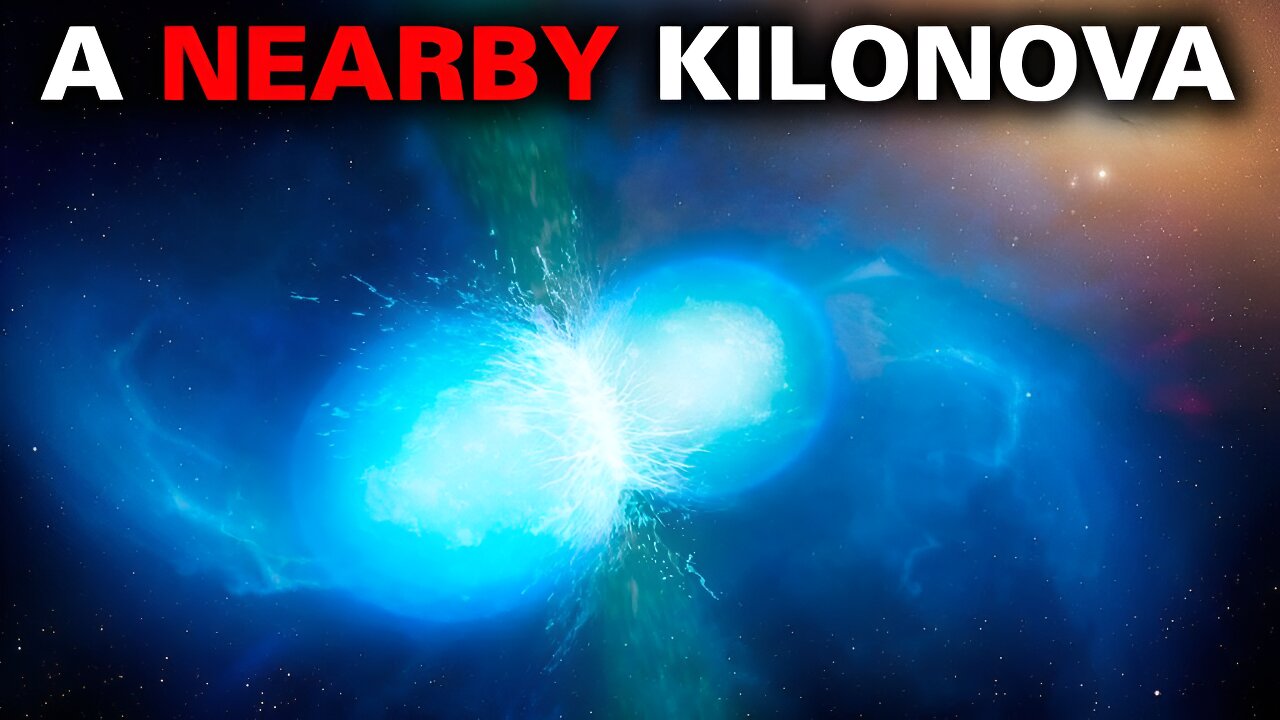
Scientists have calculated that being too close to a kilonova, a massive explosion resulting from the collision of two neutron stars, could be catastrophic for a planet like Earth due to the release of high-energy electromagnetic radiation and cosmic rays. The study, published in The Astrophysical Journal, suggests that Earth would have to be within 3 light-years of a kilonova to be affected by X-ray afterglow and within 13 light-years for gamma rays to have a catastrophic impact. However, the likelihood of a kilonova occurring within these distances from Earth is very low, and the authors conclude that such events are probably not significant threats to life on Earth.

"Simultaneous Modeling of Kilonova Explosion Signatures Achieved by Research Team"
science-and-technology2 years ago

"Simultaneous Modeling of Kilonova Explosion Signatures Achieved by Research Team"

A research team has developed a method to simultaneously model the observable signals of a kilonova, which occurs when two neutron stars merge. By analyzing the data coherently and simultaneously, the team can obtain more precise results and gain insights into the behavior of nuclear matter under extreme conditions. This method will help understand the expansion of the universe, the formation of heavy elements, and the properties of matter at extreme densities. The researchers are eagerly waiting to apply this tool to future detections of neutron star mergers.

Ancient Evidence Unveils Nearby Kilonova 3.5 Million Years Ago
astronomy2 years ago

Ancient Evidence Unveils Nearby Kilonova 3.5 Million Years Ago

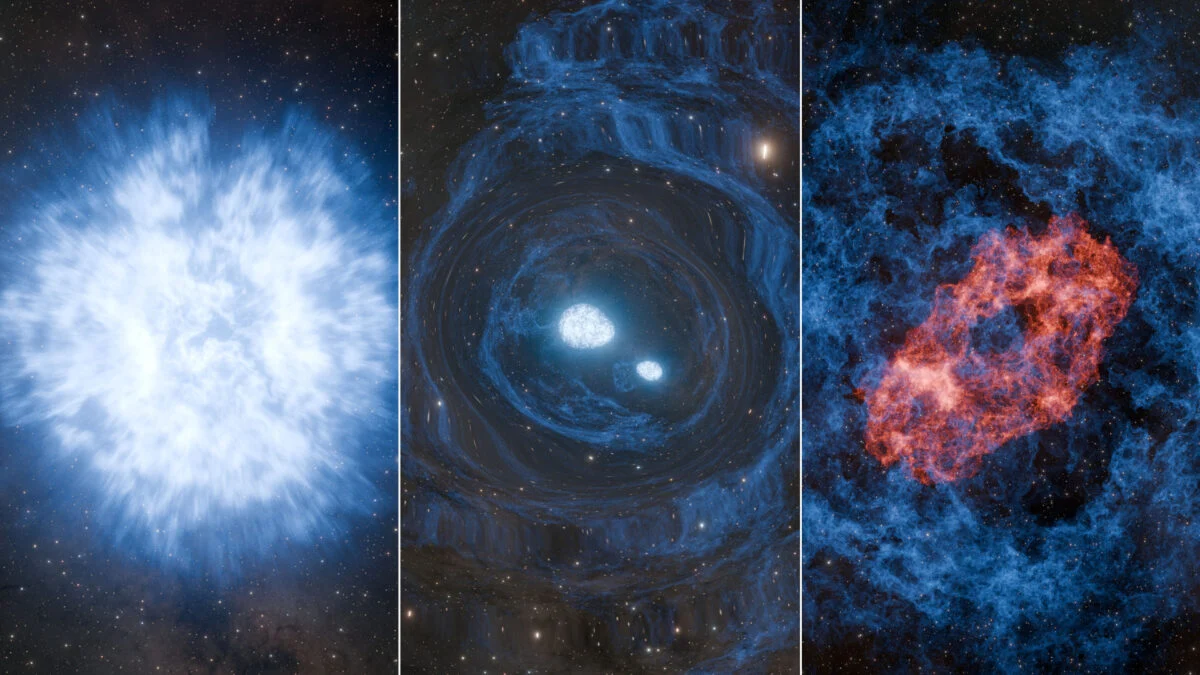
Scientists have discovered evidence of a nearby kilonova event that occurred approximately 3.5 million years ago. The presence of isotopes Fe-60 and Pu-244 in ocean sediments suggests the occurrence of a cataclysmic event, such as the merger of two neutron stars or a neutron star with a black hole. The specific ratio of these isotopes, along with simulations, indicates that the kilonova was located about 500-600 light years away from Earth. While this event did not pose a threat to life on Earth, it serves as a reminder of the potential dangers present in the universe.

astronomy2 years ago

Ancient Kilonova Unearthed: Evidence of a Nearby Cataclysmic Event 3.5 Million Years Ago

Scientists have discovered evidence of a kilonova, a cataclysmic event involving the merger of neutron stars or a neutron star and a black hole, that occurred 3.5 million years ago in our galactic backyard, about 500-600 light years away. The discovery was made through the analysis of isotopes, specifically Fe-60 and Pu-244, found in ocean sediments. The presence of Pu-244, which is only created in certain types of supernovae, suggests that a kilonova was the most likely source. The research also indicates that the kilonova had a specific debris ejection pattern and a certain tilt during the merger event. While the event did not pose a threat to life on Earth, it serves as a reminder of the dangers present in the universe.