Tag

Polarization

All articles tagged with #polarization

Magnetar Polarization Sheds Light on Quantum Vacuum
science1 day ago

Magnetar Polarization Sheds Light on Quantum Vacuum

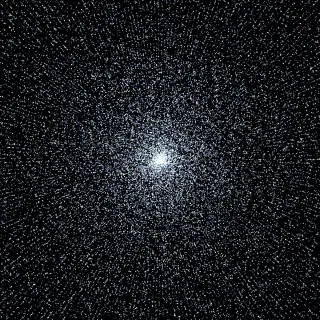
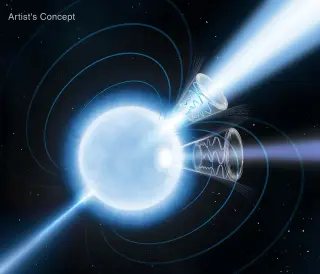
Astronomers report what may be the first evidence of vacuum birefringence, a quantum effect predicted by Heisenberg, by observing highly polarized X-rays and radio waves from magnetar 1E 1547.0-5408 with IXPE, NICER, and Parkes. The extreme magnetic field around the magnetar aligns virtual particles, causing polarization to correlate with the star’s magnetic axis and offering a natural laboratory to test quantum physics—though further data and simulations are needed to confirm the finding.

Sunlight-Powered Quantum Entanglement Demonstrated for the First Time
science6 days ago

Sunlight-Powered Quantum Entanglement Demonstrated for the First Time

A team used a Fresnel-lens concentrator to focus sunlight onto a crystal, generating polarization-based entangled photons without a laser. The photons achieved ~94% similarity to a perfectly entangled state and violated Bell’s inequality, marking a proof-of-principle step toward cheaper, energy-efficient quantum tech for satellites and remote stations—though a practical, deployable sun-powered entangler remains to be built and improved.

Quantum Internet Proves Real-World Feasibility Across 38 Miles of Fiber
science7 days ago

Quantum Internet Proves Real-World Feasibility Across 38 Miles of Fiber

NIST researchers transmitted polarization-entangled photons across 62 kilometers (38.5 miles) of existing, above-ground fiber in real-world conditions, maintaining entanglement despite environmental noise by using a laser reference to calibrate corrections. The setup operated with 200–1,500 entangled photons per second, showing feasibility for practical quantum networks and potential uses in quantum-secure communications and distributed telescopes, though faster hardware and better software are needed for a full quantum internet.

Magnetar Lights Up Space-Time: First Clear Proof of Vacuum Birefringence
space-and-astronomy9 days ago

Magnetar Lights Up Space-Time: First Clear Proof of Vacuum Birefringence

Observations of a highly magnetic magnetar (1E 1547-5408) with NASA’s IXPE show X-ray polarization nearly three times higher than typical neutron-star emission and aligned with the star’s magnetic field, providing the strongest evidence yet that vacuum birefringence occurs—empty space acting like a prism under extreme magnetic fields. This long-predicted quantum effect, rooted in Heisenberg and Euler’s work from 1936, tests quantum electrodynamics in nature’s most extreme laboratories and motivates future missions (e.g., GoSOX) to confirm the finding.

Magnetar’s polarized light tests quantum vacuum, solving a 90-year mystery
science11 days ago

Magnetar’s polarized light tests quantum vacuum, solving a 90-year mystery

New observations of magnetar 1E 1547-5408 with IXPE and other telescopes show X-ray polarization about three times higher than standard models and aligned with the star’s magnetic field, providing strong evidence for vacuum birefringence — the idea that empty space behaves like a prism under ultra-strong magnetic fields and a prediction dating back to Heisenberg and Euler nearly 90 years ago; the findings test fundamental physics and future missions like GoSOX may help confirm the effect and illuminate the fabric of reality.

science11 days ago

Magnetar Polarization Tests Quantum Vacuum: Evidence of Vacuum Birefringence

Astronomers observing magnetar 1E 1547.0–5408 with IXPE and NICER detected strong X-ray polarization aligned with the star's magnetic field, matching predictions for vacuum birefringence, a long-predicted quantum electrodynamics effect where empty space behaves like a birefringent medium under extreme magnetic fields. While this could be the first direct test of the effect, researchers caution that other magnetar processes could mimic the signal and more data are needed to confirm the finding.

Photonic altermagnetism: symmetry-driven spin control in magnetophotonic crystals
science21 days ago

Photonic altermagnetism: symmetry-driven spin control in magnetophotonic crystals

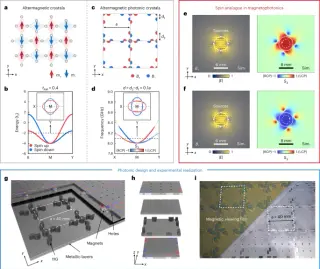
A Nature Physics preview demonstrates a magnetophotonic crystal that mimics altermagnetic behavior, achieving momentum-dependent polarization splitting and spin–momentum locking with zero net magnetization. By solving Maxwell’s equations, the effect is shown to be symmetry‑driven rather than due to conventional gyrotropy, offering a photonic route to spin-functional devices without net magnetization.

Vertical polarization steered sideways in ultrathin ferroelectrics
science26 days ago

Vertical polarization steered sideways in ultrathin ferroelectrics

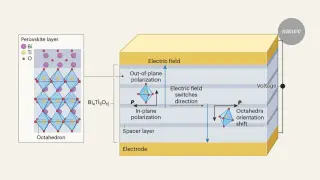
Nature News & Views summarizes Gupta et al.'s finding that a thin-film ferroelectric couples vertical polarization to in-plane polarization, enabling small voltages to switch and stabilize large polarization using standard device geometry and potentially overcoming surface-polarization instability in ultrathin films for chip-compatible memories.

Venus May Harbor Ring-shaped Polarization Signals From Atmospheric Waves
science29 days ago

Venus May Harbor Ring-shaped Polarization Signals From Atmospheric Waves

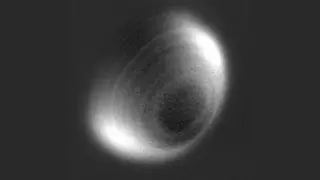
A 2010 Venus observation with the Extreme Polarimeter showed possible concentric rings visible only in polarized light; initially suspected as an instrument artifact, simulations indicate 5–10% upper-atmosphere density variations caused by atmospheric gravity waves could produce similar rings. The signal hasn’t yet been replicated, but the authors published their findings to spur further observations with newer polarimeters, which could reveal how Venus’ atmospheric waves transport energy and relate to its famous superrotation.

Milky Way Radio Enigma Sparks Talk of a New Class of Objects
science1 month ago

Milky Way Radio Enigma Sparks Talk of a New Class of Objects

A six-appearance, highly polarised radio transient near the Galactic Centre (ASKAP J173608.2−321635) has baffled researchers because it produced no X-ray or infrared counterparts; while not yet proven to be a new object class, it highlights the potential for unseen astrophysical phenomena revealed by wide-field radio surveys and the need for simultaneous multiwavelength follow-up.

Blue Counties, Healthier Lives? A New Look at the Political Health Gap
society-and-culture2 months ago

Blue Counties, Healthier Lives? A New Look at the Political Health Gap

A new study examines a health gap tied to political ideology in the U.S.: Democrats in blue counties appear healthier than Republicans in red counties, and conservatives are sometimes said to have better mental health than liberals. The Dispatch reviews possible explanations—from social determinants and access to care to the effects of polarization—without asserting a simple causal story.

Graduation Day Reveals a Nation Split on AI
technology2 months ago

Graduation Day Reveals a Nation Split on AI

Graduation speakers nationwide frame AI as both promise and peril, triggering boos, cheers, and debate as graduates weigh jobs, democracy, and creativity. Eric Schmidt urges grads to shape AI, Fareed Zakaria stresses human intelligence, and others—from Steve Wozniak and Ed Bastian to Conan O’Brien, Jeremy Scott, Magic Johnson, and Ronny Chieng—offer mixed takes, illustrating a divided view of AI’s role in the Class of 2026’s future.

Polar ID Goes Subdisplay: Metalenz Puts Face Unlock Behind the Screen
technology3 months ago

Polar ID Goes Subdisplay: Metalenz Puts Face Unlock Behind the Screen

Metalenz’s Polar ID uses polarization data captured by metasurface optics to distinguish real faces from masks, enabling biometric authentication that can operate beneath an OLED display. The system promises a notch-free, secure Face ID-like solution for laptops and smartphones, resistant to high-quality masks, with mass production planned for 2027; the under-display version is expected to arrive around 2028 after closer collaboration with display makers.

Spotting MAGA Spaces: Signs a Restaurant Might Take Sides
politics5 months ago

Spotting MAGA Spaces: Signs a Restaurant Might Take Sides

A HuffPost piece gathers sociologists and hospitality experts to identify cues that may reveal a restaurant’s political leanings, from overt decor (patriotic or nationalist imagery) to subtler signals like staff policies, in-house branding, permitted displays, TV networks, and an owner’s social‑media activity. The article stresses that these indicators are largely circumstantial and not definitive, noting examples such as Idaho’s Old State Saloon offering free beer to those who helped deport an undocumented immigrant and Minneapolis’ Modern Times Cafe giving free meals during protests. It also discusses how polarization drives greater consumer interest in venues that align with beliefs, and concludes that people “vote with their dollars” while acknowledging the complexities of interpreting signals in today’s climate.

Swing Voters Split Over Trump's State of the Union Pitch
politics6 months ago

Swing Voters Split Over Trump's State of the Union Pitch

Seven swing-district voters react to Trump's State of the Union, revealing deep partisan divides: some praised issues like housing costs, prescription drug pricing, and the economy, others felt insulted by immigrant references or criticized the speech's tone and unilateral framing; a few praised the data and 'receipts' presented, while concerns about unaddressed topics (e.g., Epstein files) and the speech feeling more like a pep rally than a unifying address emerged—underscoring ongoing polarization ahead of the midterms.