Tag

Singularities

All articles tagged with #singularities

Lab-made dark voids sprint past light speed without breaking relativity
science1 month ago

Lab-made dark voids sprint past light speed without breaking relativity

Researchers used ultrafast electron microscopy to observe empty voids, or singularities, in phonon-polariton waves inside a boron nitride flake moving faster than light; because these singularities contain no information or energy, they do not violate relativity, illustrating universal laws of wave dynamics and offering new tools to study ultrafast processes in physics and beyond.

Dark voids sprint past light in lab—without breaking relativity
physics-and-mathematics1 month ago

Dark voids sprint past light in lab—without breaking relativity

Physicists using ultrafast electron microscopy observed empty voids (singularities) in phonon-polariton waves inside a thin boron nitride sample that move faster than light. Because these voids contain no information, their superluminal motion does not violate special relativity, and the work reveals universal laws of wave dynamics with potential to advance ultrafast studies across physics and materials science.

Quantum Censorship: Concealing Black Hole Mysteries
science1 year ago

Quantum Censorship: Concealing Black Hole Mysteries

Recent research supports the idea of cosmic censorship, suggesting that quantum mechanics may prevent the observation of singularities within black holes. This aligns with Roger Penrose's conjecture that singularities are hidden by event horizons, maintaining the predictability of physics. The study introduces a quantum Penrose inequality, linking the energy of space-time to the entropy of black holes and quantum matter, reinforcing the concept of quantum cosmic censorship and its implications for a theory of quantum gravity.

science2 years ago

"Mathematicians Explore Pre-Big Bang Universe"

Mathematicians are exploring what might have existed before the Big Bang by applying Einstein's general theory of relativity to the earliest moments of the universe. Researchers Ghazal Geshnizjani, Eric Ling, and Jerome Quintin have published a paper suggesting that the singularity at the start of the Big Bang might be a coordinate singularity, which can be mathematically bypassed, rather than a curvature singularity, which represents a breakdown of physical laws. This work could help extend our understanding of the universe's history beyond the Big Bang.

The Reality of Singularities: Ask Ethan
science2 years ago

The Reality of Singularities: Ask Ethan

The existence of singularities, such as those found in black holes, is still a topic of debate in physics. While the Big Bang theory suggests that the universe began from a singularity, the addition of cosmic inflation complicates this idea. Inflationary spacetimes, which are dominated by vacuum energy, do not necessarily lead to a singularity but rather to a progressively smaller and finite size. As for black holes, they inevitably collapse to a singularity, and attempts to avoid this fate have been unsuccessful within the framework of general relativity. The possibility of a singularity-free universe or a connection between black holes and the birth of new universes remains speculative and requires further exploration in the realms of quantum gravity and unified theories.

Harnessing the Power of Dark Structures for Optimal Resilience
science-and-technology2 years ago

Harnessing the Power of Dark Structures for Optimal Resilience

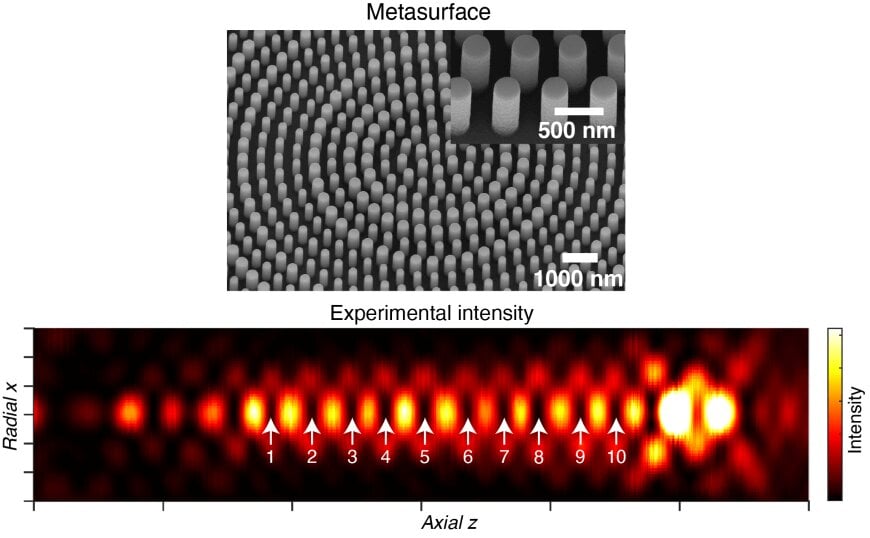
Researchers at the Harvard John A. Paulson School of Engineering and Applied Sciences have developed new techniques using metasurfaces to control points of darkness, or optical singularities. These dark spots have potential applications in remote sensing, precision measurement, and imaging. The team designed metasurfaces with titanium dioxide nanopillars to create an array of optical singularities, which could be used as optical traps for capturing atoms or as reference positions for imaging. They also developed extremely stable points of darkness in a polarized optical field, known as polarization singularities, which are topologically protected and can withstand perturbations. These advancements in optical singularities have implications for remote sensing, covert detection, and creating compact, lightweight optical devices.