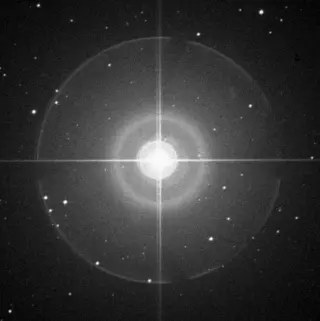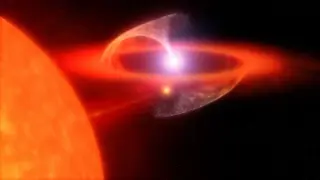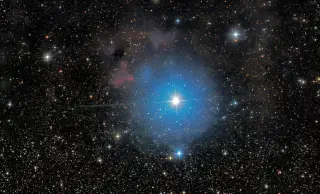
XRISM observations reveal that Gamma Cassiopeiae’s peculiar X-rays come from matter falling onto a hidden white-dwarf companion, solving a 160-year mystery and prompting new models of binary evolution in Be-star systems.
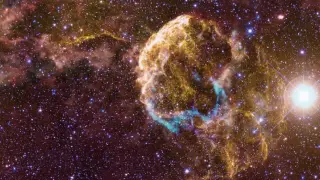
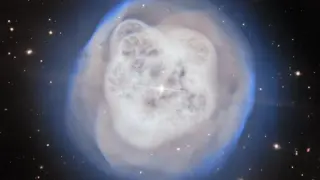
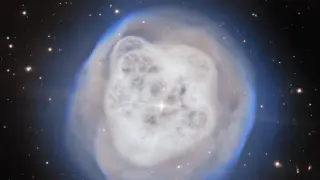
A color image from the Gemini North Telescope reveals the Crystal Ball Nebula (NGC 1514), a 1,500-light-year-away binary star system in which a dying star casts off its outer layers, heating the ejected gas to tens of thousands of degrees to create a glowing, billowing spherical cloud.
Astronomers monitoring the red supergiant WOH G64 in the Large Magellanic Cloud report a rapid evolution into a yellow hypergiant, with a temperature rise of about 1,000 C and significant shrinking. This rare color and size change may signal an impending supernova, though researchers offer two possible explanations—binary interaction with a companion or a prior eruptive episode—and the star’s exact fate remains uncertain.
New spectroscopic analysis of the behemoth star WOH G64 in the Large Magellanic Cloud finds it remains a red supergiant and not a yellow hypergiant or imminent supernova as previously thought. Titanium oxide detected in its atmosphere and a possible binary companion suggest gas is being redistributed rather than the star dying soon, painting a picture of a phoenix-like resurgence rather than an explosive end.
Astronomers reinterpreted the puzzling behavior of the red supergiant WOH G64 in the Large Magellanic Cloud, finding it is not rapidly dying but part of a binary system with a hotter, smaller companion that interacts with the red star’s extended atmosphere. New optical spectra from SALT show strong titanium oxide bands indicating a cool atmosphere, contradicting claims it was turning into a yellow hypergiant. The strange emissions and the recent dust cloud are explained by material being pulled from the red giant and forming structures around the companion, not by an imminent collapse. The result is a dramatic reminder that binary interactions can mimic signs of stellar death while the star’s evolution continues, with a future supernova still possible but not imminent.
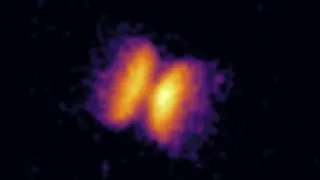
Astronomers using the CHARA Array and other telescopes captured real-time images of two novae (V1674 Herculis and V1405 Cassiopeiae), revealing complex, multi-stage gas outflows and gamma-ray emissions—showing that nova explosions are not single blasts and linking surface nuclear processes to the geometry of ejected material and high-energy radiation.
Astronomers using the VLT have spotted a rainbow-colored bow shock around RXJ0528+2838, a white dwarf in a binary about 730 light-years away. The nebula, extending ~4,000 AU and at least 1,000 years old, surrounds a diskless system that is actively pulling material from its companion. Researchers believe an extremely strong magnetic field powers an unusual, outflow-like phenomenon—the so-called mysterious engine—without a traditional accretion disk, challenging current models of mass transfer in binary systems. The finding, published in Nature Astronomy, suggests more such systems may exist and could be studied in detail with the upcoming ELT set to go online by 2028.
Astronomers using X-ray observations discovered that Betelgeuse's companion is likely a young Sun-like star rather than a white dwarf or neutron star, challenging previous expectations and offering new insights into stellar evolution and binary systems.
Astronomers have discovered a new type of supernova, SN 2023zkd, likely triggered by a massive star interacting with a black hole companion, with evidence suggesting the star was under extreme gravitational stress before exploding, and this discovery highlights the importance of studying binary star interactions in stellar evolution.
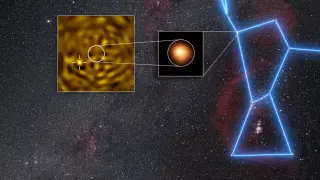
Astronomers have for the first time directly observed a close stellar companion to Betelgeuse using advanced imaging techniques, solving a long-standing mystery about its periodic brightness variations and revealing that Betelgeuse may eventually cannibalize this smaller star within the next 10,000 years.
Astronomers using NASA's TESS have discovered a new cataclysmic variable system called TIC 378898110, which is an AM Canum Venaticorum (AM CVn) binary star. AM CVn systems are rare and consist of a white dwarf accreting helium-dominated matter from a degenerate or semi-degenerate donor star. TIC 378898110 is the third-brightest known AM CVn and has an orbital period of 22-23 minutes. The system recently underwent a brightening event, and its dominant photometric period decreased during this time.
Astronomers have discovered evidence of an exoplanet in a polar circumbinary disk surrounding a binary star system, marking the first observation of its kind. The disk, located around the binary star AC Herculis, exhibits a large inner radius and a telltale gap indicating the presence of a planet. The primary star in the system is a post-AGB star, suggesting that the exoplanet may be a second-generation planet formed from the debris of destroyed first-generation planets. While the characteristics of the planet remain unknown, further study of this unique system is warranted.
The James Webb Space Telescope has captured detailed imagery of the ancient star Earendel, the most distant star ever detected. Surprisingly, the telescope has revealed evidence that Earendel may have a companion, a cooler red star. This finding challenges previous expectations and suggests that binary star systems are more common than previously thought. Earendel was discovered through the magnifying effect of a massive galaxy cluster, which warped the fabric of space and allowed astronomers to observe it. The star, located 12.9 billion light-years away, is incredibly hot and bright, making it a fascinating object for study.