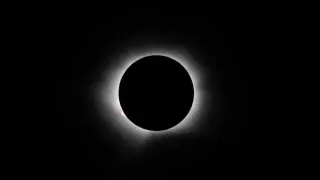
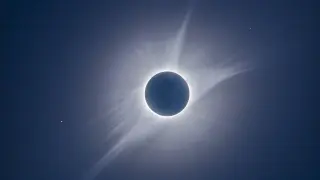
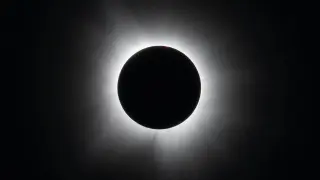
NASA used a WB-57F high-altitude aircraft off Iceland at 50,000 feet to chase the Moon's shadow during a total solar eclipse, capturing eclipse data above clouds; the onboard cameras reveal the solar corona at totality, with Venus, Jupiter, and Mercury visible near the Sun as the horizon glows in the distance.
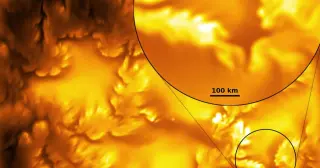
New high-resolution images from the NSF’s Inouye Solar Telescope show 20-km-wide plasma vortices at the edges of magnetic flux on the Sun’s surface, caused by Kelvin-Helmholtz instability. These swirling motions could braid magnetic fields and help channel energy from the surface into the corona, offering a potential piece of the coronal-heating puzzle, but the authors caution they have not quantified the energy contribution and call for independent confirmation with even more powerful instruments.
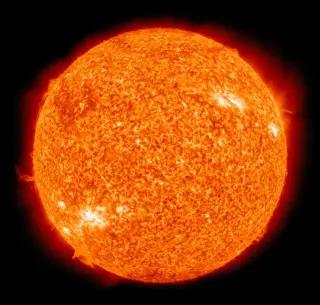
New findings from India's Aditya-L1 mission show the Sun's outer atmosphere, the corona, is heated mainly by magnetic-field-line reconnection (≈93%), with surface waves contributing about 7%. By analyzing a highly energetic CME on 5 August 2024, scientists quantified energy replenishment and confirmed the corona remains exceptionally hot despite repeated eruptions; the results, published in Astrophysical Journal Letters, provide a key benchmark for solar physics.
Space.com reports the start of the 2026 total solar eclipse, with the first totality photos from Scoresby Sund, Greenland, taken aboard the MS Spitsbergen on HX Expeditions showing the sun’s corona as the moon’s shadow swallows the Sun. The eclipse path then moves toward Spain, with Space.com editors Daisy Dobrijevic and Anthony Wood providing live updates from Greenland and central Europe. Totality will sweep across the Northern Hemisphere before fading off the north coast of Africa at 2:34 p.m. EDT (1834 GMT).
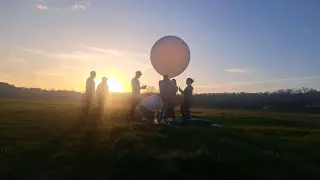
Spain witnessed its first total solar eclipse in more than a century, with totality lasting about two minutes along a path across the north and western regions; scientists used the event to study the solar corona via a nasa WB-57 mission and balloon experiments, while observers across towns captured dramatic eclipse imagery as daylight dimmed and returned.
NASA will use a high-altitude WB-57 research jet and the Nationwide Eclipse Ballooning Project to study the sun’s corona during the Aug. 12 total solar eclipse, with four cameras in the jet to capture corona dynamics while coordinated balloons examine atmospheric changes, ozone levels, and the Earth’s boundary layer as daylight fades in the eclipse path.
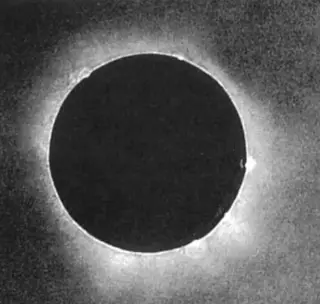
In 1851, Berkowski captured the first successful photo of a total solar eclipse with a daguerreotype, fixing the solar corona for objective study and transforming solar astronomy. The article then previews the Aug. 12, 2026 eclipse, noting that modern digital gear allows better images and offering practical tips—site choice along the totality, solar filters for any partial phases, exposed-bracketed shots, and removing filters only at totality to reveal the corona—highlighting how eclipse photography has evolved from 19th‑century plates to today’s sensors.
During the Aug. 12, 2026 total solar eclipse, the sun’s corona will briefly become visible and will reflect the solar magnetic activity of Solar Cycle 25, meaning no two eclipses look the same. Observers may see prominences along the edge and, with luck, a CME snapshot, but the exact corona depends on sunspot activity in the days around totality and viewing conditions.
NASA’s Parker Solar Probe detected voltage spikes from clouds of charged dust near the Sun, suggesting dust interacts with Alfvén waves and the solar wind to deposit energy into the corona. This could help explain why the corona reaches millions of degrees hotter than the Sun’s surface and may influence how future solar missions study near-sun dust.
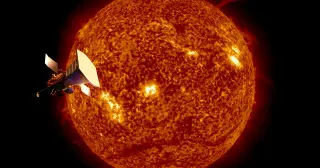
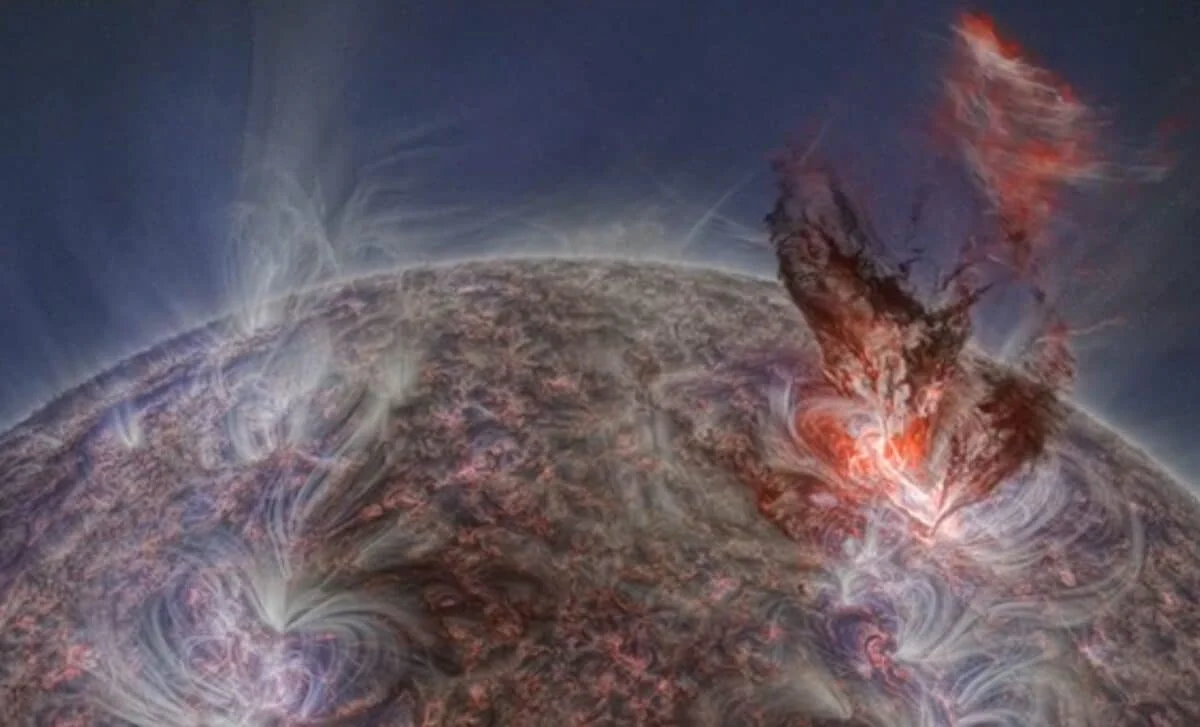
NASA’s Parker Solar Probe has repeatedly traversed the Sun’s corona—the outer atmosphere where temperatures soar above a million degrees—giving in-situ measurements that deepen the mystery of why the corona is so hot. A December 2024 near-surface pass (6.1 million km from the Sun, traveling ~692,000 km/h) confirmed the craft’s survival and enabled direct plasma, magnetic-field, and flow readings. The results keep the heating question open, highlighting two leading ideas—wave heating and small-scale magnetic reconnection (nanoflares)—neither of which is yet confirmed as dominant. The mission also finds switchbacks (abrupt magnetic reversals) abundant in the near-Sun solar wind but apparently absent inside the corona, refining how the wind is accelerated and fed by coronal processes. With repeated passes through late 2026 and NASA’s review looming, Parker’s data are helping to distinguish between competing explanations, but the exact energy transfer powering the corona remains unresolved.
The Parker Solar Probe is now flying through the Sun’s outer atmosphere, the corona, at about 430,000 mph—fast enough to cross the continental U.S. in 20 seconds. Behind a 4.5-inch-thick carbon-carbon shield with a carbon foam core, the electronics stay near room temperature while the shield’s face reaches roughly 2,500°F. The shield’s design lets it approach the Alfvén surface and sample fast‑moving solar wind and structures, a capability made possible by seven Venus flybys to tighten its orbit. The probe carries four instrument suites (FIELDS, SWEAP, WISPR, ISʘIS) to study electric and magnetic fields, particles, and corona imagery, and its speed and shielding enable science beyond the original plan.
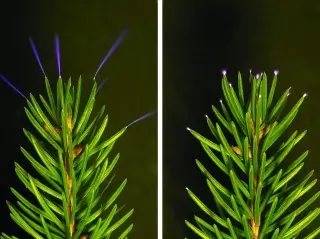
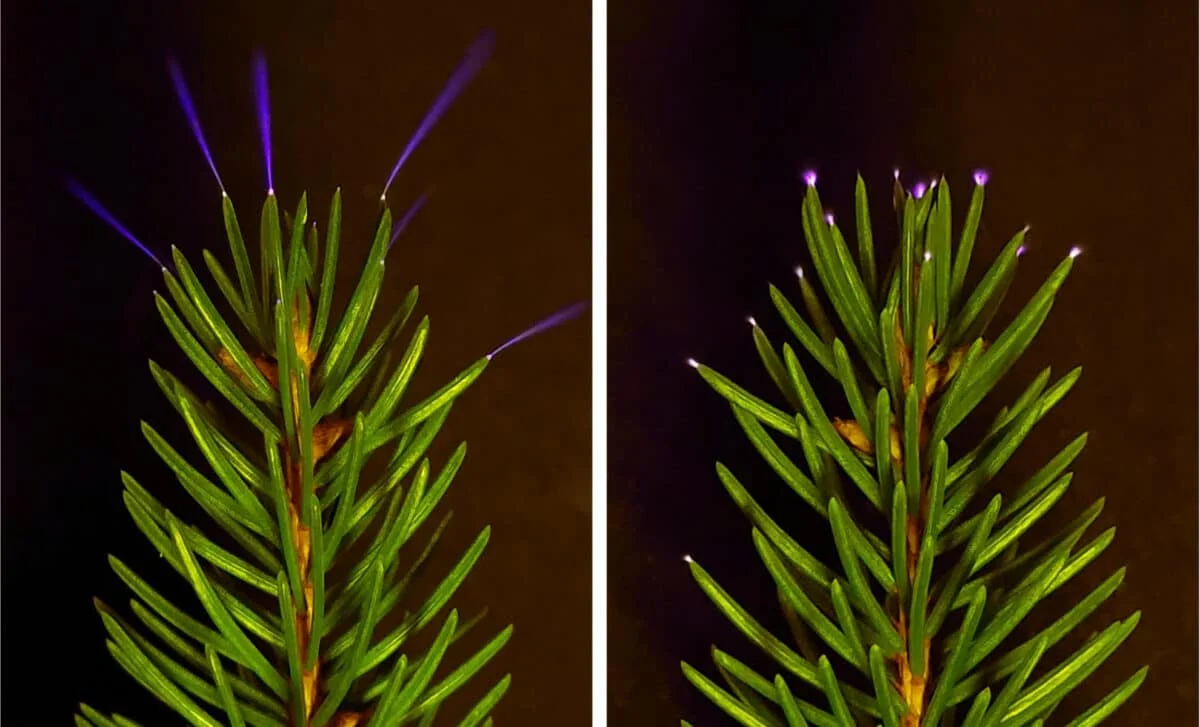
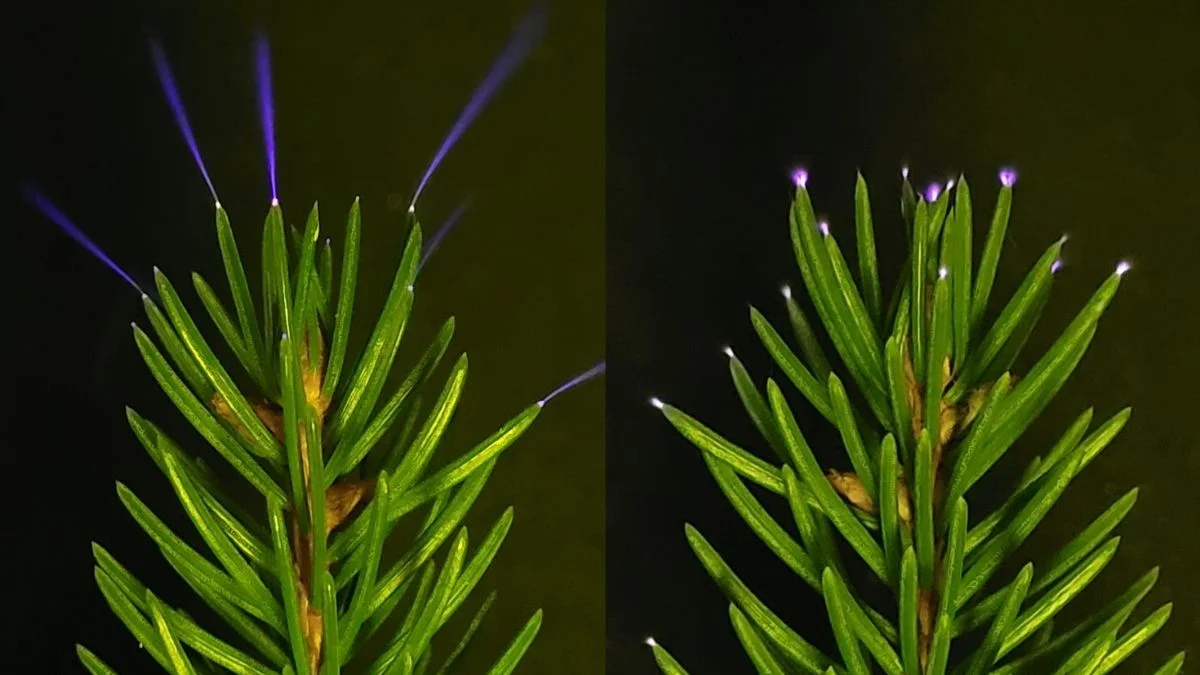
Using a UV camera mounted on a research vehicle, scientists captured hundreds of tiny corona discharges glowing along treetops during thunderstorms, showing that nearly every leaf can glow under a storm’s electric field; each corona carries about a microamp of current and produces hydroxyl radicals that can scrub pollutants but may also damage leaves, with potential implications for forest chemistry and even storm dynamics, observed across multiple storms and tree species and reported in Geophysical Research Letters by Penn State researchers led by P. J. McFarland.
Researchers mounted a UV camera on a modified minivan to capture the ultraviolet corona emitted by trees during thunderstorms for the first time. The team observed 41 bursts in sweetgum and loblolly pine across the U.S. East Coast, with each burst emitting billions of photons at around 260 nanometers. This real but previously unobserved glow could influence forest health and atmospheric chemistry and may play a role in thunderstorm electrification, suggesting such coronae occur across forests worldwide.
Scientists captured the first field evidence of coronae—ultraviolet glows at leaf tips—generated by charge buildup as storms pass over trees. In lab simulations and storm-intercept observations along the US East Coast, researchers logged 41 bursts lasting 0.1–3 seconds, emitting about 100 billion photons per frame at ~260 nm, across species including sweetgum, loblolly pine, maple, and spruce, suggesting a real, widespread electrical glow with potential implications for forest chemistry and how thunderstorms electrify in a warming climate.
A decade of eclipse-era observations by researchers at the University of Hawai'i reveals turbulent structures in the Sun's outer atmosphere that originate from prominences and survive as they travel outward with the solar wind, providing new clues to coronal heating and space-weather effects on Earth.