Tag

Parker Solar Probe

All articles tagged with #parker solar probe

Parker Solar Probe Surges Near the Sun Behind Ultra-Light Heat Shield
space6 days ago

Parker Solar Probe Surges Near the Sun Behind Ultra-Light Heat Shield

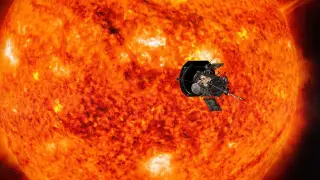
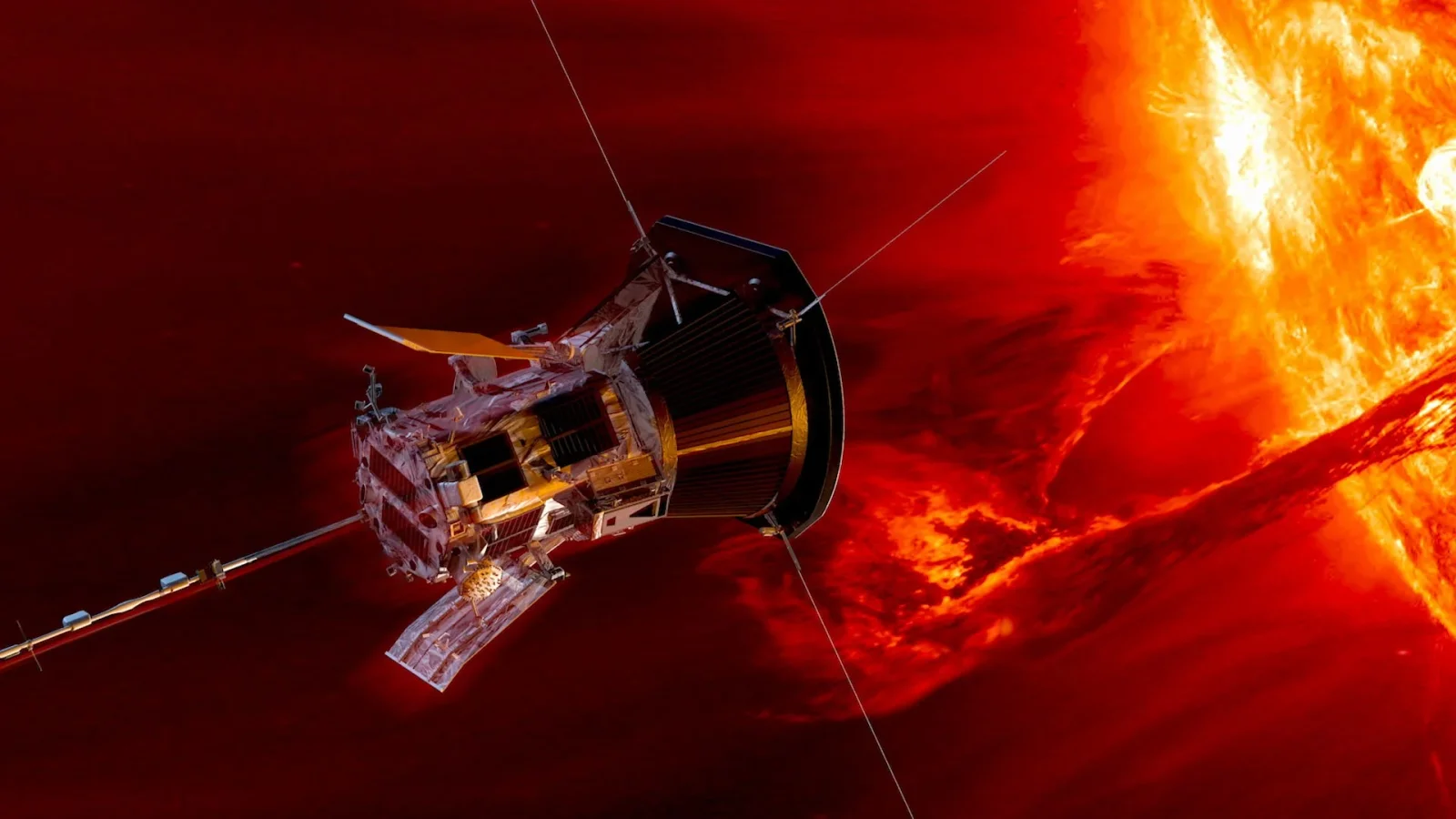
NASA’s Parker Solar Probe, launched in 2018, pushed closer to the Sun than any spacecraft by reaching about 3.8 million miles from the solar surface at ~430,000 mph during the December 2024 pass; its 4.5-inch-thick, 2.3-meter heat shield—a carbon-carbon sandwich with a carbon foam core weighing ~160 pounds and a white alumina coating—keeps the instruments at room temperature while the sun-facing side reaches up to 2,500°F, with actual temperatures staying well below worst-case estimates, providing thermal margin; the mission has transformed solar physics by directly measuring the corona and solar wind, and is planned to operate through 2026 as it conducts further perihelia.

Gravity, not a bigger engine, drives Parker Solar Probe's sun-speed record
space7 days ago

Gravity, not a bigger engine, drives Parker Solar Probe's sun-speed record

Parker Solar Probe reached a record ~430,000 mph near the Sun not primarily through propulsion, but through seven Venus gravity assists over seven years that gradually lowered its solar orbit. As the probe fell closer to the Sun, the Sun's gravity converted potential energy into kinetic energy, making it the fastest human-made object in history. The feat highlights orbital design and gravity as key drivers in spaceflight, while the mission continues to study the Sun’s corona and solar wind.

Parker Solar Probe Finds Unexpected High-Energy Protons From Near-Sun Magnetic Reconnection
space21 days ago

Parker Solar Probe Finds Unexpected High-Energy Protons From Near-Sun Magnetic Reconnection

NASA’s Parker Solar Probe crossed the solar corona during perihelion and recorded protons at energies far above what existing reconnection-driven acceleration models at the heliospheric current sheet could predict, linking magnetic island merging in the reconnection exhaust to a near-Sun source of high-energy particles and prompting questions about the limits of current particle-acceleration theories and implications for coronal heating.

Parker Solar Probe Dives into Corona to Untangle the Sun’s Heat Mystery
space1 month ago

Parker Solar Probe Dives into Corona to Untangle the Sun’s Heat Mystery

NASA’s Parker Solar Probe has repeatedly traversed the Sun’s corona—the outer atmosphere where temperatures soar above a million degrees—giving in-situ measurements that deepen the mystery of why the corona is so hot. A December 2024 near-surface pass (6.1 million km from the Sun, traveling ~692,000 km/h) confirmed the craft’s survival and enabled direct plasma, magnetic-field, and flow readings. The results keep the heating question open, highlighting two leading ideas—wave heating and small-scale magnetic reconnection (nanoflares)—neither of which is yet confirmed as dominant. The mission also finds switchbacks (abrupt magnetic reversals) abundant in the near-Sun solar wind but apparently absent inside the corona, refining how the wind is accelerated and fed by coronal processes. With repeated passes through late 2026 and NASA’s review looming, Parker’s data are helping to distinguish between competing explanations, but the exact energy transfer powering the corona remains unresolved.

Parker Solar Probe Braces the Sun at 430,000 mph Behind a 4.5-Inch Shield
science1 month ago

Parker Solar Probe Braces the Sun at 430,000 mph Behind a 4.5-Inch Shield

The Parker Solar Probe is now flying through the Sun’s outer atmosphere, the corona, at about 430,000 mph—fast enough to cross the continental U.S. in 20 seconds. Behind a 4.5-inch-thick carbon-carbon shield with a carbon foam core, the electronics stay near room temperature while the shield’s face reaches roughly 2,500°F. The shield’s design lets it approach the Alfvén surface and sample fast‑moving solar wind and structures, a capability made possible by seven Venus flybys to tighten its orbit. The probe carries four instrument suites (FIELDS, SWEAP, WISPR, ISʘIS) to study electric and magnetic fields, particles, and corona imagery, and its speed and shielding enable science beyond the original plan.

Parker Solar Probe Pushes into the Sun’s Shadow, Shield Protects the Mission
space1 month ago

Parker Solar Probe Pushes into the Sun’s Shadow, Shield Protects the Mission

The Parker Solar Probe remains the fastest human-made object, zipping through the Sun’s corona at about 430,000 mph and protected by a 4.5-inch-thick carbon-foam heat shield; after seven Venus gravity assists it now sits in its closest solar orbit, operating autonomously and returning data on the corona and solar wind as NASA extends the mission beyond its original plan.

Parker Solar Probe Reveals the Hidden Heating of the Solar Wind
space4 months ago

Parker Solar Probe Reveals the Hidden Heating of the Solar Wind

NASA’s Parker Solar Probe, flying closer to the Sun than any prior mission (within 3.8 million miles of the surface), uses a new ALPS analysis tool to map how energy heats and accelerates the solar wind, addressing the coronal heating puzzle and improving space-weather forecasts while providing insights into plasma behavior across the cosmos.

Parker Solar Probe Maps How the Sun Heats Its Solar Wind
space5 months ago

Parker Solar Probe Maps How the Sun Heats Its Solar Wind

NASA’s Parker Solar Probe delivered unprecedented close-up data from the Sun’s corona, enabling researchers to use the Arbitrary Linear Plasma Solver (ALPS) to analyze how particles respond to waves in the Sun’s plasma. The study shows how heating and damping shape the solar wind near the Sun, with cooling of particles occurring more gradually than expected as they stream outward—improving space weather forecasts and informing similar plasma processes in the universe.

NASA's Parker Probe Reveals New Details of the Sun's Dynamic Atmosphere
science6 months ago

NASA's Parker Probe Reveals New Details of the Sun's Dynamic Atmosphere

NASA's Parker Solar Probe captured unprecedented close-up images of the Sun's magnetic activity during its 22nd flyby, revealing new details about magnetic 'tadpoles', the tearing of the heliospheric current sheet, and the formation of magnetic in/out pairs, advancing our understanding of solar phenomena.