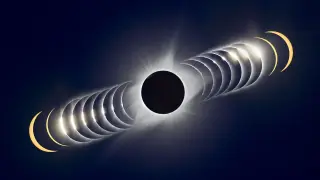
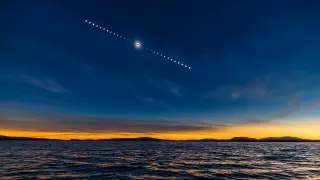
The article reports that the ancient Minoan civilization created what is described as the first portable eclipse calculator, suggesting they possessed advanced astronomical knowledge for their time.
During Artemis II’s historic seven-hour lunar flyby, NASA astronauts aboard Orion came within about 4,067 miles of the Moon and roughly 252,756 miles from Earth, capturing thousands of photos that included Earth appearing to set behind the Moon (Earthset), a solar eclipse with visible corona and planets, and views of the Orientale Basin with two newly named craters, Integrity and Carroll; the crew also photographed the Milky Way on the return, while honoring Wiseman’s late wife Carroll and advancing science ahead of future lunar missions.
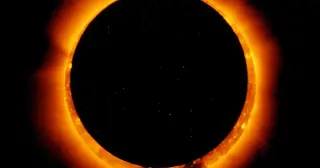
ESA’s Proba-2 spacecraft photographed an annular solar eclipse on 17 February 2026, showing a ring of fire as the Moon sat near apogee. The view from space accompanied Earth observations mainly from Antarctica, with partial sights in southern Chile/Argentina and southern Africa. ESA also notes three more European eclipses expected between 2026 and 2028.
A rare annular solar eclipse on Feb 17, 2026 will create a ring of fire across a 2,661-mile path over Antarctica, with annularity lasting 2 minutes at Concordia Station and 1 minute 52 seconds at Mirny Station; outside Antarctica, a partial eclipse will be visible in parts of southeastern Africa, southern South America, and nearby oceans, though weather and extreme cold could limit viewing opportunities.
New research reframes the Dresden Codex as a working astronomical tool: its eclipse table spans 405 lunar months and uses overlapping reset points to keep predictions within about 51 minutes of accuracy over 134 years, showing Maya scribes maintained data for long-term eclipse forecasting and linking to events like the 1991 eclipse when properly anchored.
After the September 21, 2025 eclipse, three zodiac signs—Capricorn, Aquarius, and Pisces—will experience relief from previous challenges, with the difficult period ending and a chance for renewed confidence and progress.
On July 20, in North America, a lunar eclipse called the 'Seven Sisters Eclipse' will occur, where the Moon will pass in front of the Pleiades star cluster, temporarily obscuring it from view, an event visible to about 60% of the world's population.
Fred Espenak, renowned eclipse expert and NASA astrophysicist, passed away at 71 after a battle with pulmonary fibrosis. He was celebrated for his extensive work on solar eclipses, including detailed maps, predictions, and outreach that inspired countless eclipse enthusiasts. His websites remain valuable resources for celestial phenomena, and his legacy as 'Mr. Eclipse' endures in the astronomy community.
Pilgrim's Bounty is set to launch in Warcraft Rumble on November 20, 2024, offering players the chance to complete challenges and earn tickets for rewards. The event introduces new Treant Minis and Eclipse spells, alongside new cosmetics like the Harvest Avatar and "Roast" Beast Kobold Skin. Players must use their tickets before the event ends on December 3, 2024, as unspent tickets will convert to Arclight Energy. Stay updated through Warcraft Rumble's official channels.
YouTuber and aerospace engineer Destin Sandlin captured footage of unidentified objects flying across the total solar eclipse on April 8, 2024. While initially thought to be satellites, astronomers have raised doubts due to the objects' speed and brightness, suggesting they could be bugs, meteors, or space junk. The mystery remains unsolved, and Sandlin has asked viewers to help identify the objects.
Evansville won't experience another total solar eclipse until 2153, with the next opportunity in 2044. The 2153 eclipse is predicted to coincide with an increasingly perilous climate, with rising global temperatures and extreme precipitation events. The population in Evansville and the world is expected to rise significantly, adding strain to the environment and economy. The following eclipse in 2343 will not pass directly over Evansville, and predicting the area's state then is nearly impossible.
US astrology influencer Danielle Johnson, also known as Danielle Ayoka, expressed concern about the recent solar eclipse, warning followers about "spiritual warfare." She fatally stabbed her partner, pushed her two children out of a moving car, and crashed the vehicle into a tree, killing herself and her baby. Only one child survived. The influencer's body was difficult to identify due to the crash. Scientists debunked eclipse-related conspiracies, while millions in North America witnessed the celestial event.
Danielle Johnson, an astrology influencer known as Danielle Ayoka, killed her partner and 8-month-old child before dying in a car crash, possibly influenced by her alarming posts about an upcoming eclipse. She had a significant online following despite posting antisemitic content and conspiracy theories. Johnson offered astrology and reiki services for a fee and had a history of controversial online behavior.
Vermont officials estimate that around 160,000 people drove into the state for Monday's total solar eclipse, with about 60,000 vehicles recorded. Despite the influx, officials praised the conduct of both visitors and locals on the roads, noting fewer accidents than during a recent snowstorm. The state's welcome centers saw about 35,000 visitors, and traffic on interstates was heavily impacted, with slow speeds lasting into the early hours of Tuesday. Additionally, Vermont experienced historic levels of private airplane traffic, with 248 total landings at state-owned airports. Amtrak routes also saw higher ridership leading up to the eclipse, and officials expect to gather more data on the economic impact of the event in the coming weeks.
During the recent solar eclipse in Missouri, viewers were treated to the rare sight of "shadow bands" - undulating waves of faint light that appeared on the ground just before and after totality. These bands are caused by the refraction of light in the atmosphere, and are typically only visible during total eclipses when the sun's light is faint enough. Scientists, including Washington University professor Mike Krawczynski, were particularly excited about this year's eclipse due to the sun's increased activity, resulting in longer totality and the appearance of dramatic bursts of light at the sun's edges called "prominences." This event provided an exciting opportunity to expose the public to the wonders of science and the universe.