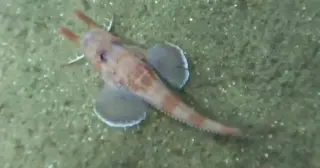
Sea-floor Moonwalk: First Backward Movement Captured in a Fish
Scientists documented the armored searobin Scalicus engyceros moving sideways and backward across the seabed—the first observed instance of a fish walking in reverse—using thick, stiff pectoral fin rays. The footage, captured with HOVs and ROVs in the South China Sea, also highlights the fish’s eye sensitivity and adaptive locomotion, expanding understanding of deep-sea life and evolution.