Tag

Magnetic Field

All articles tagged with #magnetic field

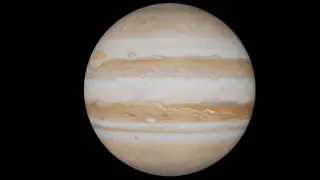
Ganymede’s Forming Core Sparks a New Dynamo Theory
space-and-spaceflight1 day ago

Ganymede’s Forming Core Sparks a New Dynamo Theory

A Science Advances study suggests Ganymede’s metallic core is still forming today, and that ongoing convection in this migrating, hot iron core powers its long-unique magnetic field via a ‘cold-start’ dynamo; the results don’t fully overturn older theories, but they offer a new mechanism to explain why Ganymede’s dynamo persists while Callisto shows no obvious one, with implications for Europa and future data from Europa Clipper and Juice.

Ganymede’s hidden heat may power a late-forming magnetic dynamo
space2 days ago

Ganymede’s hidden heat may power a late-forming magnetic dynamo

New Science Advances study suggests Jupiter’s moon Ganymede could have formed a metal core later than previously thought and still sustain a magnetic field via a warming-driven dynamo powered by protracted core formation, radioactive heating, and tidal forces. This challenges the idea that dynamos always originate early and cool over time, and implies Ganymede’s magnetism—potentially active today—arises from a “warm start” process that could influence how we think about magnetic fields on other worlds, including exoplanets.

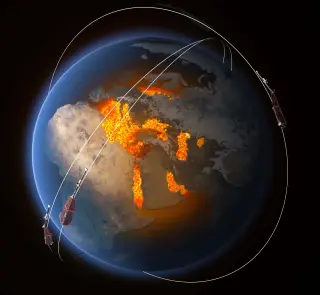
Pacific Core Flow Reverses, Revealing a Dynamic Geodynamo
science3 days ago

Pacific Core Flow Reverses, Revealing a Dynamic Geodynamo

ESA satellites detected a sudden reversal of flow in Earth's liquid outer core beneath the Pacific in 2010, showing the core is more variable than once believed and offering new insights into the geodynamo that sustains Earth’s magnetic field; scientists will monitor whether this is a temporary fluctuation, part of a cycle, or a new stable state with potential impacts on navigation and space weather models.

Ganymede’s secret core may still be forming after billions of years
space16 days ago

Ganymede’s secret core may still be forming after billions of years

A new study suggests Jupiter’s moon Ganymede could still be differentiating its metallic core billions of years after formation, with iron–sulfur melt slowly feeding a protocore that powers a long‑lived magnetic dynamo and likely an ocean beneath its ice. If correct, this ongoing core growth could explain why Ganymede remains magnetically active while other moons fade, and future missions like JUICE may test the idea.

Webb Discovers Neptune’s Hidden Auroras, Solving a 30-Year Mystery
space19 days ago

Webb Discovers Neptune’s Hidden Auroras, Solving a 30-Year Mystery

NASA’s James Webb Space Telescope has for the first time imaged Neptune’s auroras, solving a decades-long mystery. Webb’s near-infrared spectroscopy detected infrared auroral signatures and the H3+ ion, revealing mid-latitude auroras caused by Neptune’s tilted magnetic field, while the planet’s upper atmosphere has cooled substantially since the Voyager 2 flyby. Ongoing Webb observations will deepen understanding of Neptune’s magnetosphere and atmospheric dynamics.

Deep Mantle Giants Have Shaped Earth’s Magnetic Field for Millions of Years
science3 months ago

Deep Mantle Giants Have Shaped Earth’s Magnetic Field for Millions of Years

Geologists report that two massive, buried mantle anomalies called large low-shear-velocity provinces (LLSVPs) have modulated Earth's magnetic field for about 265 million years by creating temperature- and density-driven flow differences that alter the outer-core liquid iron; computer simulations show only models including LLSVPs reproduce observed magnetic irregularities, with implications for ancient continental configurations and climate.

Basal magma oceans could power magnetic shields on super-Earths, boosting habitability
space4 months ago

Basal magma oceans could power magnetic shields on super-Earths, boosting habitability

A Nature Astronomy study suggests that some super-Earths (about 3–6 times Earth's mass) may sustain long‑lived magnetic fields not from a core dynamo but from a basal magma ocean layer between the core and mantle, potentially protecting atmospheres and improving habitability; while detecting such fields remains challenging, future observations could test this BMO‑driven dynamo scenario.

Hear Earth's Ancient Magnetic Flip: A Haunting Audio
science4 months ago

Hear Earth's Ancient Magnetic Flip: A Haunting Audio

Scientists reconstructed the Laschamps magnetic reversal (about 41,000 years ago) by merging ESA’s Swarm satellite data with geomagnetic records, turning the upheaval into an eerie audio track that suggests the field briefly weakened to around 5% of its current strength for about 440 years. The work, highlighted by DTU and GFZ researchers and published in 2024, underscores the importance of understanding past extreme geomagnetic events to anticipate future space weather and environmental effects, especially amid ongoing pole drift and the South Atlantic Anomaly.

Rainbow bow shock around a nearby white-dwarf binary challenges stellar physics
space4 months ago

Rainbow bow shock around a nearby white-dwarf binary challenges stellar physics

Astronomers using the VLT have spotted a rainbow-colored bow shock around RXJ0528+2838, a white dwarf in a binary about 730 light-years away. The nebula, extending ~4,000 AU and at least 1,000 years old, surrounds a diskless system that is actively pulling material from its companion. Researchers believe an extremely strong magnetic field powers an unusual, outflow-like phenomenon—the so-called mysterious engine—without a traditional accretion disk, challenging current models of mass transfer in binary systems. The finding, published in Nature Astronomy, suggests more such systems may exist and could be studied in detail with the upcoming ELT set to go online by 2028.

Scientists develop device harnessing Earth's rotation for electricity
science5 months ago

Scientists develop device harnessing Earth's rotation for electricity

Scientists in the US have developed a device that can generate tiny amounts of electricity by harnessing Earth's rotation and magnetic field, suggesting a potential, though currently impractical, new energy source if scaled up. The experiment involved a specially shaped ferrite shell that avoids the usual cancellation of voltage caused by electromagnetic forces, producing measurable microvolts as Earth spins. While promising, the technology is in early stages, and further independent testing is needed to verify and explore its scalability.

Earth's Atmosphere and Water Contributions Make the Moon More Habitable
science5 months ago

Earth's Atmosphere and Water Contributions Make the Moon More Habitable

New research suggests that Earth's atmosphere has been gradually leaking particles, including water and nitrogen, to the Moon over billions of years, facilitated by Earth's magnetic field, which acts more like a guiding rail than a shield. These particles are preserved in lunar soil, creating a long-term archive of Earth's atmospheric history and potentially providing resources for future lunar exploration.

New Discoveries Reveal Complex Layers and States in Earth's Inner Core
science5 months ago

New Discoveries Reveal Complex Layers and States in Earth's Inner Core

A NASA-led study reveals a strong correlation between Earth's magnetic field and atmospheric oxygen levels over the past 540 million years, suggesting that processes in Earth's molten core have played a crucial role in creating conditions suitable for complex life, with implications for understanding planetary habitability and the search for life on exoplanets.