Tag

Population Iii

All articles tagged with #population iii

JWST uncovers the universe’s most primitive galaxy, LAP1-B
science2 days ago

JWST uncovers the universe’s most primitive galaxy, LAP1-B

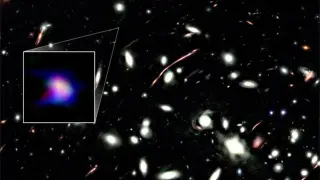
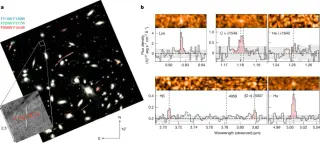
The James Webb Space Telescope, aided by gravitational lensing from a foreground galaxy cluster, studied LAP1-B, a tiny galaxy formed about 800 million years after the Big Bang. Spectroscopy shows it has an exceptionally low oxygen abundance (about 1/240 of the Sun) and an elevated carbon-to-oxygen ratio, marking it as one of the most chemically primitive galaxies observed to date. The light was magnified roughly 100× by the MACS J0416 cluster, enabling insights into the early stages of galaxy formation and deeper connections to the Milky Way’s ancient fossil dwarf galaxies.

JWST Finds the Most Metal-Poor Galaxy Yet, a Fossil from Cosmic Dawn
science20 days ago

JWST Finds the Most Metal-Poor Galaxy Yet, a Fossil from Cosmic Dawn

James Webb Space Telescope spectroscopy of LAP1-B, a strongly lensed galaxy at zspec ≈ 6.63, reveals an ultra-faint, chemically primitive star-forming system with gas-phase oxygen abundance of ~4×10⁻³ Z☉—the lowest yet for a high-redshift galaxy. It hosts a hard ionizing radiation field inconsistent with enriched populations, shows an elevated C/O ratio suggesting metal-free/poor stellar origins, and has a stellar mass <3,300 M⊙ while its dynamical mass exceeds baryons, implying a dominant dark-matter halo. LAP1-B is a direct high-redshift progenitor of local ultra-faint dwarfs, providing a rare window into early galaxy formation.

Ancient Immigrant Star Offers Glimpse of the Universe's First Generations
astronomy1 month ago

Ancient Immigrant Star Offers Glimpse of the Universe's First Generations

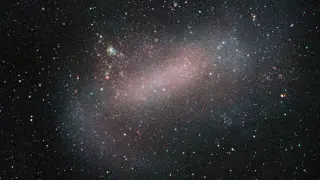
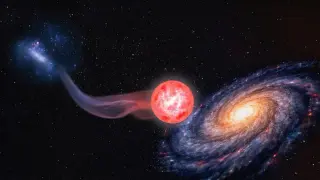
Astronomers report that SDSS J0715-7334 is an extraordinarily metal-poor star—almost pure hydrogen and helium—likely formed from a primordial cloud polluted by a Population III supernova. Found ~80,000 light-years away near the Large Magellanic Cloud, its metal content is about 0.005% that of the Sun, making it the closest analogue to the first stars. Follow-up observations with the Sloan Digital Sky Survey and Magellan telescope suggest its Population III progenitor had at least 30 solar masses and an unusually energetic explosion, earning it the nickname “Ancient Immigrant.” The discovery, published in Nature Astronomy, helps illuminate the early chemical evolution of the cosmos.

Nearby Pristine Star Carries Clues to the Universe's First Stars
space1 month ago

Nearby Pristine Star Carries Clues to the Universe's First Stars

Astronomers identified SDSS J0715-7334, a Sun-like star now a red giant, as the most metal-poor star known (about 0.005% of the Sun) with an unusually low carbon content. Its chemistry implies it formed through a rare cooling pathway aided by tiny cosmic dust from Population III supernovae, possibly born in the Large Magellanic Cloud — a fossil of the early Universe that could guide the search for more ultra-metal-poor stars.

Cosmic fossil star unlocks secrets of the universe's first generations
astronomy2 months ago

Cosmic fossil star unlocks secrets of the universe's first generations

Astronomers identified PicII-503, an extremely metal-poor second-generation star in the dwarf galaxy Pictor II, with just 1/40,000th the Sun's iron and a striking carbon overabundance. This rare star acts as a fossil record of the universe's earliest element production, offering clues about how the first stars enriched later generations and linking to signatures seen in Milky Way halo stars; the discovery was reported in Nature Astronomy.

Could JWST’s Tiny Dots Hint at the Universe’s First Monster Stars
science3 months ago

Could JWST’s Tiny Dots Hint at the Universe’s First Monster Stars

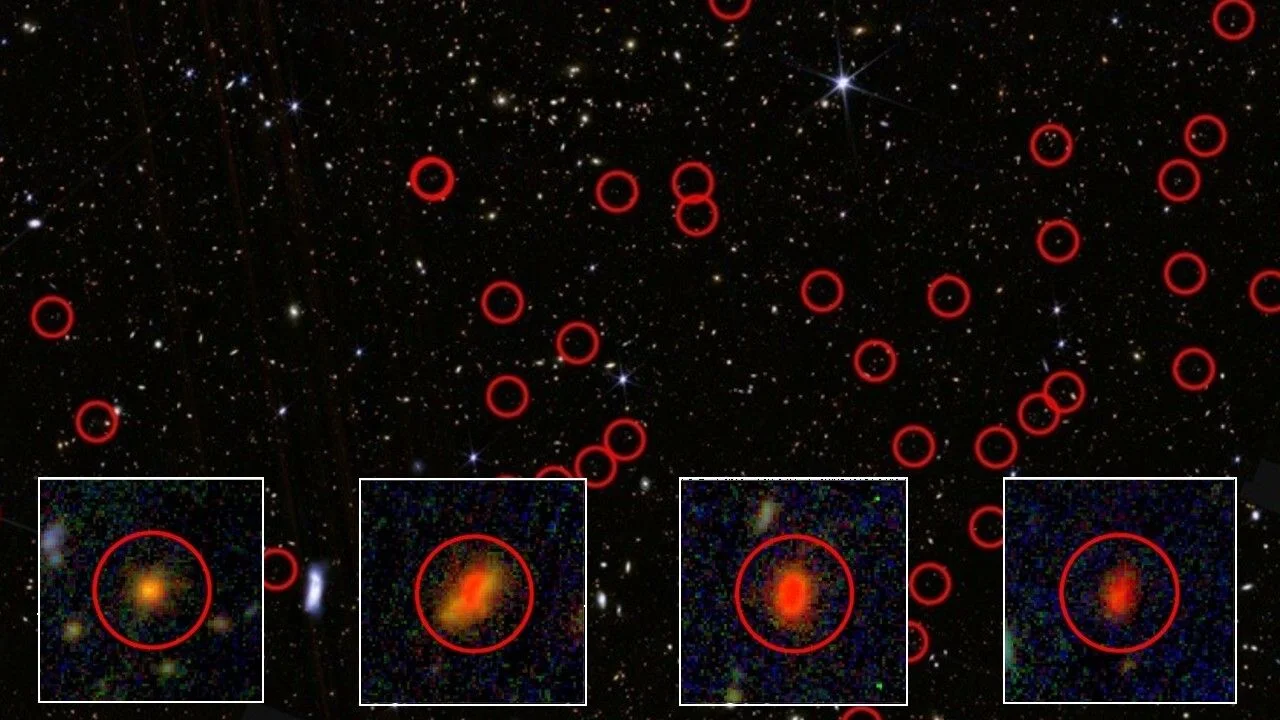
A study linked to the James Webb Space Telescope’s “little red dots” proposes they could be the first generation of supermassive stars (Population III) rather than powered black holes. The team modeled metal-free supermassive stars approaching a million solar masses and found their brightness and spectral features match two observed dots, MoM-BH*-1 and The Cliff, suggesting these stars might eventually collapse into the universe’s first supermassive black holes. If correct, these stars would live only a very short time (around 10,000 years at such masses), limiting how often we might see them; lack of X-ray signals could fit the star scenario, though accreting black holes remain an alternative. Future radio observations could decisively test the idea by detecting emission that would escape if black holes power the dots.