Tag

Xenon

All articles tagged with #xenon

Strange Signal at the World’s Largest Dark Matter Detector Stirs Debate
science1 month ago

Strange Signal at the World’s Largest Dark Matter Detector Stirs Debate

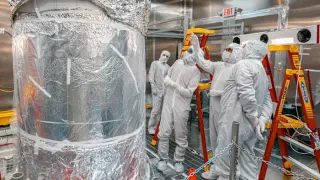
Physicists running the LZ dark matter detector in South Dakota report a 2023 event—a previously unobserved interaction in seven tons of liquid xenon that produced a flash of light. While the team says it could be a dark-matter signal, it yielded more energy than standard WIMP models predict, and the odds of it being a fluke are about 1 in 400—far below the five-sigma threshold—so independent confirmation from PandaX and XENONnT is planned before any firm claim.


Possible dark-matter signal surfaces from South Dakota underground lab
science1 month ago

Possible dark-matter signal surfaces from South Dakota underground lab

Scientists with the LUX-ZEPLIN (LZ) dark‑matter experiment underground at the Sanford Underground Research Facility in South Dakota report a single event that could match a WIMP– xenon interaction. While intriguing, the researchers caution it is not a discovery and emphasize the need for additional data and rigorous checks to rule out other explanations.

Underground xenon detector hints at possible dark-matter signal
science1 month ago

Underground xenon detector hints at possible dark-matter signal

Scientists working on the LUX-ZEPLIN (LZ) dark matter experiment in a South Dakota underground facility reported a potential hit: a single event where a hypothetical WIMP may have collided with a xenon atom, producing a faint UV flash and a nuclear recoil. While intriguing, this does not meet the statistical threshold for a discovery, and researchers say further data and scrutiny are needed to rule out other explanations before claiming dark matter has been observed.

Possible Dark Matter Hint Emerges From Underground Experiment
science1 month ago

Possible Dark Matter Hint Emerges From Underground Experiment

Scientists at the LUX-ZEPLIN (LZ) experiment, housed about a mile underground at the Sanford Underground Research Facility in South Dakota, report what could be the first hint of dark matter—a weakly interacting massive particle (WIMP) scattering off xenon atoms and producing a faint UV flash. But with only a single event, the observation does not meet the statistical threshold for a discovery, and researchers caution more data and rigorous checks are needed to rule out other explanations before claiming dark matter detection.

Underground detector hints at dark matter particle (WIMP)
science1 month ago

Underground detector hints at dark matter particle (WIMP)

An ultra-deep underground Lux-Zeplin detector in South Dakota recorded a light flash likely caused by a dark-matter particle colliding with xenon, marking the strongest hint yet that WIMPs could be the universe’s dark matter. The finding, based on 220 days of data, has about 2.6-sigma significance—below the 5-sigma discovery threshold—so it could be a real signal or a background fluctuation. Further data and corroboration from other detectors and methods are needed to confirm whether WIMPs constitute dark matter.

Mars Flyby Boosts NASA’s Psyche Mission Toward a Metal-R-rich World
space5 months ago

Mars Flyby Boosts NASA’s Psyche Mission Toward a Metal-R-rich World

NASA’s Psyche spacecraft will perform a Mars gravity assist on May 15, passing about 2,800 miles above the planet at roughly 12,333 mph to boost its trajectory toward the metal-rich asteroid 16 Psyche. Launched Oct 13, 2023, the mission uses solar-electric propulsion with xenon propellant, and the gravity assist helps save propellant while also calibrating science instruments for the upcoming encounter.

Unveiling Nuclear Shapes: Insights from High-Energy Collisions
science1 year ago

Unveiling Nuclear Shapes: Insights from High-Energy Collisions

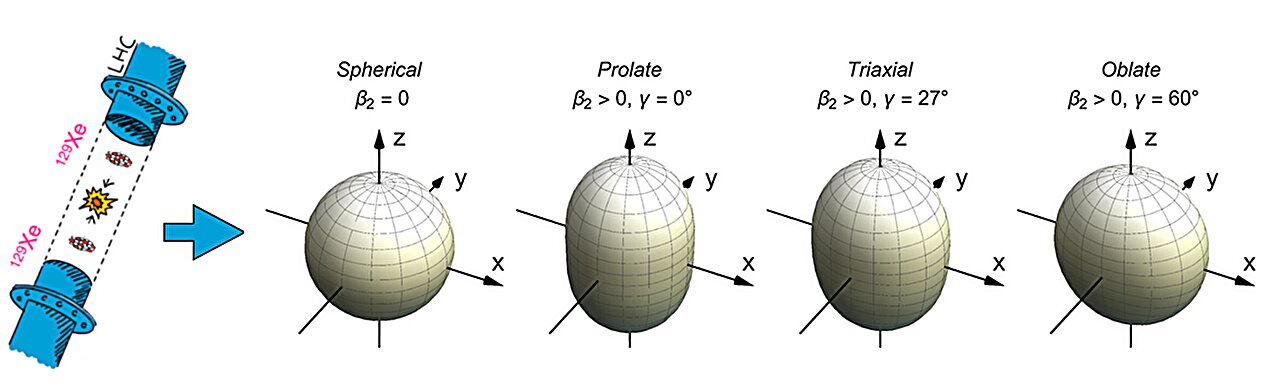
Researchers from the Niels Bohr Institute and Peking University have used experiments at CERN's Large Hadron Collider to predict changes in the shape of Xenon nuclei during high-energy collisions. These findings, published in Physical Review Letters, reveal that the initial geometry of colliding nuclei significantly influences the outcomes of such collisions, challenging previous assumptions. The study also provides insights into the quark-gluon plasma, a state of matter present shortly after the Big Bang, and demonstrates a novel algorithm for analyzing particle interactions without supercomputers.

Dark Matter Experiments Unveil 'Ghostly' Neutrino Fog
science1 year ago

Dark Matter Experiments Unveil 'Ghostly' Neutrino Fog

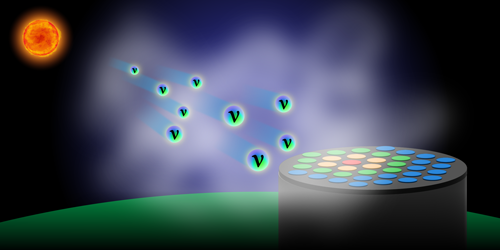
For the first time, two dark matter experiments, XENON in Italy and PandaX in China, have detected a 'neutrino fog,' a dense cloud of neutrinos, using liquid xenon detectors. This discovery, involving coherent elastic neutrino-nucleus scattering (CEvNS), complicates the search for dark matter as neutrinos can create background noise that mimics dark matter signals. Despite this challenge, experts believe the impact of this 'neutrino fog' on dark matter research is manageable. The findings are published in Physical Review Letters.

Unveiling the Mysteries of the Neutrino Fog
physics1 year ago

Unveiling the Mysteries of the Neutrino Fog

Two dark matter experiments, PandaX and XENON, have detected signals from solar neutrinos, known as the "neutrino fog," which could complicate future dark matter searches. These experiments, using liquid xenon detectors, observed coherent elastic neutrino-nucleus scattering (CEvNS) events, a process predicted to mimic dark matter signals. While the neutrino fog poses a potential challenge, it is not expected to significantly impact dark matter searches for at least a decade. The findings also open new avenues for neutrino research and standard-model testing.

"Unexplained Disappearance: Earth's Atmosphere Depleted of Xenon"
science2 years ago

"Unexplained Disappearance: Earth's Atmosphere Depleted of Xenon"

Earth's atmosphere is missing a significant amount of xenon, a noble gas that typically does not react with other elements. Scientists have proposed various theories, including xenon being trapped in Earth's core, degassing into space, or being dissolved in perovskite in the mantle. Recent research suggests that a substantial amount of xenon may have been carried off into space early in Earth's history, leaving behind trace levels dissolved in perovskite. This mystery also raises questions about the xenon levels on Mars and the potential role of perovskite in trapping the gas.