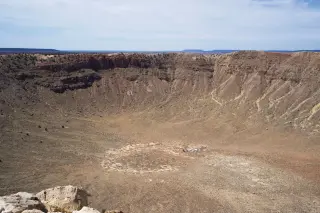
A new study re-dates the buried Ames impact crater in Oklahoma from 470 million to 370 million years ago, linking it to the Frasnian-Famennian extinction rather than the Ordovician meteor event.
New analysis of carbonaceous iron meteorites shows the first outer-Solar-System planetesimals contained just 8–17% fine, volatile-rich matrix and 83–92% chondrules—heated rock beads formed when aluminium-26 decayed, melted interiors, and drove core formation. Aerodynamic gas drag in the protoplanetary disk caused larger chondrules to drift and concentrate while fine dust stayed with the gas, effectively filtering out much ice-rich material from the earliest bodies. This early selective construction extends a pattern seen in younger meteorites and implies the outer disk’s composition was shaped from the start by particle size and gas dynamics, not by temperature alone.
A new analysis of ten isotope systems in meteorites shows Earth's building blocks came exclusively from the inner Solar System, with outer-Solar-System material contributing less than 2% of Earth's mass and possibly none at all. Jupiter's gravity likely formed a barrier that prevented material exchange between the inner and outer Solar System, implying Earth, Mars, and Vesta share a similar inner-Solar-System composition. The findings raise questions about how Earth's oceans formed if water-rich material did not come from farther out, and whether this pattern applies to Mercury and Venus as well.
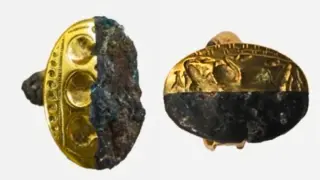
Researchers analyzed 91 Bronze Age iron objects from Greece and found 13 with meteoritic iron (nickel-rich), mostly ornate rings used by Minoan and Mycenaean elites; 78 items were made from smelted iron dating to as early as 1400 BCE, including two pieces older than 1200 BCE. The meteoritic iron was likely imported from Egypt and served as a prestige symbol in funerary contexts, with the meteoritic-ring fashion fading by around 1200 BCE.
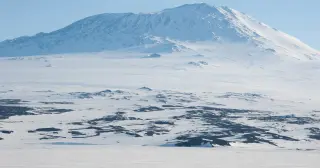
Antarctica’s blue-ice fields act as a natural sorting conveyor: flowing ice, mountains, and dry katabatic winds concentrate meteorites on vast ice surfaces, creating the world’s largest meteorite collection (more than 45,000 specimens, nearing 50,000 in total). While most rocks come from asteroids, a small fraction are lunar or Martian; programs like ANSMET recover, document, and freeze-store samples for researchers, turning a natural accident into a valuable, wide-ranging low-cost sample library. The hotspot locations depend on ice speed and climate, and the process is not permanent as ice movement can bury or wash away specimens.
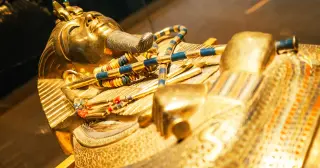
New analyses confirm Tutankhamun’s iron dagger is meteoritic iron, with nickel and cobalt ratios matching iron meteorites rather than terrestrial ore. Earlier 2016 results and a 2022 follow-up converge on a meteoritic origin and point to a close match with the Kharga meteorite, though the exact source remains uncertain. The dagger’s hilt and other iron artifacts are still under study, highlighting Bronze Age sky-iron use and the craft, trade, and linguistic context surrounding “iron of the sky.”
A refined model of the Sun's atmosphere shows the Sun contains about 55% more silver than earlier estimates, meaning silver isn't missing but was misread due to simplified models; the solar abundance now aligns better with ancient meteorites and resolves a decades-long discrepancy. The improvement comes from more realistic treatment of the Sun's outer layers and how silver atoms interact with light, rather than discovering new silver. Researchers say the Sun remains a key reference for understanding heavier elements in stars and plan to apply the method to other stars while checking for biases from other elements.
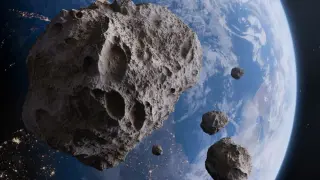
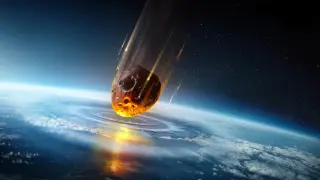
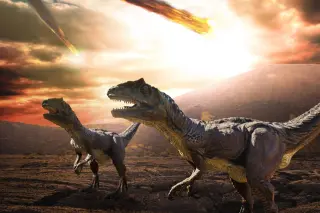
A new study suggests the asteroid that caused the dinosaur extinction was an exceptionally rare CO chondrite; nickel isotope measurements of a global KT clay layer link the impact to this meteorite, indicating that atmospheric debris and dust, rather than sulfur in the meteorite, played the primary role in the mass extinction.
A new study identifies Chicxulub’s impactor as a rare carbon monoxide–bearing chondrite, a meteorite type comprising about 5% of samples. While this confirms the asteroid theory for the dinosaurs’ extinction, researchers say atmospheric debris—not sulfur in the meteorite—was the main killer, and trace elements in a KT boundary clay point to an origin from the outer asteroid belt near Jupiter or the distant solar system.
A 2026 study of Northwest Africa 12774, an angrite meteorite, argues its unusually aluminium-rich clinopyroxene records formation under very high pressure (at least ~17.5 kilobars) inside a large parent body—potentially Moon-sized or larger—suggesting a planetary embryo once orbited the young Sun and may have vanished in a catastrophic collision while Earth was still forming. The interpretation does not reveal an orbit or Earth impact and does not prove all angrites come from such worlds; still, it shows meteorites can preserve mineral memories of large, long-gone planetary bodies.
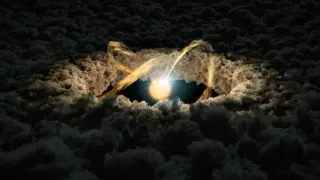
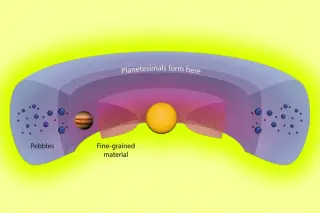
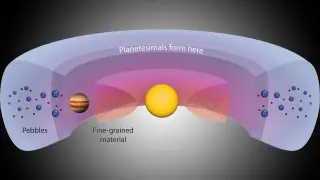
Astronomers used computer simulations to show a dust-trap ring just outside Jupiter’s orbit that concentrates material into two generations of planetesimals, potentially explaining carbonaceous chondrite meteorites found on Earth and highlighting the ring as a key birthplace for early planets in our solar system.
Simulations show a dust-loaded ring just outside Jupiter acted as a long-lasting dust trap, producing multiple generations of planetesimals with varied compositions over millions of years and linking to meteorite types like carbonaceous chondrites, offering insight into the Solar System’s early planet-building history.
New isotopic evidence suggests Earth formed largely from material in the inner Solar System, with Jupiter’s gravity acting as a barrier that kept outer Solar System material from mixing into Earth; while most building blocks were local, some water and possibly carbon may have arrived later from outer-body impacts.
New isotopic analyses of meteorites and early Earth rocks indicate Earth formed predominantly from material from the inner Solar System, with Jupiter’s gravity acting as a barrier that limited outer-Solar-System material; the planet’s overall isotopic composition is homogeneous, while water (and some carbon) likely arrived later from outer-body sources.
A Basque Country team analyzed six Martian meteorite slices and found traces of ballpoint-pen ink and other contaminants tied to sample processing, not Martian material. Using Raman spectroscopy, they identified seven contaminants, including a copper compound, printer-ink molecules, and blue polyester, across samples with and without prior processing. While analytic methods can distinguish these contaminants, the study underscores the lack of standardized, contamination-aware prep protocols and proposes steps to minimize leftovers as future Mars sample-return missions proceed.