
stargazing139.685 min read
Aug. 27–28, 2026: Deep Partial Lunar Eclipse Sparks Worldwide Skywatching
1 month ago•Source: Space

The latest stargazing stories, each synthesized from multiple sources with added background and context.

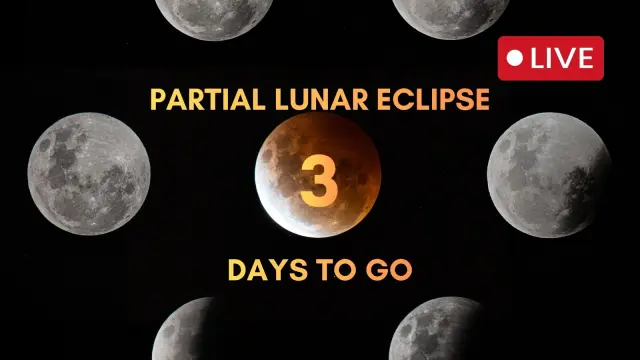
Space.com is live with updates for the Aug. 27–28 deep partial lunar eclipse, where up to 96.2% of the Moon will be in Earth's umbra at maximum, likely taking on a rusty reddish hue. This is the deepest partial lunar eclipse visible until the end of 2028, with the best views expected from the Americas and viewing tips provided for skywatchers.
Space•1 month ago
Space•1 month ago

Space.com’s live coverage explains that the Aug. 27–28, 2026 partial lunar eclipse will see up to 96.2% of the Moon enter Earth's umbra, producing a deep reddish hue and marking the deepest such event until 2028. Visible across the Americas, Europe, Africa and parts of western Asia, it’s a skywatching can’t-miss that will require clear, dark skies and a good view of the western horizon; Space.com will provide latest news and practical viewing tips for peak viewing.
Space.com is providing live coverage of the Aug. 12, 2026 total solar eclipse from two sites along the path of totality: Scoresby Sund in Greenland and Valoria la Buena in northern Spain. Observers will experience totality as the Moon fully covers the Sun and reveals the corona, while millions elsewhere will see a partial eclipse. Reporters Daisy Dobrijevic (aboard the MS Spitsbergen) and Anthony Wood (Spain) will deliver updates, weather notes, safety tips (eclipse glasses), and details about citizen-science efforts like DEB and NASA livestreams. The event marks Europe’s first total solar eclipse since 1999; totality lasts only a few minutes.
Space.com is live-covering the August 12, 2026 total solar eclipse from Greenland and northern Spain, with two reporting teams along the path of totality, updates on weather prospects, safety tips for viewing, and citizen-science involvement (DEB and Dynamic Eclipse Broadcast).
Space.com is counting down to the Aug. 12, 2026 total solar eclipse with live coverage from two locations along the path of totality—Greenland and northern Spain. The article notes that Europe, plus parts of the northeastern U.S. and eastern Canada, will see a partial eclipse, while the moon's shadow briefly darkens the sky along the path of totality. Skywatching editors Daisy Dobrijevic and Anthony Wood are reporting from Greenland's Scoresby Sund and from Valoria la Buena, Spain, respectively, bringing updates before and during totality. Viewers are reminded to wear certified eclipse glasses or use safe projection methods, and to be prepared for variable weather as the event approaches, with four days remaining until totality.
Space.com outlines a five‑day countdown to the Aug. 12, 2026 total solar eclipse, with Europe seeing a brief totality along a narrow path that crosses Greenland, Iceland, northern Spain and the Balearics; a partial eclipse will be visible across much of Europe and parts of the northeastern US and eastern Canada. The site will provide live coverage from two locations on the path—Daisy Dobrijevic aboard MS Spitsbergen in Greenland and Anthony Wood in Spain—plus viewing tips, weather caveats and reminders to use ISO‑certified eclipse glasses.

Space.com reports that Comet C/2025 R3 PanSTARRS displayed its ion tail as it passed about 45 million miles (72 million km) from Earth, with a dust tail lagging behind. The comet heated as it neared the Sun (perihelion on April 19) and then reached its closest approach to Earth around April 26, with SOHO imagery capturing the ion tail brightening and pointing away from the Sun.

Tonight after sunset (March 30), look northeast to spot the Big Dipper. Use its bowl-to-handle arc to guide your gaze to Arcturus, then follow up to Spica for another bright spring star—a quick, naked-eye sky-navigation trick ideal for learning the spring constellations; binoculars help reveal fainter stars if you want a closer look.

Tonight, March 26, 2026, the night sky features a 57%-illuminated Moon near Jupiter in Gemini after dark, with Sirius below and Castor and Pollux nearby—an accessible, binocular-friendly skywatching highlight.

Tonight (March 25) the first-quarter Moon will glow in the southern sky after dusk, appearing about four degrees from the bright planet Jupiter for a striking nocturnal pairing, while Saturn is approaching solar conjunction and will reappear in the pre-dawn sky in April; observers with binoculars or a telescope can enjoy a classic night-sky setup and learn the Moon’s changing phase as part of ongoing stargazing.

After dark on March 24, the Big Dipper rises in the northeastern sky while the Moon sits about 40% illuminated in the southwestern sky; use the Big Dipper’s pointer stars, Merak and Dubhe, to find Polaris in the north, and note the handle points toward Arcturus in the east-northeast as spring skies unfold.