Investment strategists are recommending a shift away from Nvidia due to leadership uncertainty and valuation concerns, favoring memory chipmakers Micron and Sandisk, as well as AI-driven drug developer Insilico Medicine, citing strong demand and low valuations.
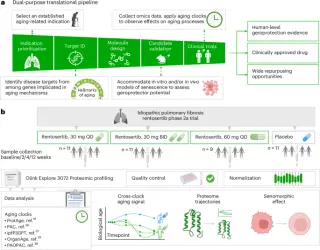
A new study published in Nature Biotechnology indicates that rentosertib, an AI-designed drug for idiopathic pulmonary fibrosis (IPF), may slow biological aging. In a 12-week trial with 42 participants, six different proteomic aging clocks showed that patients treated with the drug appeared biologically younger, with some estimates suggesting a reduction of 3 to 4 years. While the findings are promising, researchers emphasize that the results are preliminary and do not yet prove the drug extends lifespan or reverses aging in healthy individuals.
A small clinical trial found that rentosertib, an AI-designed drug for idiopathic pulmonary fibrosis (IPF), may slow biological aging. Patients appeared 3-4 years younger on blood protein tests, though researchers caution this is preliminary and does not prove longevity benefits.
A phase 2a trial of rentosertib, an AI-designed drug for lung fibrosis, showed that patients appeared biologically younger by 3-4 years on multiple aging clocks, though experts caution that results are preliminary and may reflect disease improvement rather than true anti-aging effects.
A phase 2a trial of rentosertib, an AI-designed drug for idiopathic pulmonary fibrosis (IPF), suggests it may slow biological aging by 3-4 years. Published in Nature Biotechnology, the study used six proteomic clocks to measure changes in blood proteins, finding that treated patients appeared younger. Researchers caution that the small sample size and disease-specific context limit conclusions, noting that anti-fibrotic effects may confound aging results. A larger phase 3 trial in China is underway to further investigate these dual-purpose outcomes.
A new study in Nature Biotechnology reports that rentosertib, an AI-generated drug developed by Insilico Medicine for idiopathic pulmonary fibrosis, reduced biological age markers in a 12-week phase 2a trial. While promising, experts caution that aging clocks are not yet universally validated, and the drug remains far from regulatory approval.
A phase 2a trial of rentosertib, an AI-designed drug for idiopathic pulmonary fibrosis, shows that the treatment significantly slowed biological aging across six proteomic clocks. While the drug improved lung function, the aging effects were distinct from disease improvement, suggesting potential dual-purpose benefits for aging and fibrosis.
Insilico Medicine reported that rentosertib, an AI-designed drug for idiopathic pulmonary fibrosis, reduced biological age markers in a small clinical trial. Published in Nature Biotechnology, the study analyzed blood samples from 42 patients using six independent proteomic aging clocks. While the drug showed potential to reverse aging indicators by up to three years, experts caution that the results may reflect lung health improvements rather than true anti-aging effects. The findings highlight the promise of AI in drug discovery but require larger trials to confirm efficacy.
Eli Lilly and Insilico Medicine have agreed to a commercialization deal valued at up to $2.75 billion (including $115 million upfront) to develop, manufacture, and bring to market Insilico’s AI-discovered preclinical oral drug candidates, with milestones tied to regulatory and commercial success. The companies deny rumors of a full acquisition, and specific asset details aren’t disclosed, though a GLP-1 candidate has been licensed to an undisclosed partner.
Eli Lilly agreed to a $2.75 billion deal to bring AI‑discovered drugs from Insilico Medicine to the global market, with $115 million upfront and remaining milestones plus royalties. Insilico has developed about 28 AI‑driven drug candidates, roughly half in clinical stages, and will join Lilly’s Gateway Labs; the collaboration—dating to a 2023 AI software license—aims to accelerate discovery across multiple disease areas as Lilly expands its AI‑driven R&D and China investment strategy.
U.S. drugmaker Eli Lilly is poised to sign a roughly $2 billion deal with Hong Kong-listed Insilico Medicine to use AI in drug discovery, securing exclusive rights to sell Insilico’s GLP-1 diabetes drug with an upfront $115 million and potential milestone payments that could lift the total beyond $2 billion, underscoring Lilly’s China-focused expansion and its heavy AI investment in pharma.
Insilico Medicine, an AI-driven biotech company, has developed an AI-designed drug, ISM5411, for inflammatory bowel disease (IBD) that has entered Phase I clinical trials. The drug targets a protein that regulates gut barrier protection genes and aims to treat IBD in a new way. Current IBD drugs have limitations, and ISM5411 is designed to promote mucosal repair and restore normal gut functioning. The drug is being tested for safety and tolerability in healthy volunteers, with plans for international multi-center trials. While promising, AI-generated drugs like ISM5411 may carry inherent risks and require public awareness and education as they move from research labs to clinical settings.
Insilico Medicine, an AI-driven biotech company, has announced that its AI-designed drug for COVID-19 has entered Phase I clinical trials. The oral drug, if approved, would become the first-ever alternative to Paxlovid and has shown effectiveness against all variants of the virus. It is also more stable and works for a longer period of time compared to Paxlovid. The new drug is easy to produce in large quantities and is currently being evaluated for safety and tolerability in healthy volunteers. The results of the clinical trials are expected to be released by the end of 2023.