Tag

Lambda Cdm

All articles tagged with #lambda cdm

JWST Spots Mature, Chaotic Galaxies in the Early Universe, Forcing Revisions to Early Formation Models
science9 days ago

JWST Spots Mature, Chaotic Galaxies in the Early Universe, Forcing Revisions to Early Formation Models

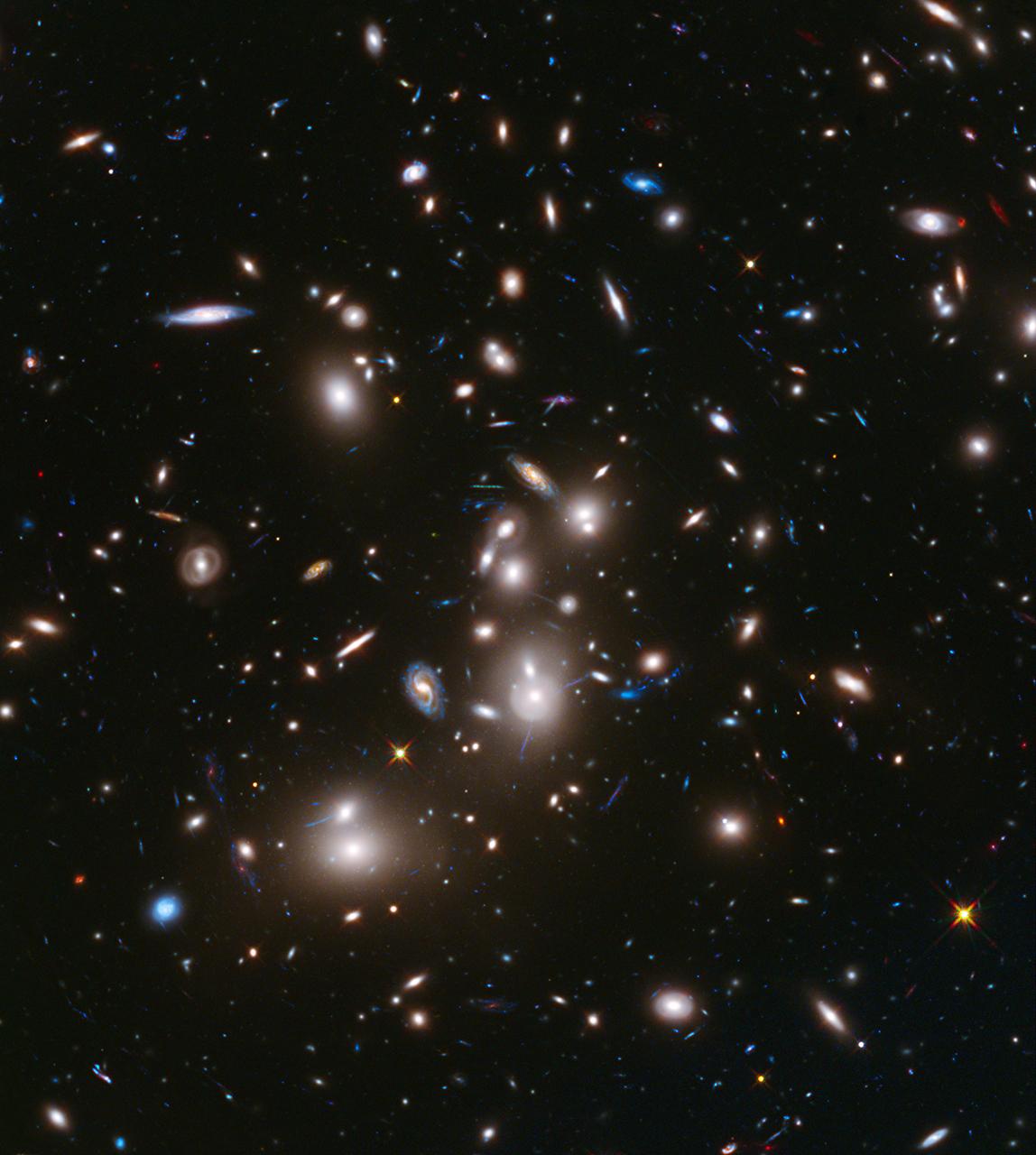
JWST observations of galaxies formed within the universe’s first billion years reveal unexpectedly massive, non-rotating, and dust-rich systems with chaotic morphologies. These findings strain the standard Lambda-CDM prescriptions for early star formation efficiency, feedback, and assembly, suggesting the need to revise the models rather than overturn the overall cosmology. Spectroscopic follow-up and updated cosmological simulations are underway to identify which parameters (star-formation efficiency, IMF, dust corrections, etc.) must be adjusted, while Lambda-CDM itself remains intact at large scales.

DESI's 3D universe map hints dark energy is weakening, sparking a cosmology rethink
space1 month ago

DESI's 3D universe map hints dark energy is weakening, sparking a cosmology rethink

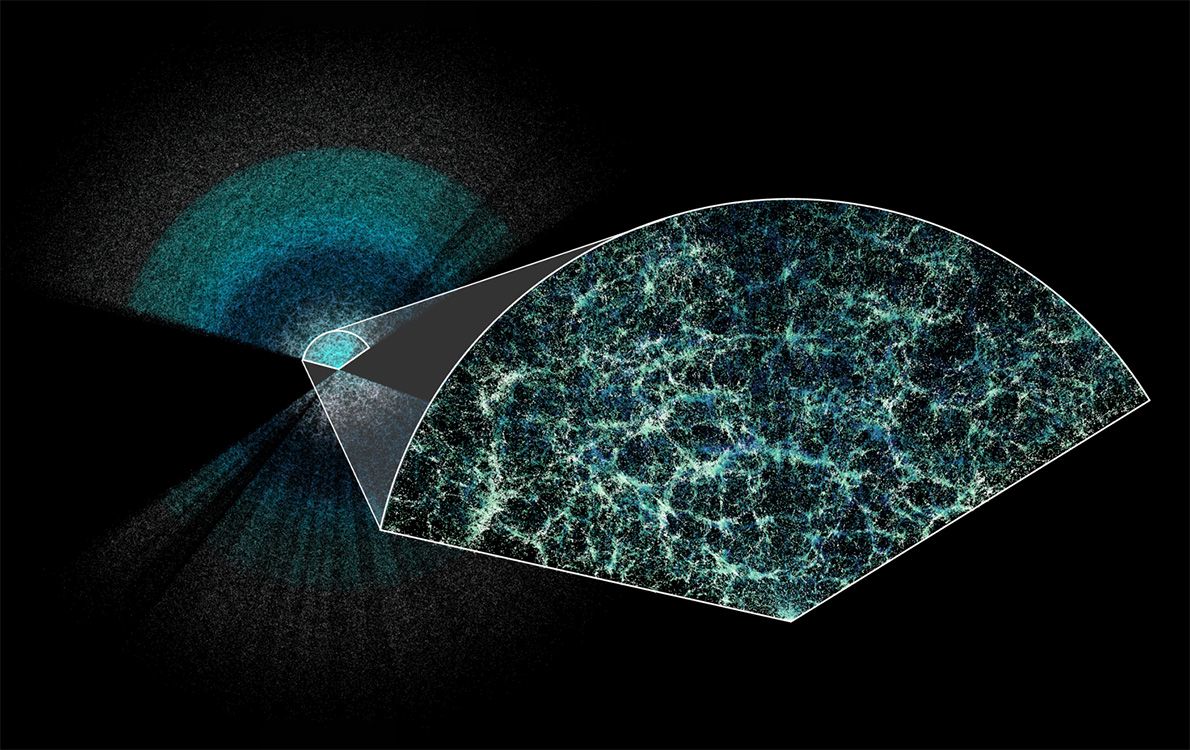
DESI finished its five-year survey, delivering the largest-ever 3D map of the cosmos (about 47 million galaxies/quasars and 20 million stars). Early analyses suggest dark energy may be weakening, a finding that could challenge the Lambda-CDM cosmology and signal a major shift in our understanding of the universe; further data from the full map are expected.

DES six-year dataset teases possible cracks in the dark-energy picture
science3 months ago

DES six-year dataset teases possible cracks in the dark-energy picture

A six-year analysis from the Dark Energy Survey finds results largely consistent with the standard lambda-CDM cosmology (constant dark energy density) but also fits the evolving-energy wCDM model. Hints of late-time discrepancies in how galaxies cluster could point to new physics, though nothing is yet conclusive (not five-sigma). The DES team plans to explore alternative gravity models and other fits with forthcoming data, with 19 papers detailing the analysis.

570-Megapixel Eye Maps the Cosmos, Tightening Dark Energy Clues
space3 months ago

570-Megapixel Eye Maps the Cosmos, Tightening Dark Energy Clues

The Dark Energy Survey used the 570‑megapixel Dark Energy Camera on the Blanco telescope to combine weak lensing, galaxy clustering, BAO, Type Ia supernovae, and other probes over six years, delivering the clearest expansion history of the Universe to date and broadly supporting the standard Lambda-CDM model while noting a remaining tension, with the Rubin Observatory’s decade‑long Legacy Survey approaching.

Dark matter–neutrino interaction hints at a cosmology breakthrough
physics-and-mathematics4 months ago

Dark matter–neutrino interaction hints at a cosmology breakthrough

Researchers report a 3-sigma hint that dark matter and neutrinos may interact, transferring momentum and potentially reducing the universe’s observed clumpiness. If confirmed, this could require updates to the lambda-CDM model and help address the S8 tension between early- and late-universe measurements. The finding combines Planck/ACT early-universe data with BAO and cosmic-shear observations and simulations, but it remains unproven and will hinge on forthcoming data from surveys like the Vera Rubin Observatory for confirmation. A confirmed interaction would constitute a fundamental breakthrough in cosmology and particle physics.

Elusive Particles May Interact, Redrawing Our Cosmic Map
science4 months ago

Elusive Particles May Interact, Redrawing Our Cosmic Map

A new study suggests a possible though not yet proven interaction between dark matter and neutrinos with a coupling strength around 10^-4, which could help explain why the universe is less clumpy than early-universe data alone would predict. By analyzing cosmic shear data from both early and late universe observations (ACT, Planck, DES, and SDSS), researchers propose that such interactions could influence structure formation without overturning the ΛCDM model. The finding sits at about 3 sigma significance, far from definitive proof, but it offers a potential direction for future telescope surveys and laboratory experiments to probe dark matter properties further.

Exploring the Concept of Dark Matter in the Universe
science11 months ago

Exploring the Concept of Dark Matter in the Universe

Martín López-Corredoira challenges the mainstream cosmological model that relies on dark matter, arguing that there is no evidence for an elusive dark matter particle and suggesting alternative explanations like modified gravity and baryonic matter. The article reviews the history of dark matter detection and criticizes the focus on the Big Bang and related phenomena, proposing that the universe could be understood without these unobserved components.

"Evolution of Dark Energy: Insights from the Largest 3D Map of the Universe"
astronomy2 years ago

"Evolution of Dark Energy: Insights from the Largest 3D Map of the Universe"

The largest 3D map of the universe, created by the Dark Energy Spectroscopic Instrument (DESI), suggests that dark energy, which makes up 70% of the universe, may evolve with time rather than remain constant. This challenges the prevailing Lambda CDM model and could lead to a paradigm shift in cosmology. The map, which includes high-precision measurements of the universe's expansion rate over the past 11 billion years, indicates a potential transition in the influence of dark energy on the universe's acceleration. Further observations are needed to confirm this finding and explore alternative models of the universe.

Standard model of cosmology supported by galaxy clusters.
astronomy3 years ago

Standard model of cosmology supported by galaxy clusters.

Physicists at the Department of Energy's SLAC National Accelerator Laboratory and Stanford University have found new evidence for the standard model of cosmology by making detailed measurements of the X-ray emission from galaxy clusters, which revealed the distribution of matter within them. The data helped the scientists test the prevailing theory of the structure and evolution of the universe, known as Lambda-CDM. The team found consistent results from both data sets: Overall, clusters have become more centrally concentrated over time, while at any given time, less massive clusters are more centrally concentrated than more massive ones.