Tag

Neurodevelopmental Disorders

All articles tagged with #neurodevelopmental disorders

36 Genes Link OCD, Tourette's, and Autism in Large Neurogenetics Study
science1 month ago

36 Genes Link OCD, Tourette's, and Autism in Large Neurogenetics Study

A large Nature Neuroscience study analyzed exome data from roughly 4,000 individuals with OCD and/or chronic tic disorders (CTD) and found 36 high-impact risk genes, with substantial overlap between OCD and CTD and links to autism and schizophrenia. The researchers mapped these genes to brain circuits, notably the cortico-striato-thalamo-cortical loop, showing prenatal and postnatal expression in the cortex, striatum, thalamus, and cerebellum, and suggesting networks of genes rather than single culprits. This expanded set of targets could guide future therapies tailored to neural pathways across neurodevelopmental conditions.
Reactivating hippocampal PV interneuron plasticity reverses deficits in a neurodevelopmental disorder model
science1 month ago

Reactivating hippocampal PV interneuron plasticity reverses deficits in a neurodevelopmental disorder model

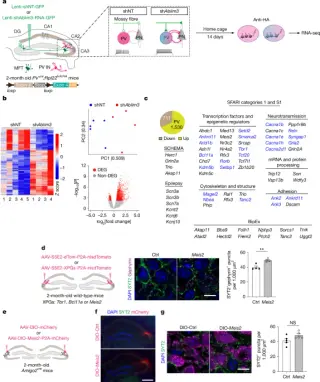
Researchers identify regulators of experience-dependent PV interneuron plasticity (XPGs) in the CA3/CA2 hippocampal circuit and show that adult upregulation of the Meis2 gene in PV interneurons restores this plasticity. This restoration improves ensemble activity and sharp-wave ripple dynamics, reduces seizures, and enhances cognition in a CNTNAP2-based neurodevelopmental disorder model, suggesting PV interneuron plasticity as a convergent, targetable mechanism to reverse developmental circuitry and cognitive deficits.

Birth Order Across the Human Phenome: Broad Patterns in Disease Risk
health2 months ago

Birth Order Across the Human Phenome: Broad Patterns in Disease Risk

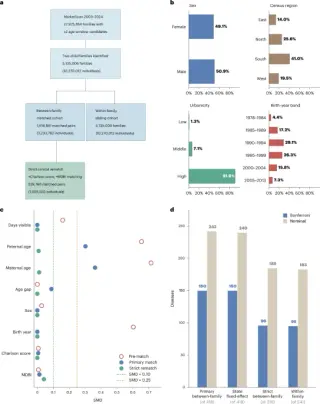
Two designs in over 5 million two‑child families from Merative MarketScan scanned 569 diseases. The primary between‑family matched cohort (1.6 million pairs) and a within‑family sibling comparison (5.1 million families) identified 150 Bonferroni‑significant birth‑order associations among 418 diseases. First‑borns have higher risk for neurodevelopmental and immune/allergic conditions (e.g., other/unspecified PDD, autism, food allergy, allergic rhinitis) while second‑borns show higher odds for substance‑abuse disorders and certain digestive diseases (gastritis/duodenitis). Across designs, effects are broadly concordant (r ≈ 0.66; 74% concordant; 84.7% of Bonferroni hits agree in direction), robust to state fixed effects and full‑sibling restrictions. A phenome‑wide atlas reveals domain‑specific patterns: first‑born excess dominates neuropsychiatric conditions; second‑born excess appears in digestive, musculoskeletal, infectious and some neurological diseases. The study provides a comprehensive, robust map of birth‑order influences on human disease and shows spacing between siblings can modulate several associations.

6 Million Genomes Uncover Shared Genetic Threads Across Mental Illnesses
science6 months ago

6 Million Genomes Uncover Shared Genetic Threads Across Mental Illnesses

A large international genetic study of over 6 million people finds that major psychiatric disorders share substantial genetic risk, clustering into five broad groups (compulsive disorders; schizophrenia and bipolar; neurodevelopmental disorders; internalizing disorders; and substance-use disorders). The work links these patterns to specific brain cell types and argues for a biology-based reclassification of mental illness and treatments that target shared pathways, while noting that genetics influence risk but environmental factors also shape outcomes.

Base editing reverses CHD3-linked neurodevelopmental defects in mice
science7 months ago

Base editing reverses CHD3-linked neurodevelopmental defects in mice

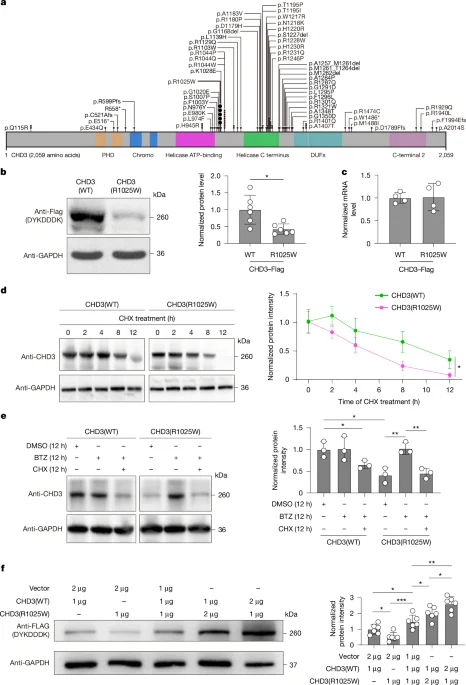
Researchers created a humanized CHD3 R1025W mouse model of SNIBCPS and used a TadA-embedded adenine base editor delivered by dual AAVs to correct the pathogenic A•T base pair in the brain, restoring CHD3 protein levels and rescuing social, cognitive, and motor deficits; supplementary nonhuman primate work showed widespread neuronal transduction, supporting translational potential for CHD3-related neurodevelopmental disorders.