Tag

Population

All articles tagged with #population

Eight Billion Alive, Seven Percent of All Humans Born: A Fresh Look at Our Place in History
science9 days ago

Eight Billion Alive, Seven Percent of All Humans Born: A Fresh Look at Our Place in History

About 117 billion people have ever been born; with roughly 8 billion alive today, that’s ~7% of everyone who has ever lived. The figure comes from a model by demographers Haub and Kaneda and is inherently uncertain due to sparse historical data, relying on assumptions about how long humanity has existed, past populations, and birth rates. Because life expectancy was very low for most of history, recent population growth has made the living share larger, with estimates for those who reached 65 ranging roughly from 5.5% to 9.5% of all who ever lived.

Swiss voters reject bid to cap population at 10 million
world27 days ago

Swiss voters reject bid to cap population at 10 million

Swiss voters rejected the far-right SVP’s plan to cap the population at 10 million by 2050 (54.79% against, 45.21% in favour) with a 58.86% turnout. The proposal would have forced limits on family reunification and residency and risked withdrawal from the EU free-movement agreement if the cap was approached, prompting warnings from the government and business groups about harm to the economy and EU ties.

Swiss voters reject plan to cap population at 10 million by 2050
politics27 days ago

Swiss voters reject plan to cap population at 10 million by 2050

Swiss voters rejected a right-wing proposal to cap the population at 10 million by 2050, with about 54% voting against and 59% turnout, in 25 of 26 cantons reporting. The result preserves Switzerland’s bilateral path with the EU and keeps immigration concerns on the political agenda, avoiding a potential clash over free movement as the population nears 10 million.

Japan’s 2025 census shows record population decline, with Tokyo bucking the trend
world1 month ago

Japan’s 2025 census shows record population decline, with Tokyo bucking the trend

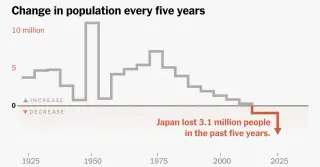
Japan’s 2025 census shows total population falling to 123.05 million—down about 3.09 million (2.5%) from 2020—marking the steepest decline on record. The drop occurred in 45 prefectures, while Tokyo and Okinawa grew. Tokyo added about 199,000 people to stay the most populous, and households rose 2.3% to 57.12 million as average household size fell to 2.15, signaling more single-person homes.

Japan Faces Historic Population Drop as Aging Crisis Deepens
world1 month ago

Japan Faces Historic Population Drop as Aging Crisis Deepens

Japan’s population fell by more than 3 million in five years, to 123 million in 2025 from 126.1 million in 2020, the largest decline since census data began in 1920. The aging population and ultra-low birth rates are driving declines across nearly all prefectures, with rural areas hardest hit, while Tokyo’s metro area remains dense and continues to grow. Experts warn that reversing the trend will require mass immigration to offset demographic headwinds.

Most of the World Is Below Replacement Fertility, Reshaping Aging Populations
demographics1 month ago

Most of the World Is Below Replacement Fertility, Reshaping Aging Populations

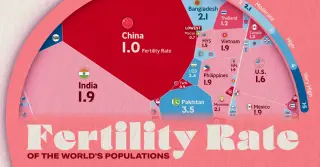
A Voronoi-style visualization of fertility rates across 236 countries shows about 71% of the global population lives in countries with below-replacement fertility (2.1 births per woman). India (~1.94) and China (~1.02) sit below replacement, while Sub-Saharan Africa has the highest rates (Chad 5.94, Somalia 5.91, DR Congo 5.90). Fertility has fallen from about five births per woman in the 1960s to a 2024 global average of roughly 2.2, with future growth increasingly concentrated in high-fertility regions, shaping aging populations, labor markets, and long-term demographics. The data come from the UN World Population Prospects 2024 Revision, using 2025 estimates.

Prosperity's paradox: shrinking global workforce ahead
science2 months ago

Prosperity's paradox: shrinking global workforce ahead

Global population is projected to decline by about a billion from its peak this century, not due to war or disease but rising wealth, education, and longevity leading to fewer births. The sharpest drops are in rich economies, shrinking the working-age population and risking slower growth, with shortages emerging in sectors like teaching, engineering, and nursing. Solutions call for a “revolution of minds”—automation/AI and upskilling—to keep economies afloat as the human base contracts.

Immigration Slowdown Reshapes U.S. Metro Demographics
society3 months ago

Immigration Slowdown Reshapes U.S. Metro Demographics

New Census Bureau estimates show net immigration fell in every U.S. metro area in 2025, with large urban and border counties hit hardest. About 75% of counties saw slower or negative overall population growth as births lag and immigration remains suppressed, with Los Angeles County losing about 54,000 residents, NYC around 12,000, and Miami-Dade more than 10,000, even as the nation overall grew by 1.8 million—one of the slowest growth rates in history. Experts warn that continuing low immigration could erode the country’s demographic cushion and labor force, posing long‑term economic and housing challenges for cities and regions that once depended on immigration to fuel growth.

Rural Undercounts May Boost Earth's Population Estimates
science5 months ago

Rural Undercounts May Boost Earth's Population Estimates

Aalto University researchers analyzed 300 rural dam-relocation projects across 35 countries from 1975–2010 and found rural populations are undercounted by 53%–84% in several global datasets, suggesting that Earth's population may be higher than the commonly cited ~8.2 billion; the finding could affect how countries allocate resources, though some experts remain skeptical and say decades of population data would need overhaul, and more evidence is required.

8.2 Billion and Counting: A Country-by-Country Population Visualization
demographics5 months ago

8.2 Billion and Counting: A Country-by-Country Population Visualization

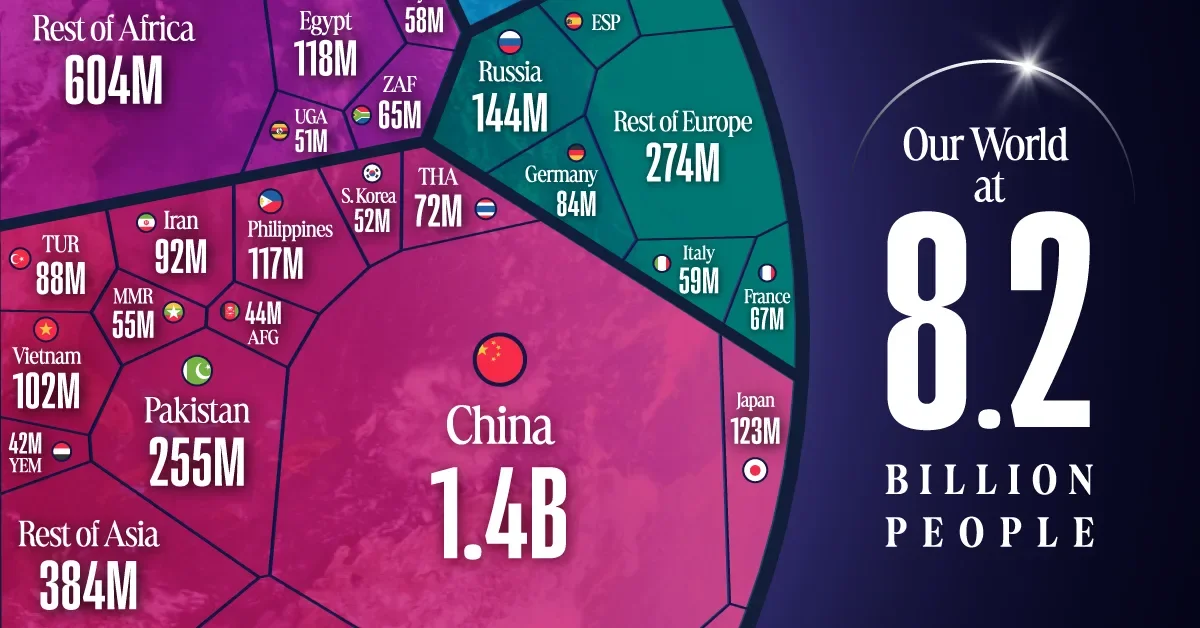
Global population surpassed 8.2 billion in 2025, with India contributing roughly a quarter of that growth and nearing 1.46–1.5 billion while China declines; the United States is around 347 million, and Nigeria is projected to overtake the U.S. by 2050. The Visual Capitalist graphic visualizes 204 countries’ populations using UN data, highlighting aging trends in Europe (Italy and Greece shrinking) and broader demographic shifts.

Coastal martens mapped: OSU study reveals habitat preferences and a 46-individual snapshot
science5 months ago

Coastal martens mapped: OSU study reveals habitat preferences and a 46-individual snapshot

Oregon State University researchers conducted a three-month study in 2022 in a 150-square-mile coastal area near Klamath to map the coastal marten’s population and habitat using hair-based genetic analysis, identifying 46 martens (28 males, 18 females). Martens favored high-elevation, snow-rich ridges and lower-elevation riparian/coastal forests with complex structure—forests with more than 50% canopy, many large trees, snags, and coarse woody debris. The coastal marten, once ranging from northern Oregon to northern California, declined due to fur trapping; current distribution and demography remain incompletely understood, underscoring the need for further conservation-focused research.