Tag

Sensor Technology

All articles tagged with #sensor technology

Sensor-equipped World Cup ball helps VAR call: Croatia’s late equalizer ruled out
world1 month ago

Sensor-equipped World Cup ball helps VAR call: Croatia’s late equalizer ruled out

Portugal advanced after a stoppage-time drama when FIFA’s new Trionda World Cup ball, containing IMU sensors, provided real-time data to VAR to overturn Croatia’s last-minute equalizer. A tiny touch from Matanović on the ball led to Pašalić being offside before Gvardiol scored, a call FIFA described as proven thanks to ball data and a heartbeat visualization. Croatia criticized the decision and VAR, while Portugal’s coach credited the technology for clarity. The story also notes NBA trials of a sensor-enabled ball.


Fujifilm Considers Merging X-H2 and X-H2S into X-H3
technology8 months ago

Fujifilm Considers Merging X-H2 and X-H2S into X-H3

The article discusses whether Fujifilm should merge its X-H2 and X-H2S cameras into a single X-H3 model, weighing the benefits of a unified sensor with high resolution and speed against maintaining two distinct models to serve different photographer needs. The author favors keeping the lines separate to cater to resolution-focused and speed-focused users, citing sensor technology and user shooting habits as key considerations.

"Apple Watch Patent: Your Personal Digital Pool Attendant"
technology2 years ago

"Apple Watch Patent: Your Personal Digital Pool Attendant"

Apple has filed a patent for future Apple Watch models to serve as personal digital pool assistants, using sensor data to detect irregular behavior in swimmers and alert nearby devices if someone is in distress, potentially preventing drowning incidents. This feature could be deployed in various types of freshwater pools and aims to address the significant issue of drowning-related deaths, although the filing does not guarantee its materialization.

"Exponential Sound Wave Amplification with Topological Metamaterial"
science-and-technology2 years ago

"Exponential Sound Wave Amplification with Topological Metamaterial"

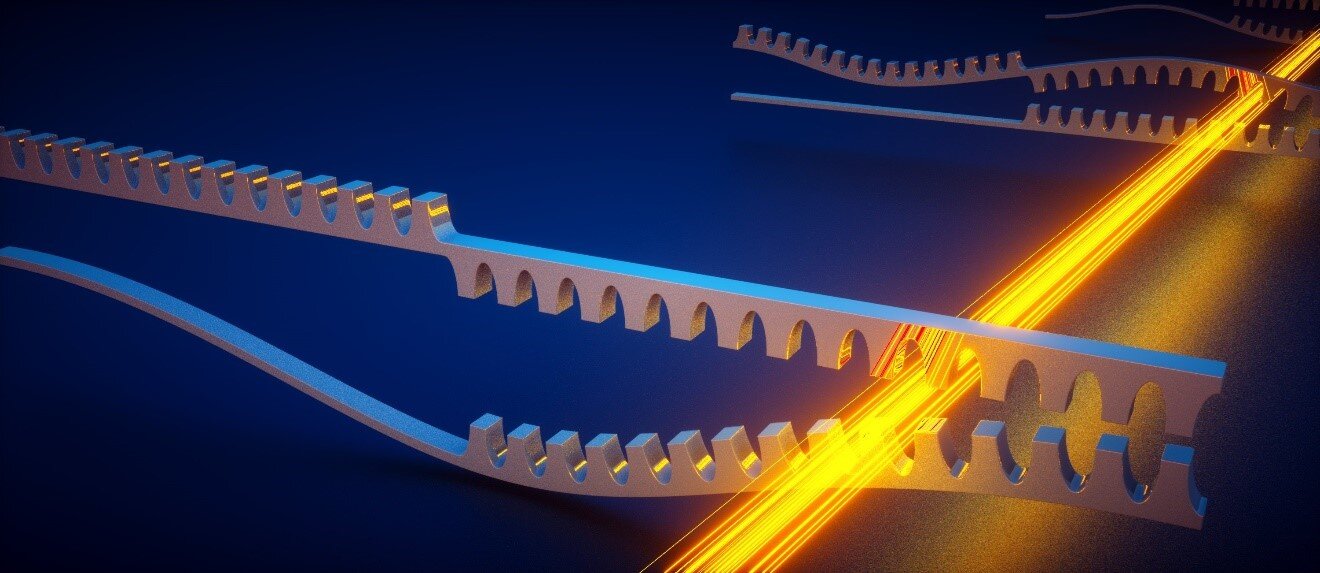
Researchers have created a new topological metamaterial, the bosonic Kitaev chain, which amplifies sound waves exponentially through the use of nanomechanical resonators and laser light. This synthetic material exhibits unique directional amplification properties and is a new topological phase of matter, potentially offering applications in sensor technology and quantum technology. The discovery, published in Nature, could lead to improved sensor performance and signal manipulation capabilities.

"Wireless Sensor Detects Chemical Warfare Agents"
technology2 years ago

"Wireless Sensor Detects Chemical Warfare Agents"

Scientists have developed a groundbreaking sensor using surface acoustic wave (SAW) technology that can wirelessly detect chemical warfare agents, such as dimethyl methylphosphonate (DMMP), without the need for direct power sources or physical connections. This innovative device offers highly sensitive and reliable monitoring in challenging environments, marking a significant advancement in safety technology for both military and civilian defense operations.

"Remote Chemical Weapon Detection Sensor Developed by Chinese Scientists"
science-and-technology2 years ago

"Remote Chemical Weapon Detection Sensor Developed by Chinese Scientists"

Chinese scientists have created a wireless sensor capable of remotely detecting chemical warfare agents, offering potential improvements in public safety by monitoring these substances. The sensor can identify stimulants for nerve agents and other chemical warfare agents, providing a passive and effective method for detection.

"Self-Powered Sensor Harnesses Magnetic Energy for Automatic Energy Harvesting"
technology2 years ago

"Self-Powered Sensor Harnesses Magnetic Energy for Automatic Energy Harvesting"

MIT researchers have developed a self-powered sensor that can harvest energy from its environment, eliminating the need for batteries or special wiring. The sensor, which can be embedded in hard-to-reach places, such as inside a ship's engine, gathers data on power consumption and operations for extended periods. The researchers offer a design guide for an energy-harvesting sensor that can be applied to various power sources, making it suitable for factories, warehouses, and commercial spaces. The sensor's energy management system addresses challenges such as cold starting, energy storage, and control algorithms, enabling it to operate without a battery and transmit data using Bluetooth.

Backlash against campus surveillance as sensors invade buildings
technology2 years ago

Backlash against campus surveillance as sensors invade buildings

Students and professors at various universities, including Queen Mary University of London, Northeastern University, and the University of Leiden, are protesting against the installation of sensors in buildings. These sensors, often referred to as cameras, are being used to monitor building occupancy and optimize space utilization. However, critics argue that the sensors invade privacy and raise concerns about the use and security of the collected data. Some universities have faced backlash and abandoned their plans due to privacy and data protection concerns. The issue of surveillance in university campuses raises questions about control over technology and its potential disciplinary use.

"International Companies Collaborate on Advanced Sensor Technology for GCAP Warplane"
defense-technology2 years ago

"International Companies Collaborate on Advanced Sensor Technology for GCAP Warplane"

Japan, Italy, and the UK are collaborating on the Global Combat Air Program (GCAP) to develop a sixth-generation fighter jet. The partners aim to define the sensor hardware by mid-2025 and establish a joint venture to allocate work share. The sensor package will include multi-function sensing nodes and a Multi-Function Processor (MFP) to enhance situational awareness. The radar, known as the Multi-Function Radio Frequency System, will be designed with fewer constraints on size, weight, and power. The partners plan to deliver initial capability by 2035 and continue development beyond that, with flexibility to adapt to evolving threats.