Tag

Synthesis

All articles tagged with #synthesis

UCL Researchers Generate Atomic Hydrogen in Solution Using Simple LED Light
science26 days ago

UCL Researchers Generate Atomic Hydrogen in Solution Using Simple LED Light

Researchers at University College London have successfully generated isolated hydrogen atoms in a liquid solution at room temperature, a feat previously thought impossible for synthetic chemists. By mixing hydrazine and thiophenol and exposing them to near-ultraviolet light from a standard LED, the team created a reactive radical without needing toxic mercury or extreme heat. This method offers a metal-free alternative for hydrogenation reactions, potentially reducing reliance on expensive catalysts like palladium in drug manufacturing.
science2 months ago

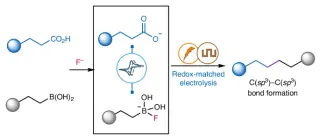
Palladium catalysis unlocks precise ketone homologation via decarboxylative rearrangement

Jing Gong, Qian Wang, and Jieping Zhu from EPFL have published a new method for ketone homologation in Nature. The approach uses palladium(II)/palladium(IV) catalysis to convert beta-hydroxy carboxylic acids into ketones. Unlike older electrochemical methods that suffer from side reactions and loss of stereochemical data, this new pathway is concerted. It allows for precise control over stereochemistry, retaining the configuration of the migrating carbon while inverting the alpha-stereocenter. The method avoids hazardous diazo reagents and demonstrates high selectivity for unsymmetrical ketones. The authors validated the technique by using it as a key step in the total synthesis of (+)-rupestine D.

science3 months ago

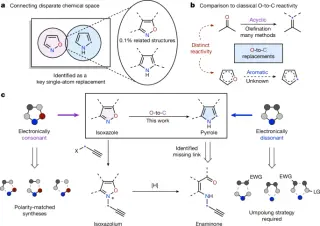
New method shifts pyridine nitrogen to unlock drug isomers

Researchers at the Institute for Basic Science (IBS) have developed a novel synthetic method to directly convert pyridine positional isomers by transposing the nitrogen atom within the ring. Published in Nature, the technique allows chemists to alter the position of the nitrogen atom while keeping existing substituents intact, bypassing the need for separate, complex syntheses for each isomer. The method, which involves temporary ring expansion and nitrogen insertion/deletion, achieved yields of up to 88% and was successfully applied to known drugs like vismodegib and abiraterone acetate to generate new candidates.

science3 months ago

Phosphine catalysts enable direct C–H coupling with water and ammonia

Researchers at Colorado State University and the University of Zaragoza have developed a new method for modifying organic molecules using simple triarylphosphine catalysts. This approach allows for the direct coupling of azine C–H bonds with water and ammonia, bypassing the need for transition metals. The technique offers a viable pathway for late-stage functionalization of pharmaceuticals and agrochemicals, enabling the introduction of hydroxyl and amino groups through a distinct mechanism involving neighboring group participation.

Lab-Forge Confirms Hexagonal Diamond, Ending a Half-Century Controversy
physics-and-chemistry8 months ago

Lab-Forge Confirms Hexagonal Diamond, Ending a Half-Century Controversy

Chinese researchers report the synthesis of a millimeter-sized, phase-pure hexagonal diamond by compressing graphite at 20 GPa and temperatures up to 1,900°C, with X-ray and atomic-scale imaging confirming a hexagonal crystal structure; the diamond is slightly harder and more oxidation-resistant than cubic diamonds, suggesting the long-sought material exists and could have practical uses, though the hardness gain is not the often-cited 50%.

Lab-Grown Diamonds Now Possible in Just 15 Minutes
science-and-technology1 year ago

Lab-Grown Diamonds Now Possible in Just 15 Minutes

Scientists have developed a method to create diamonds at room temperature and pressure in just 15 minutes, using a gallium-silicon mix in a special chamber. This new technique, led by Rodney Ruoff, eliminates the need for high-pressure, high-temperature conditions and a starter gem, making diamond synthesis more efficient. Although the diamonds produced are too small for jewelry, they hold potential for technological applications. The breakthrough could significantly impact the commercial production of synthetic diamonds in the future.

Scientists Synthesize Volcanic Crater Antibiotic
science2 years ago

Scientists Synthesize Volcanic Crater Antibiotic

Japanese researchers have successfully reverse-engineered antibiotic molecules originally found in a Cameroonian volcanic crater, using retrosynthetic analysis to synthesize β- and γ-naphthocyclinone. This breakthrough allows for the production of these compounds in larger quantities without relying on natural sources, potentially aiding in the fight against infections. The methods developed could also be applied to synthesize other complex molecules in future research.

Scientists Create Diamonds from Scratch in 15 Minutes
science2 years ago

Scientists Create Diamonds from Scratch in 15 Minutes

Scientists have developed a new technique to synthesize diamonds in just 15 minutes at normal atmospheric pressure without needing a starter gem. This breakthrough, detailed in a study published in Nature, uses gallium and silicon in a graphite crucible with super-hot carbon-rich methane gas. While the process still requires refinement, it promises to make diamond creation more accessible and eliminate several drawbacks of traditional synthesis methods.

"Revolutionizing Aromaticity: The Impact of a New Carbon Allotrope"
science2 years ago

"Revolutionizing Aromaticity: The Impact of a New Carbon Allotrope"

Chemists have recently made breakthroughs in synthesizing cyclocarbons, a new carbon allotrope, which has led to a reevaluation of the concept of aromaticity. These cyclocarbons have been created on surfaces using advanced single-atom manipulation techniques, revealing unexpected aromatic properties. The next challenge is to stabilize cyclocarbons under ambient conditions and explore their potential applications in creating new carbon materials and unique chemistry. Despite the lack of immediate practical applications, the study of cyclocarbons deepens our understanding of fundamental chemical concepts and has the potential to open up new avenues in molecular engineering.

"Surprising Discovery: Gold Buckyballs and Nanoparticle 'Seeds' are Identical"
science-and-technology3 years ago

"Surprising Discovery: Gold Buckyballs and Nanoparticle 'Seeds' are Identical"

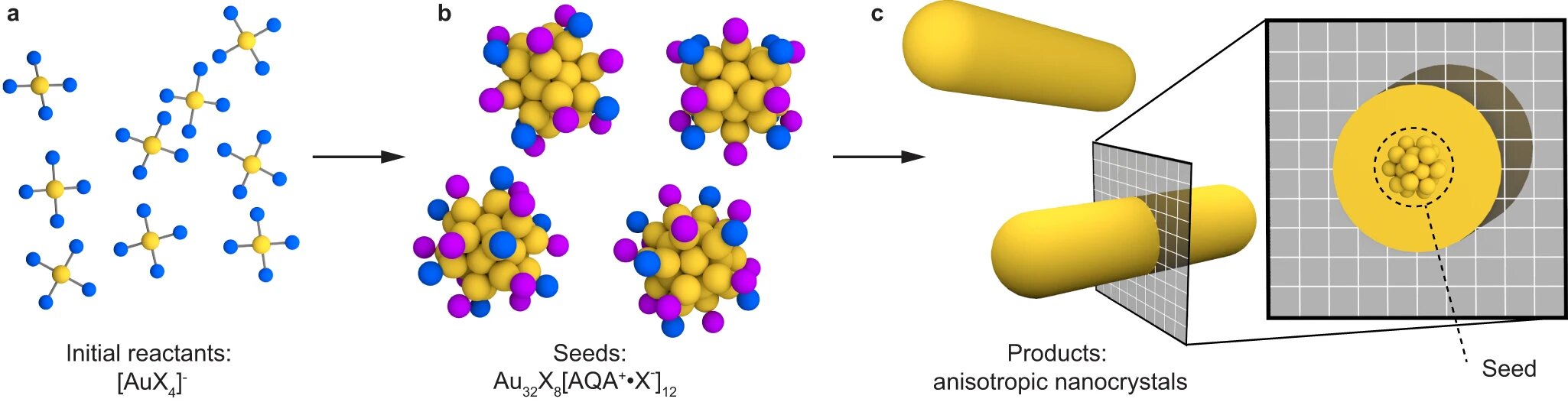
Chemists at Rice University have discovered that the tiny gold "seed" particles commonly used in nanoparticle synthesis are actually gold buckyballs, 32-atom spherical molecules. This finding could help researchers understand the mechanisms behind nanoparticle synthesis and improve control over particle shape and properties. The distinction between nanoparticles and molecules is crucial for advancing nanoscience and achieving precise control over matter.

"Scientists Create Single-Crystalline Iron Resembling Earth's Core"
science3 years ago

"Scientists Create Single-Crystalline Iron Resembling Earth's Core"

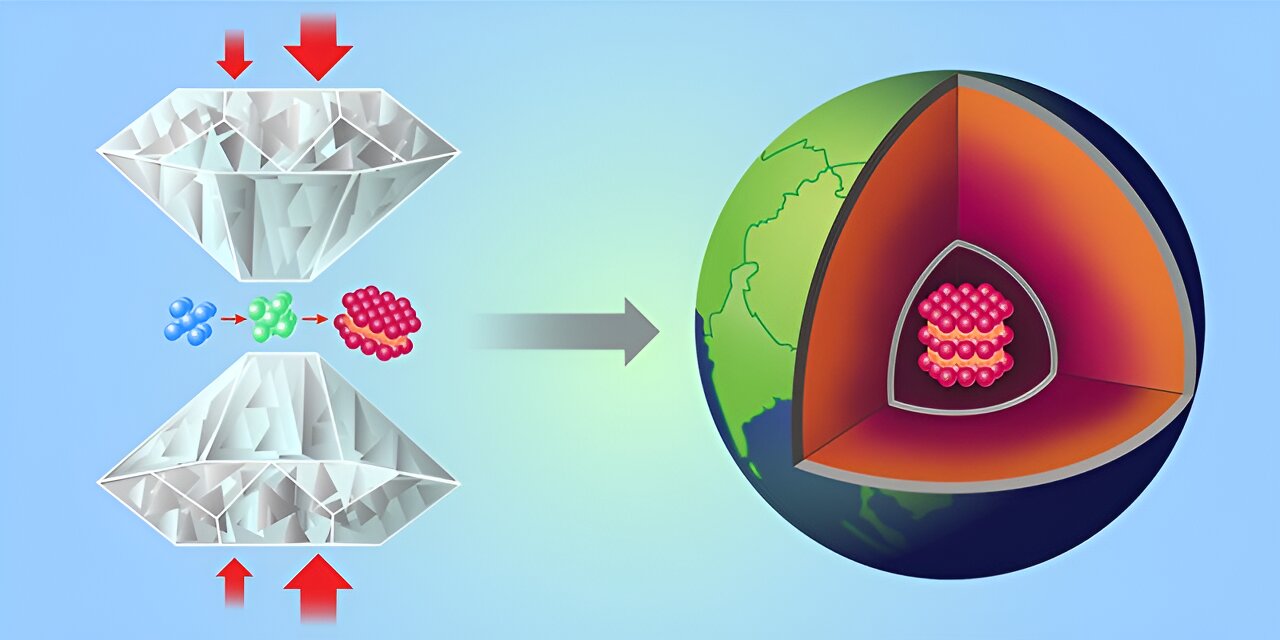
Physicists and geologists have successfully synthesized single-crystalline iron in a form that is likely found in Earth's core. By compressing a specific crystalline orientation of iron, the researchers were able to create pure single-crystalline ε-iron, which exhibits similar properties to iron in the Earth's core. This breakthrough could help answer questions about the structure and composition of the core and provide insights into Earth's internal composition.