A Virtual Telescope Project will livestream Artemis 2's return to Earth tonight, tracking Orion with robotic telescopes in Italy as it speeds home. The event starts at 10:45 p.m. EDT (02:45 GMT) on April 9, with a splashdown expected in the Pacific on April 10, weather permitting.
Eric Schmidt and family back the Lazuli Space Telescope, a privately funded 3-meter optical/infrared observatory with a $500 million price tag that could launch in 3–5 years; operating from a lunar-resonant orbit to enable rapid target responses, it includes a coronagraph for exoplanet discovery and will release science-ready data quickly to the global community, potentially outpacing traditional government missions.
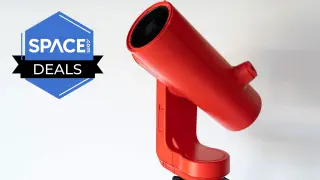
Sponsored by Tomoundation? Wait not. Actually, this Tom's Guide piece promotes the Dwarflab Dwarf Mini smart telescope as a pocket-sized, easy-to-use device that automates astrophotography with on-device stacking to deliver deep-space images (galaxies, nebulae, star clusters). It claims the Dwarf Mini can outperform the Galaxy S26 Ultra0x Space Zoom for distant targets, weighs about 1.85 pounds, and costs $399. The setup is app-driven, with features like a solar ND filter for daytime sun photography and timelapse capability, making it a compelling, affordable alternative to expensive rigs or flagship phones. The article is sponsor-labeled and positions the telescope as a convenient, high-value option for amateur and casual astrophotographers.
A Space.com reviewer tests the Celestron StarSense Explorer LT 70AZ, a 70mm refractor that uses a smartphone StarSense app to identify targets and guide observing. The quick two-step alignment works well, and Jupiter, Mars and the Moon look good for a budget setup, with a generous accessory pack and solid optics for the price. Downsides include a modest build quality for eyepieces/tripod and occasional tube droop, plus the app sometimes recommends targets that are too faint for this instrument. Overall, it’s a beginner-friendly telescope with excellent value for families, especially if you upgrade eyepieces and filters.
365Astronomy’s NOVAStar Scarlet A62Q is a compact, budget-friendly 62mm quadruplet refractor (~£195) aimed at beginners in astrophotography. It arrives in a sturdy case, features a Crayford single-speed focuser, and weighs about 1.5 kg, making it easy to transport and set up on small mounts. Daytime views are sharp, and its lunar imaging via a color camera shows good detail; for deep-sky work, the scope provides a flat field and pleasant color correction but exhibits chromatic aberration on the brightest stars. Longer exposures are needed for faint nebulae, though the overall performance exceeds expectations for its price. A versatile, travel-friendly instrument suitable for visual use, guiding, and quick astrophotography sessions.
Sky-Watcher’s StarQuest DX130P arrives as a complete, beginner-friendly Newtonian kit with a sturdy German equatorial mount and thoughtful accessories, delivering bright, wide views of star clusters and the Milky Way. It’s easy to set up and use, with a robust mount and useful features like a sub-aperture mask and a simple smartphone adapter, but eyepieces offer limited eye relief for spectacles and collimation can require adjustment. Priced at £279, it’s a polished entry point for new astronomers, though users should be prepared to fine-tune alignment and balancing for best results.
A hobbyist extends a high-end telescope's reach with a Raspberry Pi bridge, creates a headless OBS streaming setup inside Proxmox, reverse engineers the telescope's control APIs, and builds a Twitch-integrated system that lets viewers vote on targets, issue commands, and view live telemetry, turning a solitary hobby into an interactive sky-watching experience.
Space.com reports that interstellar comet 3I/ATLAS, discovered in 2025, is on an escape trajectory out of the solar system. A free livestream on Jan. 16 (5 p.m. EST) from the Virtual Telescope Project will present real-time views from a 14-inch telescope in Manciano, Italy, marking its final public observation before the comet heads into interstellar space.
Space photographer Joel Martin captured a striking image of the Orion Nebula (M42) about 1,500 light-years away, using a 6-inch Newtonian reflector with narrow-band filters to reveal the nebula’s dust and gas shaped by the region’s young stars in the Trapezium cluster; the piece notes Orion’s visibility in mid-January skies and discusses imaging and observing the nebula, including telescope recommendations.
New telescope owners should start by familiarizing themselves with setup, focusing on bright targets like the moon and planets such as Jupiter and Saturn, and learning the night sky's constellations to navigate and find deep-sky objects gradually, practicing patience and regular observation.
To see Saturn and Jupiter clearly through a telescope, a refractor with at least 50mm aperture is recommended, with larger apertures like 102mm or 125mm providing more detail such as Saturn's rings and Jupiter's Great Red Spot. For higher detail, pricier catadioptric telescopes are ideal. Viewing Uranus and Neptune requires even larger telescopes, around 200mm, and a motorized mount can help locate these distant planets.
The 4MOST telescope at ESO's Paranal Observatory in Chile captured its first light on October 18, 2025, marking a significant milestone. It can simultaneously observe 2,400 objects and analyze their spectra across 18,000 color components, enabling detailed studies of stars, galaxies, and the universe's evolution. Its capabilities will support numerous scientific programs over the next 15 years, including understanding galaxy formation, dark matter, and cosmic history.
Astronomers have achieved the sharpest view of a distant star ever using a single telescope equipped with a novel device called a photonic lantern, which splits and analyzes starlight to produce high-resolution images, potentially revolutionizing the study of celestial objects.
European Southern Observatory engineers regularly polish and recoat the 25-ton mirrors of the Very Large Telescope in Chile's Atacama Desert to maintain optimal performance for astronomical observations, ensuring the telescope can continue to deliver detailed images of the universe.
The StellaMira 86mm ED f/7 quadruplet refractor telescope, launched by First Light Optics in 2025, offers high-quality build, excellent optical performance with minimal chromatic aberration, and a hassle-free flat field for astrophotography, making it an ideal choice for both beginners and experienced astronomers. It features a sturdy aluminium body, integrated dew shield, dual-speed focuser, and comes with a comprehensive set of accessories, all at a competitive price.