Tag

Universe

All articles tagged with #universe

Cosmic Calendar: 13.8 Billion Years in One Year, a Human Life in 0.2 Seconds
science11 days ago

Cosmic Calendar: 13.8 Billion Years in One Year, a Human Life in 0.2 Seconds

Space Daily revisits Carl Sagan’s Cosmic Calendar, compressing 13.8 billion years into one year—Big Bang on January 1, recorded history ends in the final 12–13 seconds, and a human life is about 0.2 seconds. Ongoing JWST observations and cosmological simulations (COLIBRE/FLAMINGO) are refining the timeline, but the 14-second window remains the core takeaway for perspective on humanity’s place in the cosmos.

Physicists Divide on the Cosmos: A Major Survey Finds Little Consensus
science14 days ago

Physicists Divide on the Cosmos: A Major Survey Finds Little Consensus

A large American Physical Society survey of 1,600+ physicists and science enthusiasts reveals broad disagreement on core cosmology topics. While 68% view the Big Bang as a hot, dense state (not necessarily a definite beginning), 20% see it as the absolute beginning with a singularity. On dark matter, only 10% endorse the traditional WIMP view, with about 21% proposing a hybrid of ideas, and on dark energy, 24% see it as a constant while 26% think it evolves over time, per DESI. The results highlight that scientific consensus is tenuous and progress comes from continued testing and debate.

April’s science images spotlight a detailed 3D map of the universe and other breakthroughs
science22 days ago

April’s science images spotlight a detailed 3D map of the universe and other breakthroughs

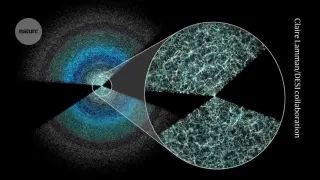
April’s best science images span cosmic to terrestrial: the DESI project delivers the most detailed 3D map of the universe from 47 million galaxies and quasars, accompanied by Earth-bound highlights such as climate-threatened cherry blossoms in Japan, the discovery of a new endangered Liopholis mutawintji skink in Australia, a lab-grown dinosaur-collagen leather bag, insights into limb regeneration, advanced 3D imaging of coral skeletons with deep learning, and NASA’s Artemis II Moon fly-by with Space Launch System boosters.

Cosmic Collapse in 33 Billion Years: A New Model Rewrites the Universe’s Fate
astronomy1 month ago

Cosmic Collapse in 33 Billion Years: A New Model Rewrites the Universe’s Fate

A new arXiv cosmological model called the axion dark energy (aDE) framework argues that dark energy could evolve rather than stay constant, slowing the expansion until the Universe reverses into a contraction and a Big Crunch roughly 33.3 billion years from now. The model aligns with DES/DESI observations but implies a dramatic shift from the prevailing eternal-acceleration view, underscoring the need for more data to validate or refine this scenario.

34 Mind-Blowing Space Facts You Probably Didn’t Know
science1 month ago

34 Mind-Blowing Space Facts You Probably Didn’t Know

BuzzFeed’s list compiles 34 bite-sized space facts—from the neutron-star density that would crush a teaspoon to the sheer size of stars like UY Scuti; eight-minute light travel from the Sun to Earth; Saturn’s density being less than water; Titan’s methane lakes; Olympus Mons on Mars; Triton’s retrograde orbit; and more cosmic quirks. It also covers human-spaceflight trivia (Apollo 11’s tiny onboard memory and post-mission quarantine), phenomena like spaghettification near black holes, planetary oddities (Mercury’s polar ice, Uranus’s extreme seasons, Pluto–Charon as a double system), and grand scales (the Sun holding ~99.8% of the solar system’s mass, the Milky Way–Andromeda collision in billions of years, and how long light from the Sun’s core takes to reach the surface). It’s a playful, educational tour through space that leaves you awed and curious about what we still have to learn.

Desi's 47 Million Galaxy Map Reveals the Cosmic Web and Dark Energy’s History
science1 month ago

Desi's 47 Million Galaxy Map Reveals the Cosmic Web and Dark Energy’s History

The Dark Energy Spectroscopic Instrument (DESI) at Kitt Peak National Observatory has produced the largest 3D map of the universe, charting about 47 million galaxies and more than 20 million Milky Way stars over a five-year survey. The map uncovers the cosmic web of filaments and voids and enables researchers to track how dark energy has shaped the universe’s expansion over the last 11 billion years, with DESI continuing observations through 2028 to expand the dataset and first full results anticipated in 2027.

Cosmic Fate Rewritten: Could the Universe End in a Big Crunch
science3 months ago

Cosmic Fate Rewritten: Could the Universe End in a Big Crunch

A Cornell-led analysis proposes the expansion of the universe could be temporary and eventually reverse if the cosmological constant is negative, driven by an ultralight axion field. The model places the universe’s total lifespan at about 33.3 billion years, with a slow crunch starting in roughly 11 billion years and final collapse about 8 billion years later (around 19–20 billion years from now). If dark energy’s behavior continues to deviate from a true constant, this Big Crunch scenario could hold; upcoming surveys and missions (Euclid, Rubin Observatory, SPHEREx) are expected to refine measurements and test the idea.

Thirty Cosmos Facts That Will Blow Your Mind
space3 months ago

Thirty Cosmos Facts That Will Blow Your Mind

BuzzFeed’s list of 30 mind-blowing space facts spans the cosmos—from the observable universe’s staggering scale (about one septillion stars) and a universe dominated by dark energy and dark matter to eye-opening specifics like Venus’s day lasting longer than its year, Saturn’s ultra-low density (it would float in water), Olympus Mons dwarfing Earth’s tallest mountain, and the Moon’s regolith preserving footprints for up to 100 million years. It also covers neutron stars’ immense density, interstellar visitors like Oumuamua and Borisov, a giant reservoir of water 12 billion light-years away, blue sunsets on Mars, and even the Sun’s hypothetical roar in space.

Webb maps the Universe's invisible scaffolding in unprecedented detail
space-and-astronomy3 months ago

Webb maps the Universe's invisible scaffolding in unprecedented detail

Astronomers using NASA's James Webb Space Telescope produced the most detailed map yet of dark matter, revealing how its gravity pulled ordinary matter into dense regions that formed galaxies and, eventually, planets. The map deepens understanding of the invisible structure shaping the cosmos and will guide future surveys (e.g., Euclid, Roman) to refine dark-matter properties and evolution.

Dark Matter Might Interact with Cosmic Ghost Particles, Scientists Say
science4 months ago

Dark Matter Might Interact with Cosmic Ghost Particles, Scientists Say

New research suggests dark matter may interact with neutrinos, which could explain why the universe is less 'clumpy' than expected and challenge current cosmological models. Future observations, including cosmic microwave background studies and gravitational lensing, aim to test this hypothesis, potentially leading to a major breakthrough in understanding dark matter.

Astronomers Mystified by Unprecedented Seven-Hour Gamma-Ray Burst
science4 months ago

Astronomers Mystified by Unprecedented Seven-Hour Gamma-Ray Burst

A record-breaking gamma-ray burst lasting nearly seven hours was observed, challenging existing models of such cosmic explosions. The event, originating from a dusty galaxy billions of light-years away, involved a high-speed jet of material and may have resulted from various extreme astrophysical processes. This unprecedented observation offers a unique opportunity to study extreme physics in the universe.