Elon Musk has become the largest individual donor in the 2026 US midterm cycle, contributing approximately $366 million to Republican causes. This spending, which exceeds his 2024 presidential election contributions, contradicts his earlier promises to reduce political involvement. The funds primarily support the Senate Leadership Fund and America PAC, targeting key races to secure GOP majorities.
President Donald Trump faces a steep decline in popularity ahead of the November midterms, with new surveys showing his approval rating at historic lows. Voters express deep dissatisfaction with his handling of the economy, inflation, and the Iran conflict. While Republican party loyalty remains high among some base voters, enthusiasm for the party is waning, particularly among younger and Hispanic supporters, raising fears of significant losses in Congress.
Democrats are outperforming expectations in deep-red states like Florida, Texas, and Ohio, driven by low approval ratings for President Trump and unpopular Republican candidates. However, securing a Senate majority remains uncertain due to tight races in blue-leaning states like Maine and Michigan, where Democratic candidates face image issues and voter skepticism.
In the final weeks before the 2026 US midterms, Senate candidates in Georgia, Michigan, and Maine clashed over economic costs, tariffs, and personal conduct. Affordability dominated all three debates, with candidates trading sharp attacks on each other's records and associations. Control of the Senate remains uncertain as Democrats seek to flip four seats.
With less than a month until the US midterm elections, President Donald Trump faces a historic low approval rating of 32%, the lowest since 1952. Polls indicate Democrats hold a double-digit lead on the generic ballot, driven by voter dissatisfaction with rising inflation, the Iran conflict, and high energy costs. While Republicans retain a significant financial advantage, analysts predict a likely loss of the House majority and potential Senate losses, marking a potential 'blue tidal wave' for Democrats.
The first televised debate between Michigan Senate candidates Abdul El-Sayed and Mike Rogers was marked by intense personal attacks and disagreements over foreign policy. El-Sayed, a Democrat, criticized Rogers for supporting the US war in Iran and aid to Israel, while Rogers accused El-Sayed of having ties to terrorism. Both candidates agreed on ending the Iran conflict but differed on the cause and consequences. The debate highlighted the race's volatility, with Rogers recently breaking with President Trump on tariffs to appeal to voters concerned about high costs.
The NAACP has sued the Trump administration, specifically Assistant Attorney General Harmeet Dhillon, for failing to release records regarding the deployment of 1,000 election monitors to polling stations in all 50 states for the November 3 midterms. The lawsuit, filed on October 2, 2026, argues that the Department of Justice lacks statutory authority for this massive deployment and that it may intimidate voters. While the DOJ claims the monitors are standard practice, critics and some Republicans describe the actions as aggressive and disruptive.
With 30 days until the US midterm elections, Democrats hold a significant polling advantage in both the House and Senate, driven by President Donald Trump’s record-low approval ratings and voter dissatisfaction with the economy and foreign policy. Despite massive spending by Republican-aligned Super PACs and high-profile rallies, GOP candidates are trailing in key battleground states. Polls indicate a 99% probability of a Democratic House majority, while the Senate race remains tight but favors Democrats in several swing states. The shift is particularly pronounced among Hispanic and independent voters, who are defecting from the Republican coalition that elected Trump in 2024.
President Donald Trump urged Republicans to vote early, by mail, or in person for the November 2026 midterms, contradicting his long-standing opposition to mail-in voting. The appeal, posted to Truth Social, follows a Supreme Court ruling that blocked his executive order to restrict mail ballots. With over one million ballots already cast, Trump's strategy now focuses heavily on mobilizing his base rather than persuading undecided voters.
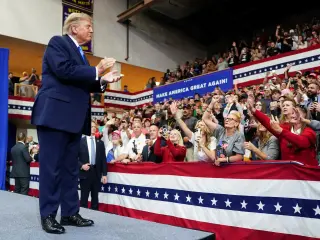
President Donald Trump rallied in Vandalia, Ohio, on October 3, 2026, urging Republicans to vote in the November 3 midterms despite polling showing Democratic gains. He predicted a 'big surprise' for the GOP, focusing on data centers and economic issues, while facing criticism over high gas prices and the Iran war. Key races for Senate and governor remain competitive, with Trump’s approval ratings at historic lows.
With one month left until the November 3 US midterm elections, Democrats hold a significant advantage in polling and seat projections, while Republicans rely on massive financial spending to counter President Donald Trump’s record-low approval ratings. The Cook Political Report and Sabato’s Crystal Ball indicate Democrats are likely to take control of the House of Representatives, with the Senate race becoming increasingly competitive. Trump’s approval rating has dropped to 31 percent, the lowest of his two terms, driven by voter dissatisfaction with the economy and the US-Israel war with Iran. Republicans are pouring over $888 million into advertising, but analysts note that high spending may not overcome the president’s unpopularity among independent voters, who currently favor Democrats by a 57-32 margin. Key Senate races in Ohio, Texas, and Michigan remain tight, while some Republican candidates are distancing themselves from Trump’s controversial policies on immigration and foreign policy to preserve their own viability.
With four weeks until the US midterm elections, polling data indicates the Republican Party is facing a severe electoral setback. President Trump's approval rating has dropped to a record low of 32%, driven by high costs of living and the ongoing conflict with Iran. Analysts predict Democrats will gain between five and 13 House seats, while the Senate race remains competitive but leans Democratic. Key battlegrounds include Iowa, Texas, and Michigan, where economic frustration is eroding support among traditional GOP voters. Despite these numbers, some Republican strategists argue that polls are unreliable and that mobilizing the base could still yield a better outcome than expected.
With five weeks until the US midterm elections, polling data indicates a significant shift in favor of the Democratic Party for control of the House of Representatives. Quinnipiac University reports a 51% to 39% preference for Democrats, a rise from two weeks prior, driven largely by independent voters. President Trump’s approval rating has hit an all-time low of 34%, with 61% disapproval, particularly regarding the economy and the conflict with Iran. A major new factor in the election is artificial intelligence: 71% of voters prefer candidates supporting stricter AI guardrails, and 79% prioritize safety over innovation. While Democrats lead on most issues, including healthcare and the cost of living, Republicans retain an edge on immigration. Analysts suggest the outcome may hinge on voter turnout, as Democrats show higher motivation but face structural disadvantages in redistricting and fundraising.
US economic data shows resilience driven by AI investment and strong consumer spending, but voter sentiment has collapsed due to high inflation, rising gas prices, and the Iran war. With midterms approaching, Trump’s boast of the 'greatest economy in history' clashes with 73% of Americans rating the economy poorly, creating a significant political vulnerability for the administration.
US gas prices have risen 37% year-over-year to an average of $4.46, driven by the ongoing Iran conflict. While President Trump dismisses the cost as a 'small price to pay,' polls show 63% of voters believe his administration worsened the economy. This economic pain is increasingly influencing voter decisions in the November midterms.