Tag

Night Sky

All articles tagged with #night sky

Comet PanSTARRS Could Shine Bright Enough to See Naked Eye This Month
space2 days ago

Comet PanSTARRS Could Shine Bright Enough to See Naked Eye This Month

Comet C/2025 R3 (PanSTARRS) is brightening in April and could become visible to the naked eye in the predawn sky this month, potentially reaching around magnitude 4 as it nears perihelion on April 20 and Earth on April 27. For Northern Hemisphere viewers, it will pass near the Great Square of Pegasus and drift toward Pisces from mid‑April, with a new Moon on April 17 helping dark skies; however visibility is uncertain and depends on the comet’s activity, so binoculars may be needed for a good glimpse.

April 2026 Skywatch: Mercury's Best View, Green Comet Glow, and Lyrid Meteors
science12 days ago

April 2026 Skywatch: Mercury's Best View, Green Comet Glow, and Lyrid Meteors

April 2026 offers a rare string of skywatching events: Mercury reaches its greatest elongation on April 3 for one of the year’s clearest views; Comet C/2025 R3 brightens in mid-April with a green glow and peaks around April 17, followed by its closest approach to Earth on April 27; the Lyrid meteor shower peaks April 21–22 with about 15–20 meteors per hour, providing multiple rewarding nights of stargazing in the Northern Hemisphere.

First-quarter Moon Pairs with Jupiter for a Night-Sky Show
stargazing16 days ago

First-quarter Moon Pairs with Jupiter for a Night-Sky Show

Tonight (March 25) the first-quarter Moon will glow in the southern sky after dusk, appearing about four degrees from the bright planet Jupiter for a striking nocturnal pairing, while Saturn is approaching solar conjunction and will reappear in the pre-dawn sky in April; observers with binoculars or a telescope can enjoy a classic night-sky setup and learn the Moon’s changing phase as part of ongoing stargazing.

Satellites Flood the Night Sky: A Photographer’s Heartbreak and a Widening Light-Pollution Crisis
photography17 days ago

Satellites Flood the Night Sky: A Photographer’s Heartbreak and a Widening Light-Pollution Crisis

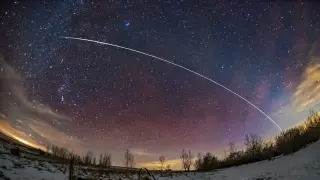
A 30‑minute composite by Alan Dyer shows satellite trails across the night sky, illustrating how the rapid growth of orbital satellites is increasing light pollution for astrophotography. A 2025 survey found 90% of astrophotographers affected; with Starlink's 10,000th satellite launched and estimates of tens of thousands more, experts warn the practice could degrade night-sky photography unless shooters time sessions to minimize satellite trails.

Last Look at the Pleiades as Spring Skies Fade
astronomy17 days ago

Last Look at the Pleiades as Spring Skies Fade

Space.com guides stargazers to see the Pleiades before it vanishes in the spring glow, noting it’s best viewed October–March and will fade toward the horizon by late April; to locate it, use Orion’s Belt as a guide—extend a line from Alnitak through Mintaka past Aldebaran to find the hazy cluster; a pair of 10x50 binoculars or a small telescope reveals dozens of stars, including the seven brightest named after Atlas’s daughters.

Spring Galaxy Season: 7 Must-See Deep-Sky Targets
space23 days ago

Spring Galaxy Season: 7 Must-See Deep-Sky Targets

Live Science highlights a spring galaxy season with seven top deep-sky targets to observe: Whirlpool Galaxy (M51) with its companion NGC 5195; Bode’s Galaxy (M81) and the Cigar Galaxy (M82); Pinwheel Galaxy (M101); the Leo Triplet (M65, M66, NGC 3628); the Whale and Hockey Stick (NGC 4631 and NGC 4656); Markarian’s Chain in the Virgo/Coma region; and the Sombrero Galaxy (M104). The piece notes this is a prime time for galaxy hunting, recommends using a GoTo or smart telescope to ease finding faint targets, and mentions the Messier Marathon as a spring observing challenge, with dark skies and a bit of patience yielding dramatic views even from modest gear.

Six-planet parade lights up the evening sky
science1 month ago

Six-planet parade lights up the evening sky

Six planets—Mercury, Venus, Saturn, Uranus, Neptune and Jupiter—will appear rising near the western horizon after sunset in a rare planetary parade. The alignment is a line-of-sight effect, not a true orbital chain. Bright planets (Mercury, Venus, Saturn, Jupiter) are visible to the naked eye, while Uranus and Neptune require binoculars or a telescope. For best viewing, find a clear western outlook about 20–30 minutes after sunset; the grouping is not a single-day event and lasts for weeks. No special equipment is needed for the brightest worlds, though binoculars help with the fainter ones, and a red-night mode app can aid night vision.

Six-Planet Parade Captured Over Dorset
science1 month ago

Six-Planet Parade Captured Over Dorset

A Bristol photographer, Josh Dury, captured a planetary parade from Worth Matravers, Dorset, featuring Earth and six other planets (Mercury, Venus, Jupiter, Saturn, Uranus and Neptune) plus the Moon in a single wide shot, after a long journey and timing with sunset; another view is expected after Saturday sunset.

Six-Planet Parade Lights Up Western Heavens After Sunset
space1 month ago

Six-Planet Parade Lights Up Western Heavens After Sunset

A rare planetary parade will bring Venus, Mercury, Saturn, Neptune, Uranus and Jupiter into the western evening sky after sunset on Feb. 28, with Venus and Mercury near the horizon and Saturn/Neptune nearby; binoculars may help spot Neptune. The Moon will accompany the Beehive Star Cluster that night, and a total lunar eclipse (the “Blood Moon”) is expected on March 3, visible from parts of the western U.S., Pacific, New Zealand, Australia and East Asia. The window to view this alignment is brief and best with a clear, unobstructed western horizon.

Megaconstellations Threaten the Night Sky and Cultural Heritage
science-tech1 month ago

Megaconstellations Threaten the Night Sky and Cultural Heritage

SpaceX filed for a megaconstellation of up to a million satellites to power space-based data centers, joining a boom of proposals that could raise the number of active satellites from about 14,000 today to millions. The article warns this will permanently alter the night sky, disrupt astronomy and Indigenous cultural practices, and raise environmental and regulatory gaps, noting the lack of unified space traffic management. It advocates a Dark Skies Impact Assessment to document cumulative effects, explore mitigation, and inform licensing—aiming to improve decision-making rather than veto space development.

Jupiter Dominates February Evenings in the Winter Sky
stargazing2 months ago

Jupiter Dominates February Evenings in the Winter Sky

On Feb. 3, Jupiter anchors the evening sky after sunset, shining at magnitude -2.6 and rising high in the east-southeast in the Gemini constellation about 30 degrees above the horizon, making it the brightest object in the night sky and an excellent target for naked eye, binoculars, or telescope; the article also notes other February sky events, such as the Moon’s occultation of Regulus on Feb. 2 and various nightly sky-watching highlights.