Tag

Clouds

All articles tagged with #clouds

Webb detects two-faced WASP-121b: scorching dusk and cloudy dawn
space8 hours ago

Webb detects two-faced WASP-121b: scorching dusk and cloudy dawn

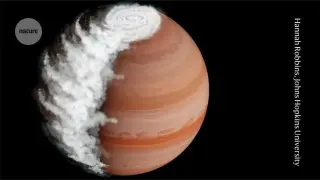
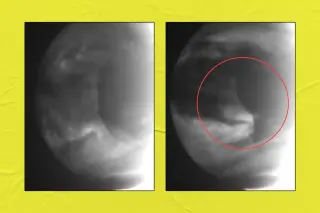
JWST mapped WASP-121b’s atmosphere longitude by longitude during a single transit as the planet rotated, revealing a hotter, expanded evening limb with water dissociation and a cooler morning limb possibly hosting silicate clouds; this rotational‑transit effect shows strong day–night circulation on this ultra-hot Jupiter (dayside ~2770 K, nightside ~1000 K) and highlights how limb-averaged spectra can miss key chemistry and cloud features.

Rock Clouds Wake in the Morning, Clear at Night on Distant Gas Giant, JWST Finds
space4 days ago

Rock Clouds Wake in the Morning, Clear at Night on Distant Gas Giant, JWST Finds

JWST observations of WASP-94A b reveal a day-night atmospheric cycle: the planet’s morning limb is cooler and cloudier due to mineral silicate clouds forming at low pressure, while the evening limb is hotter and clearer with stronger water absorption. The clouds form and evaporate as air circulates from night to day and back, a rock-based weather system on a tidally locked gas giant about 700 light-years away. This limb-resolved spectroscopy highlights why averaging spectra can mislead about atmospheric composition and demonstrates JWST's ability to map exoplanet weather.

Salt Clouds Explain the Pink Exoplanet GJ 504 b’s Faint Glow
space-and-spaceflight17 days ago

Salt Clouds Explain the Pink Exoplanet GJ 504 b’s Faint Glow

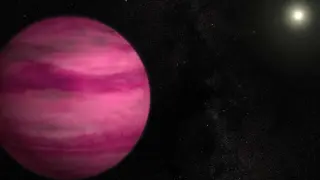
Using the James Webb Space Telescope, researchers obtained the first direct spectrum of the cool, pink exoplanet GJ 504 b and detected signatures of water vapor, methane, carbon dioxide, and ammonia; when salt clouds are included in atmospheric models, the data align with theory, implying a metal-rich planet aged roughly 2.5–4 billion years and highlighting clouds’ key role in interpreting similar faint exoplanets.

JWST spots wind-driven clouds cycling around a hot exoplanet 690 light-years away
astronomy1 month ago

JWST spots wind-driven clouds cycling around a hot exoplanet 690 light-years away

The James Webb Space Telescope detected phase‑dependent cloud formation on the hot exoplanet WASP‑94 A b during transit, revealing thick clouds on the night side that form and dissipate as winds move them onto the day side; the clouds are likely mineral droplets due to dayside temperatures around 1,600 K, offering new insight into how exoplanetary atmospheres weather and rotate.

Alaska's Winter Fades Under a Parade of Cloud Streets
science2 months ago

Alaska's Winter Fades Under a Parade of Cloud Streets

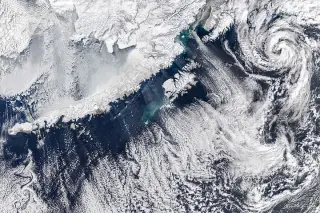
NASA's Earth Observatory image from March 19, 2026 captures a dramatic mix of cloud formations off the Gulf of Alaska—cloud streets formed by cold Arctic air over warmer water, evolving into open-cell clouds, plus von Kármán vortex streets and a polar low with tropical-storm–force winds—illustrating the turbulent transition from winter to spring as Arctic air interacts with the Gulf's ocean heat.

Chasing Clouds: AI Rewrites the Rules of Climate Modeling
science4 months ago

Chasing Clouds: AI Rewrites the Rules of Climate Modeling

Clouds remain the biggest uncertainty in climate projections, pushing researchers to blend physics with AI. Projects like CLIMA and ACE2 train neural networks on real atmospheric data and high‑resolution cloud simulations to emulate cloud effects more accurately and, in some cases, to forecast with far less computational cost than traditional Navier‑Stokes–based models. CLIMA refines cloud parameters through large-eddy simulations to double model accuracy, while ACE2 uses data-driven forecasts to capture cloud-influenced dynamics and speed up predictions, sparking debate over long-term reliability and the best balance between data and physics.