Tag

Oceans

All articles tagged with #oceans

Earth’s Energy Imbalance Reaches Record High as Climate Emergency Deepens
world18 days ago

Earth’s Energy Imbalance Reaches Record High as Climate Emergency Deepens

The World Meteorological Organization’s State of the Global Climate report warns Earth is in a climate emergency, with the planet’s energy imbalance at a record high as greenhouse gas concentrations trap more heat; heat is accumulating primarily in the oceans, driving record temperatures and increasing droughts, heatwaves, floods and other impacts, underscoring the need for a rapid shift to renewable energy to protect climate and security.

Grim climate report, hopeful path forward
world19 days ago

Grim climate report, hopeful path forward

The World Meteorological Organization’s 2025 State of the Climate report shows record CO2 levels, the hottest years on record, and heat-stored oceans driving sea-level rise and ice loss, with extreme weather increasingly linked to human emissions. It highlights Australia’s high per‑capita emissions and urges faster decarbonisation and greater carbon removal to reach net-zero by 2050; even then, climate impacts will persist, so cutting emissions and boosting renewables are essential to limit warming.

Planet's Heat Imbalance Hits Record High as Oceans Absorb Most Warming
environment19 days ago

Planet's Heat Imbalance Hits Record High as Oceans Absorb Most Warming

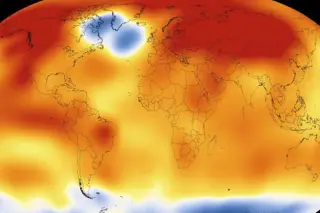
The World Meteorological Organization warns that Earth's energy imbalance has reached a record high, with about 91% of excess heat absorbed by the oceans, driving unprecedented ocean warming and higher surface temperatures. The period 2015–2025 was the hottest on record, and a shift from La Niña to El Niño could push temperatures even higher, underscoring the urgent need for climate action.

Ocean Deoxygenation Emerges as Earth's 10th Planetary Boundary
science1 month ago

Ocean Deoxygenation Emerges as Earth's 10th Planetary Boundary

Scientists argue aquatic deoxygenation could be Earth’s 10th tipping point, supplementing the existing Planetary Boundaries. Warming temperatures and nutrient runoff are reducing dissolved oxygen across lakes, reservoirs, and oceans, with notable declines such as 40% oxygen loss in midwaters off California since 1960. If widespread, this trend threatens marine life, fisheries, and global climate feedbacks, underscoring the need to cut emissions and curb nutrient pollution to safeguard ecosystems and economies.

Ocean-friendly packaging: plant-based cmcsp plastic dissolves in seawater within hours
environment1 month ago

Ocean-friendly packaging: plant-based cmcsp plastic dissolves in seawater within hours

Researchers in Japan developed a plant-based plastic called cmcsp, made from cellulose, that stays strong during use but dissolves completely in seawater within hours, leaving no microplastics and offering a potential new packaging option. The material forms a cross-linked network stabilized by salt bridges and a plasticizer; seawater ions disrupt these bonds to trigger dissolution, with a thin barrier coating slowing breakdown during use. While the approach shows promise and can be processed in water-based systems, scaling, recycling dissolved components, and real-world disposal remain challenges, and it is not a universal solution to plastic pollution.

Prince William and David Attenborough Unite to Advocate for Ocean Conservation
environment10 months ago

Prince William and David Attenborough Unite to Advocate for Ocean Conservation

Prince William will speak at a Monaco forum on World Oceans Day to rally global action and investment for ocean protection, emphasizing the importance of sustainable solutions and collaboration among environmentalists, investors, and world leaders, with a focus on innovative projects like CoralVita that aim to restore marine ecosystems.

Scientist Unveils Deep Ocean Secrets of Uranus and Neptune
science1 year ago

Scientist Unveils Deep Ocean Secrets of Uranus and Neptune

A recent study suggests that Uranus and Neptune may have vast oceans up to 5,000 miles deep beneath their atmospheres, potentially reshaping our understanding of these ice giants and their capacity to harbor life. Led by Professor Burkhard Militzer, the research used advanced computer simulations to reveal a layered structure within these planets, which could explain their unique magnetic fields. This discovery has significant implications for the search for extraterrestrial life, as similar gas giants are common in the Milky Way. Future missions to these planets could confirm these findings.

Wobbles May Reveal Hidden Oceans on Uranus' Moons
science1 year ago

Wobbles May Reveal Hidden Oceans on Uranus' Moons

NASA is planning a mission to explore the possibility of hidden liquid oceans beneath the moons of Uranus, which could provide insights into the potential for life beyond Earth. The mission, still in the conceptual stage, would use a spacecraft to measure the wobbles of Uranus's moons, as moons with internal oceans tend to sway more due to the liquid inside. This method has previously been used to confirm an ocean on Saturn's moon Enceladus. Discovering such oceans could expand our understanding of where life might exist in the galaxy.