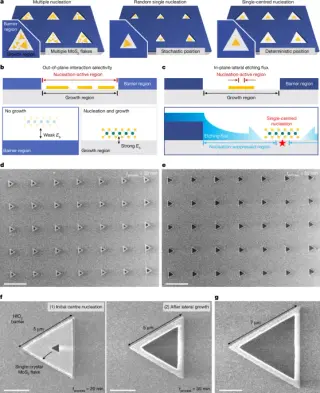
Researchers have developed a new method to control where 2D semiconductor crystals begin to form, enabling precise single-crystal growth and advanced device integration.
TSMC is in discussions with Elon Musk's Terafab to establish advanced semiconductor manufacturing in the United States. The potential joint venture would see TSMC provide manufacturing expertise while Terafab offers financial backing and equity. This move aims to boost US chip production and diversify supply chains, potentially involving a Texas facility. The collaboration could complement existing Intel-Terafab ties, though details on technology transfer remain unclear.
University of Illinois researchers demonstrate monolithic 3D silicon by stacking ultrathin silicon membranes to build a three-layer stack with 625 transistors per layer and high yields (98–100%), using low-temperature transfer and junctionless devices to stay within a ~400 C thermal budget. The approach, enabled by roll-laminated ~10 nm membranes, promises tighter interlayer connections and faster 3D SRAM/logic, with a clear path toward industrial manufacturing for commercial foundries like IBM, Intel, and TSMC.
A University of Illinois team demonstrated monolithic 3D integration by stacking ultrathin silicon nanomembranes (about 10 nm thick) on top of existing circuits at temperatures below 200°C, achieving 98–100% device yields across three stacked layers of 625 transistors each. Using junctionless transistors and dense vertical interconnects, they built multi-layer logic and SRAM with strong performance and low thermal budget, showing a scalable path toward commercial 3D silicon chips that could extend Moore’s Law. The work, published in Nature, is positioned for industrial transfer with partners including IBM, Intel, and TSMC.
Lucid reported a $1 billion net loss in Q1 2026 and scrapped its 2026 production guidance after producing 5,500 vehicles and delivering 3,093; revenue rose 20% to $282 million but lagged estimates, with the company aiming for 25,000–27,000 annual production by 2027 aided by a new Saudi factory for Cosmos. Rivian’s R2 remains highly anticipated with multiple variants and a Georgia plant to expand output. SpaceX and Tesla unveiled plans for a Texas Terafab semiconductor facility with an initial $55 billion investment (potentially up to $119 billion) to secure domestic chip supply. Tesla also recalled 218,868 vehicles for a backup-camera delay fixable via OTA, as the broader EV market navigates demand and policy headwinds.
China is increasing its AI chip production capacity by upgrading its older ASML lithography machines, aiming to boost semiconductor manufacturing capabilities.
Samsung is partnering with Nvidia to build an AI-enabled semiconductor manufacturing plant that will embed AI throughout its operations, using digital twins and advanced robotics to boost efficiency, quality, and innovation in chip production and beyond.
Intel has begun mass production at its new Fab52 facility in Arizona, utilizing its advanced 18A process node, which features innovative gate-all-around transistors and backside power delivery, aiming to regain technological leadership and boost its foundry business amidst industry competition.
Intel announced details of its upcoming Panther Lake processor, the first chip on its new 18A manufacturing process, targeting high-end AI laptops, with performance 50% faster than previous chips, marking a significant step in its manufacturing revival and competitive strategy.
Intel's stock rose 7% following reports that the US government is considering taking a stake in the company to support domestic semiconductor manufacturing, particularly its Ohio factory, amid ongoing industry challenges and national security concerns.
Texas Instruments announced a historic $60 billion investment in US semiconductor manufacturing, including building or expanding seven facilities in Texas and Utah, creating 60,000 jobs, as part of a broader effort encouraged by the US government to boost domestic chip production amidst geopolitical and economic pressures.
Micron and the Trump Administration announced a $200 billion plan to expand U.S. semiconductor manufacturing and R&D, including building new fabs in Idaho and New York, modernizing Virginia facilities, and advancing high bandwidth memory capabilities to meet AI-driven demand, creating approximately 90,000 jobs and reinforcing America's leadership in memory technology.
Micron Technology has secured $4.6 billion in federal grants to build a semiconductor manufacturing plant in Clay, New York. The project involves significant environmental changes, including the destruction of over 200 acres of wetlands and filling in more than a mile of stream banks. Before construction begins in November 2025, Micron must obtain numerous permits and approvals from local and federal agencies.
Micron has secured up to $6.1 billion in federal funding through the CHIPS & Science Law to build a complex of memory chip plants in Central New York, marking one of the largest federal investments in the region's history. The project, which aims to create thousands of jobs, is set to begin groundbreaking in November 2025. This funding is part of a broader initiative to bolster U.S. semiconductor manufacturing, with additional agreements in place for expansions in Idaho and Virginia. The investment underscores Central New York's growing role in the semiconductor industry.
The US Commerce Department has awarded Micron Technology up to $6.165 billion in funding from the CHIPS Act to support semiconductor manufacturing projects in the US, including facilities in Idaho and Syracuse, New York, expected to create around 20,000 jobs. Additionally, a non-binding agreement proposes $275 million for expanding Micron's Virginia facility. This funding is part of Micron's commitment to invest $50 billion by the end of the decade.