Tag

Ultracold Atoms

All articles tagged with #ultracold atoms

NASA's fridge-sized quantum lab on the ISS expands ultracold-atom research in orbit
space4 days ago

NASA's fridge-sized quantum lab on the ISS expands ultracold-atom research in orbit

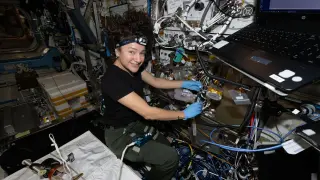
A refurbished upgrade to NASA's Cold Atom Laboratory aboard the International Space Station—about the size of a mini-fridge—lets scientists study ultracold atoms and Bose-Einstein condensates in microgravity, enabling longer observation of quantum behaviors and paving the way for future space-based quantum technologies in timing, navigation, and gravity sensing.

Time blooms from inside a tiny quantum universe
science7 days ago

Time blooms from inside a tiny quantum universe

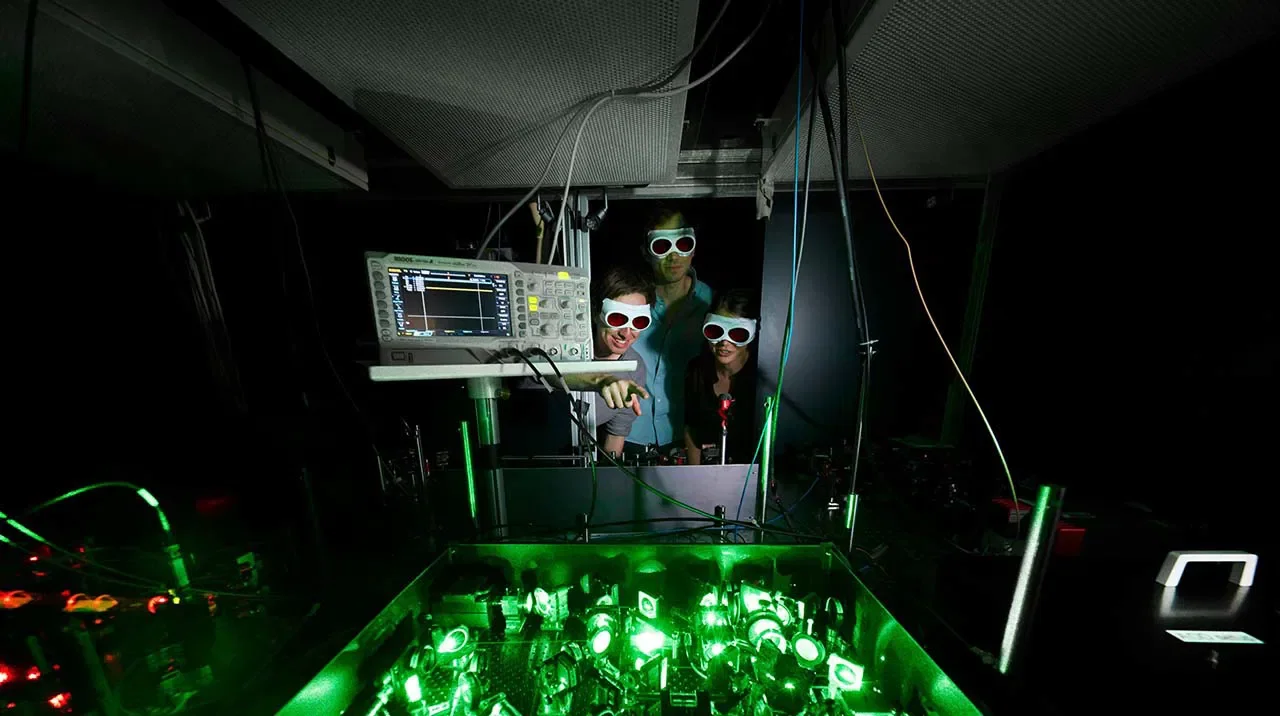
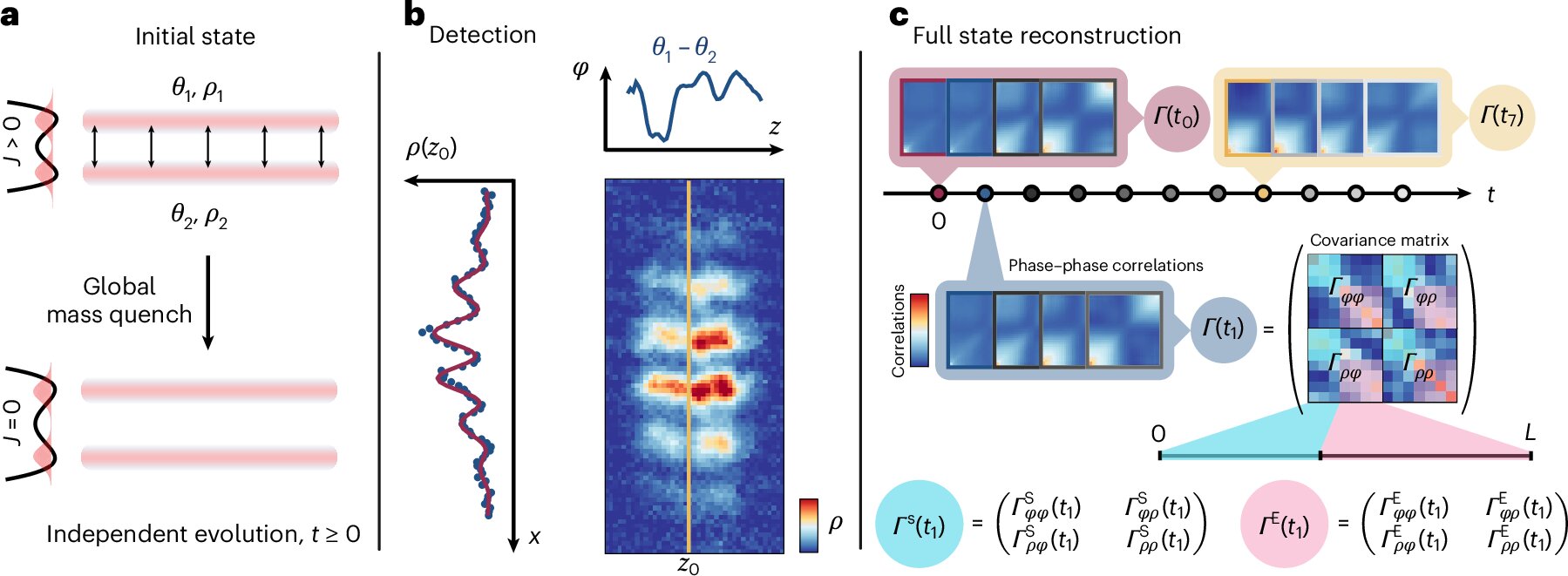
A Birmingham physicist created a nearly isolated Bose-Einstein condensate of ultracold rubidium atoms, split it into two halves, and showed that time can emerge from entropy exchange within the system—the entropic time—acting as an internal clock that speeds up, slows down, or stops as the halves exchange or cease entropy. The experiment, tied to ideas in quantum cosmology and the Wheeler–DeWitt equation, provides the first lab-based demonstration that relational time can arise from within a closed quantum system and even reproduces a Schrödinger-like description using this internal time.

Quantum Experiments Impose a Fundamental Ceiling on Electrical Resistance
science15 days ago

Quantum Experiments Impose a Fundamental Ceiling on Electrical Resistance

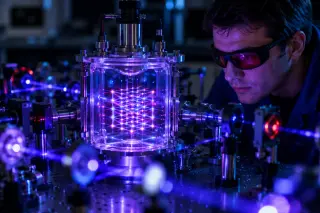
Researchers using ultracold potassium atoms in an optical lattice demonstrated that resistivity caused by particle collisions increases but saturates at a finite ceiling, revealing a microscopic limit to resistivity that could extend to metals. The quantum enhancement of collision chances—atoms acting as larger effective particles—drives the initial rise, but as interactions strengthen the system reaches a plateau, offering experimental insight into resistivity in quantum materials and informing studies of strongly correlated systems. The work, led by Joseph H. Thywissen and collaborators across the University of Toronto, ENS Paris-Saclay, and Lehigh University, was published in Physical Review Letters.

Ultracold Atoms Reveal a Fractional Fermi Sea, a New Quantum Phase
science16 days ago

Ultracold Atoms Reveal a Fractional Fermi Sea, a New Quantum Phase

Physicists used ultracold cesium atoms confined to one dimension and cyclically shifted their interactions between strong repulsion and attraction, driving the system into a highly excited but highly ordered state called a fractional Fermi sea. This phase exhibits correlations and Friedel oscillations that defy the standard Tomonaga-Luttinger liquid description, pointing to a new critical phase of matter and expanding quantum-simulation possibilities.

Time Emerges from Entropy in a Lab Mini-Universe
science25 days ago

Time Emerges from Entropy in a Lab Mini-Universe

A University of Birmingham team built a sealed quantum system of 24,000 ultracold rubidium atoms that mimics a tiny expanding/contracting universe and found that the flow of time can arise from internal entropy changes rather than an external clock. The experiment demonstrates entropic time, provides experimental support for time as a derived property in some quantum gravity theories, and shows the Schrödinger equation can be expressed with entropic time, offering a new laboratory testbed for quantum cosmology and gravity ideas.

Lab-made 24,000-atom cosmos hints time can emerge from entropy
science1 month ago

Lab-made 24,000-atom cosmos hints time can emerge from entropy

Researchers built a sealed, two-region quantum system of 24,000 ultracold rubidium atoms that behaves like a tiny universe, cycling between expansion and contraction without any external clock. Time appears to flow from internal changes in entropy (entropic time), allowing the sequence of events to be inferred from within the system and offering a controllable testbed for ideas in quantum gravity and early-universe physics. The study also shows Schrödinger dynamics can be reformulated under this time concept and could help probe fundamental questions about the origin of time.

Tunable One-Dimensional Anyons Signal New Quantum Matter
science3 months ago

Tunable One-Dimensional Anyons Signal New Quantum Matter

Researchers show that in one dimension, particles can have exchange statistics between bosons and fermions (anyons) whose strength can be tuned by short-range interactions; momentum-distribution measurements in existing ultracold-atom setups could observe these 1D anyons, opening a path to new forms of quantum matter and tests of fundamental quantum statistics.

Hidden Magnetic Order in Pseudogap Narrows Path to Room-Temp Superconductivity
science5 months ago

Hidden Magnetic Order in Pseudogap Narrows Path to Room-Temp Superconductivity

Physicists used ultracold lithium atoms in an optical lattice to simulate the Fermi-Hubbard model and uncovered a hidden magnetic order beneath the pseudogap, revealing universal spin correlations and multi-particle interactions up to five bodies. By imaging thousands of individual atoms with a quantum gas microscope and varying temperature and doping, they gain new clues about how pseudogap physics connects to superconductivity and how analog quantum simulations can guide theory and materials design for higher-temperature superconductors.

science5 months ago

Ultracold-Atom Study Uncovers Hidden Magnetism in Pseudogap Phase

Physicists using an ultracold lithium-atom quantum simulator have revealed hidden magnetic order in the pseudogap phase of certain quantum materials, showing universal antiferromagnetic correlations above the superconducting transition and offering fresh insight into how high-temperature superconductivity may emerge, with results published in Proceedings of the National Academy of Sciences.

Scientists Discover New Quantum Optics Behaviors with Matter Waves
science1 year ago

Scientists Discover New Quantum Optics Behaviors with Matter Waves

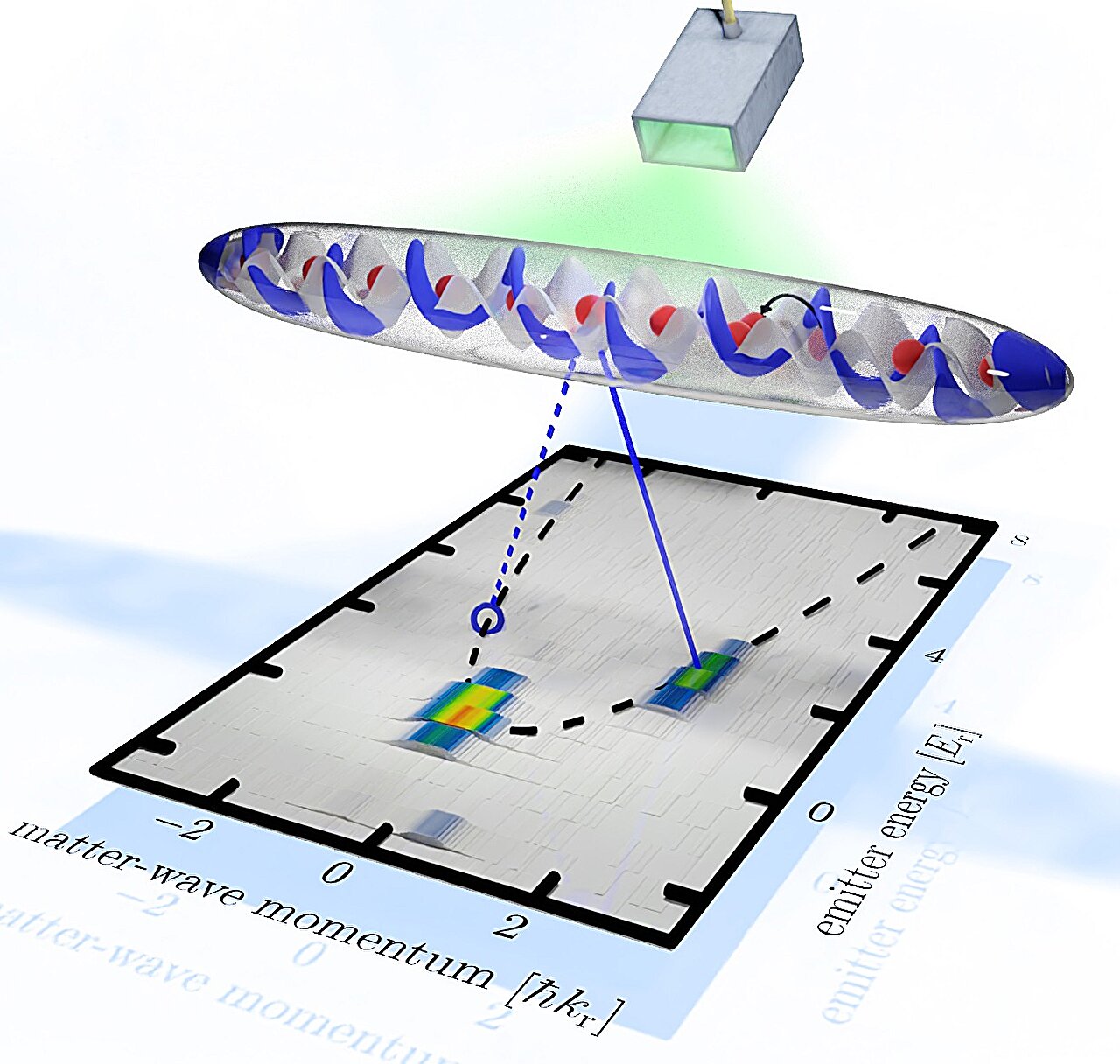
Researchers led by Dominik Schneble have discovered new collective behaviors in quantum optics using matter waves, revealing novel cooperative radiative phenomena in synthetic atom arrays. Their work, published in Nature Physics, explores super- and subradiant dynamics by manipulating ultracold atoms in an optical lattice, offering insights into quantum information science. This study challenges traditional assumptions about photon behavior in quantum systems, demonstrating unprecedented control over subradiant states and highlighting the potential of ultracold matter waves in quantum optics research.

"MIT Physicists Capture First Images of Second Sound in Superfluid"
physics2 years ago

"MIT Physicists Capture First Images of Second Sound in Superfluid"

MIT physicists have captured direct images of "second sound," the movement of heat sloshing back and forth within a superfluid, for the first time. This breakthrough will expand scientists' understanding of heat flow in superconductors and neutron stars, and could lead to better-designed systems. The team visualized second sound in a superfluid by developing a new method of thermography using radio frequency to track heat's pure motion, independent of the physical motion of fermions. The findings will help physicists get a more complete picture of how heat moves through superfluids and other related materials.

"MIT Physicists Uncover Heat "Sloshing" Sounds in Superfluids"
physics2 years ago

"MIT Physicists Uncover Heat "Sloshing" Sounds in Superfluids"

MIT physicists have captured direct images of second sound, the movement of heat in a superfluid, for the first time. Using a new method of thermography, they were able to observe heat moving like a wave, independent of the physical motion of fermions in the superfluid. This breakthrough will help physicists gain a better understanding of how heat moves through superfluids and related materials, with potential applications in high-temperature superconductors and neutron stars.

Giant Trilobite Rydberg Molecules: Physicists' Remarkable Discovery
science2 years ago

Giant Trilobite Rydberg Molecules: Physicists' Remarkable Discovery

Physicists at the University of Kaiserslautern have successfully observed trilobite Rydberg molecules, which have a unique shape resembling trilobite fossils and the largest electric dipole moments of any known molecule. Using a specialized apparatus, the researchers prepared these molecules at ultralow temperatures and discovered their distinct chemical binding mechanisms. The molecules are formed through the quantum mechanical scattering of a Rydberg electron from a ground state atom, resulting in an effective attraction. The properties of these molecules, including their interference pattern and large bond length, provide insights into fundamental binding mechanisms and their potential applications in quantum computing.