A powerful September nor'easter is forecast to bring 60 mph winds, heavy rain, and coastal flooding to the Northeast, prompting officials from Massachusetts to Maryland to cancel major public events and urge residents to stay indoors.
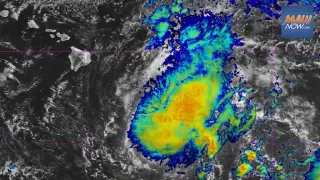
Tropical Storm Moke is tracking south of the Hawaiian Islands but will still bring periods of heavy rain and gusty winds to the Big Island today through Monday, with the heaviest rainfall on windward and southeast slopes. A Flood Watch and Wind Advisory remain in effect for the Big Island, while tradewinds strengthen and drier conditions are expected to return by mid next week. Residents should expect east-shore cyclone swell, a small south pulse through the weekend, and next-week swells along north and west coasts.
Tropical Storm Moke is strengthening as it moves west-northwest toward the Hawaiian Islands, bringing heavy rainfall (5–10 inches on the Big Island, with isolated totals up to 15 inches) and gusty winds tonight into Sunday. The center is forecast to pass south of the Big Island, with winds remaining robust but gradually weakening. Residents should be alert for potential life-threatening flooding and mudslides in windward terrain; Maui could see 3–6 inches of rain on the east side, with 1–2 inches elsewhere. Swells from Moke will affect eastern and southern shores over the next few days, and another advisory is expected around 5 p.m. HST.
Neptune hosts the solar system’s fastest winds—about 2,000 km/h (roughly 1,200 mph)—well above Earth’s Category 1 hurricane speeds (minimum 119 km/h). These speeds were first inferred from Voyager 2’s 1989 cloud-tracking flyby and later confirmed by ALMA measurements at known pressure levels. Scientists think the winds are powered more by internal heat and planetary rotation than by sunlight, with a shallow atmospheric layer (roughly 1,000 km deep) driving the stormy weather. Neptune’s extreme distance means little solar input, and with one Neptune year equal to 165 Earth years, our data come from a small, early snapshot—awaiting future probes to reveal more of its atmospheric mysteries.
Neptune hosts the fastest winds in the solar system—over 2,000 km/h—despite daylight being about 900 times dimmer than Earth’s, because it radiates more internal heat than it absorbs from the Sun. Rapid rotation, convection, atmospheric waves and low drag organize this energy into broad east-west jets; the planet’s weather layer is likely relatively shallow, and a heat surplus drives the storms. Voyager 2 measured near-2,000 km/h winds during its 1989 flyby; later observations show persistent jets with changing vortices, but the exact mechanism remains debated and likely a combination of internal heat, atmospheric dynamics, and rotation. Future missions could help pinpoint how Neptune converts energy into its striking winds.
ESA's Mars Express HRSC captures a field of bright, sheen-like dunes in Kaiser Crater on Noachis Terra, sculpted by westward winds into transverse and barchan forms; the shiny appearance comes from frost on south-facing slopes, while exposed clay rocks and gullies hint at past water activity in this ancient Martian region.
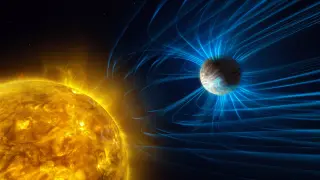
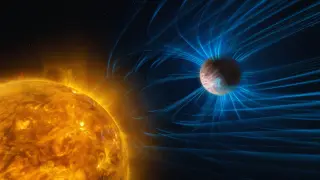
Astronomers using the Very Large Telescope and Gemini North studied seven hot giant exoplanets and found a surprising link between wind speeds and temperature: the hottest worlds have slower winds, explained by strong magnetic fields acting as brakes. The inferred magnetic fields are about four times stronger than Saturn’s and roughly half as strong as Jupiter’s, a finding that could affect atmospheric retention and planetary survival, and possibly hint at spectacular auroral activity. The work opens a new window for exoplanet research, with future observatories like the Extremely Large Telescope expected to extend these methods to Earth-sized worlds.
Scientists using ESO's Very Large Telescope and Gemini North measured wind speeds on seven hot, Jupiter-like exoplanets and found patterns best explained by global magnetic fields, marking the first robust evidence of magnetospheres around worlds beyond our solar system. The inferred magnetic strengths are roughly four times Saturn’s and about half Jupiter’s. This breakthrough opens a new window for exoplanet research, suggesting magnetically driven aurorae and paving the way for future ELT observations to characterize smaller, potentially habitable worlds.
Astronomers directly measured magnetic fields on seven ultra-hot Jupiter exoplanets, finding fields of a few gauss that slow their winds—a first-of-its-kind result that informs exoplanet atmospheres, magnetic shielding, and the search for habitable worlds.
Astronomers using the Very Large Telescope (VLT) and Gemini North measured wind speeds on seven tidally locked, hot Jupiter–like exoplanets and found winds up to 15,530 mph, offering the first direct evidence of magnetic fields around planets beyond the solar system. The winds appear to slow with higher planetary temperatures due to magnetospheric braking, allowing researchers to infer magnetic-field strengths—roughly four times Saturn’s and about half Jupiter’s. The findings, published in Nature Astronomy, imply these worlds could host dramatic auroras and provide a new way to study exoplanet magnetospheres and atmospheric evolution.
A 56-year-old woman, Dana Weinger of Huger, South Carolina, died after a loose umbrella blown by high winds struck her while she was dining with her husband and family at Driftwood Grill on Lake Marion during Memorial Day weekend.
Stagecoach 2026 in Indio paused Saturday as high winds whipped dust and toppled props, triggering an emergency evacuation; Lainey Wilson’s headlining set was delayed about an hour, while Journey and Riley Green saw their performances canceled. After a staggered restart, Wilson opened again but the crowd faced shuttle- and parking-lot chaos; the final day remains headlined by Post Malone.
Anyma’s planned midnight Coachella set was canceled because strong winds affected the stage build. Organizers and Anyma cited safety as the priority and apologized, with Anyma saying they’re working on a solution. It’s unclear whether the first weekend performance will be rescheduled or moved to the second weekend, where he’s still slated to perform.
Anyma’s Coachella 2026 main-stage closing set was canceled about 15 minutes after its scheduled midnight start on Friday of Weekend One due to strong winds affecting the stage build, with safety prioritized and the ÆDEN debut postponed while other festival acts continued.
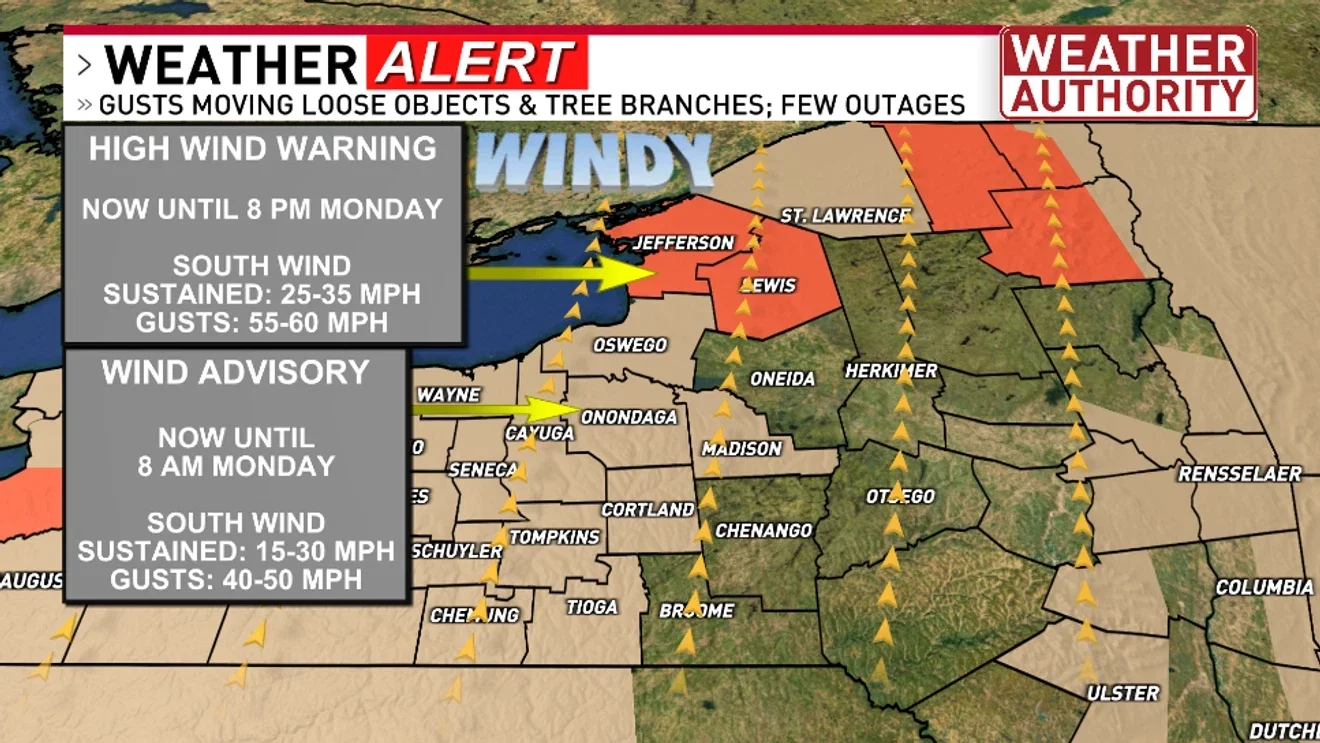
Central New York faces an active weather pattern: strong winds tonight with wind advisories, a potential for damaging gusts up to 60 mph and isolated tornado risk Monday afternoon along a cold front, followed by wet snow Monday night and a dramatic drop in temperatures that could cause a flash freeze Tuesday morning; conditions are expected to calm by midweek as winter gives way to spring.