Tag

Pulsars

All articles tagged with #pulsars

Feeble Radio Whispers Reveal the Blue Eye Pulsar After Decades of Silence
space5 days ago

Feeble Radio Whispers Reveal the Blue Eye Pulsar After Decades of Silence

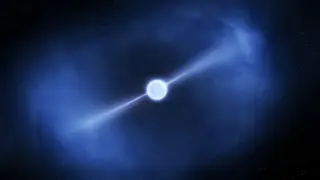
Astronomers using the MeerKAT telescope detected faint radio pulses from the central compact object 1E 1207.4-5209—the Blue Eye Pulsar—located about 10,000 light-years away in the Milky Way. The neutron star emits radio waves every 424 milliseconds, matching its rotation and suggesting that some radio-quiet central compact objects can produce detectable radio emission under certain magnetic-field conditions, possibly triggered by a 2015 spin glitch. The finding implies a larger population of ultra-faint pulsars in the galaxy and could help explain missing pulsars in some supernova remnants, with the study published in Nature Astronomy on June 25.

Milky Way gamma-ray glow still leaves dark matter in contention
science20 days ago

Milky Way gamma-ray glow still leaves dark matter in contention

Using machine learning on more than a million simulated gamma-ray observations, researchers test whether the Galactic Center Excess—the Milky Way’s central gamma-ray glow—could come from self-annihilating dark matter or from many faint pulsars. They find pulsars would have to be far more numerous and dim than previously thought, making them hard to distinguish from a dark-matter signal, so dark matter remains a plausible but unproven explanation; the bright, crowded galactic center makes definitive conclusions difficult.

Nevada Desert to Welcome 1,650-Dish Deep Synoptic Array
science20 days ago

Nevada Desert to Welcome 1,650-Dish Deep Synoptic Array

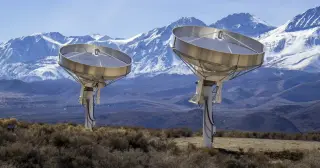
Caltech’s Deep Synoptic Array will be built in Nevada’s White Pine County as a 1,650-dish radio telescope network designed to survey the sky 100 times faster and produce sharper radio images, enabling precise localization of radio sources for follow-up by optical, infrared and X-ray observatories; funded by Schmidt Sciences, with prototype dishes already built and construction planned to begin next year and finish by 2029.

Voyager Golden Record: Uranium Clock and Pulsar Map Date Its Cosmic Drift
space23 days ago

Voyager Golden Record: Uranium Clock and Pulsar Map Date Its Cosmic Drift

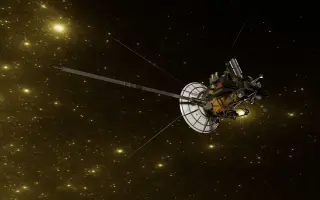
The article explains that the Voyager Golden Record carries two dating methods: a uranium-238 patch acting as a long-lived clock (half-life ~4.51 billion years) to measure how long the record has drifted since placement, and a pulsar map encoded on the cover that provides a second, independent time stamp via the regular pulsar periods. Together they let any finder, even without human context, determine the record’s age; the clock’s timescale dwarfs the disc’s expected survival, and while the odds of recovery are tiny, the clocks are designed to outlive the civilization that created them. Voyager is not aimed at any particular star and will remain adrift for millennia, with milestones like 24-hour light-time delays illustrating the probe’s great distance from Earth.

Golden Message Adrift: Pioneer 10, Pulsar Map and a Quiet Cosmic Drift
space1 month ago

Golden Message Adrift: Pioneer 10, Pulsar Map and a Quiet Cosmic Drift

Pioneer 10 carries a gold plaque showing a man and a woman alongside a pulsar-based map meant to mark Earth’s location for any finder; the spacecraft has been silent since 2003 and is now drifting outward toward Aldebaran, a journey NASA estimates at about two million years, though the star’s own motion means it isn’t a fixed rendezvous. The plaque was designed as a durable, albeit uncertain, message to distant intelligences, and while the craft may fade, the plaque’s intended message endures as a symbol of human curiosity.

Cosmic data tighten the test of light’s speed, keeping relativity intact
space1 month ago

Cosmic data tighten the test of light’s speed, keeping relativity intact

A comprehensive review of 65 observations from pulsars, active galaxies, and gamma-ray bursts tightens the limits on any energy-dependent variation in photon speed, finding no violation of Lorentz invariance and reinforcing Einstein’s relativity; it also refines how such limits are calculated and points to future instruments for even tighter tests.

Voyager Golden Record Doubles as a Billion-Year Time Capsule
space1 month ago

Voyager Golden Record Doubles as a Billion-Year Time Capsule

The Voyager Golden Record on each spacecraft carries two built-in clocks—a tiny uranium-238 sample on the cover to date its age by radioactive decay, and a pulsar map to date it via the slowdowns of 14 pulsars—providing two independent ways to estimate how long the record has drifted and offering redundancy on a timescale of hundreds of millions to billions of years.

Hunting Exotic Trojans Around Pulsars Could Rewrite Cosmic Orbits
space3 months ago

Hunting Exotic Trojans Around Pulsars Could Rewrite Cosmic Orbits

Astronomers are chasing exotrojans—hypothetical bodies that could orbit pulsars at Lagrange points—by cross-checking optical light curves with pulsar radio timing and analyzing NANOGrav data; so far no conclusive detections, two signals were false positives, and no object bigger than Earth has been found in seven systems, though one showed hints of a body up to eight Jupiter masses, leaving the search open for future data.

Obituary of Sir Francis Graham-Smith
obituaries11 months ago

Obituary of Sir Francis Graham-Smith

Sir Francis Graham-Smith, a pioneering figure in radio astronomy and former Astronomer Royal, passed away at 102. His groundbreaking work in radio surveys, pulsar studies, and his leadership at Jodrell Bank significantly advanced our understanding of the universe, including the identification of distant galaxies and the development of major radio telescopes. He was a highly influential scientist, author, and leader in British astronomy, recognized with numerous honors including a knighthood and the Royal Medal.

Breakthrough Method for Detecting Dyson Rings Announced
science-and-technology1 year ago

Breakthrough Method for Detecting Dyson Rings Announced

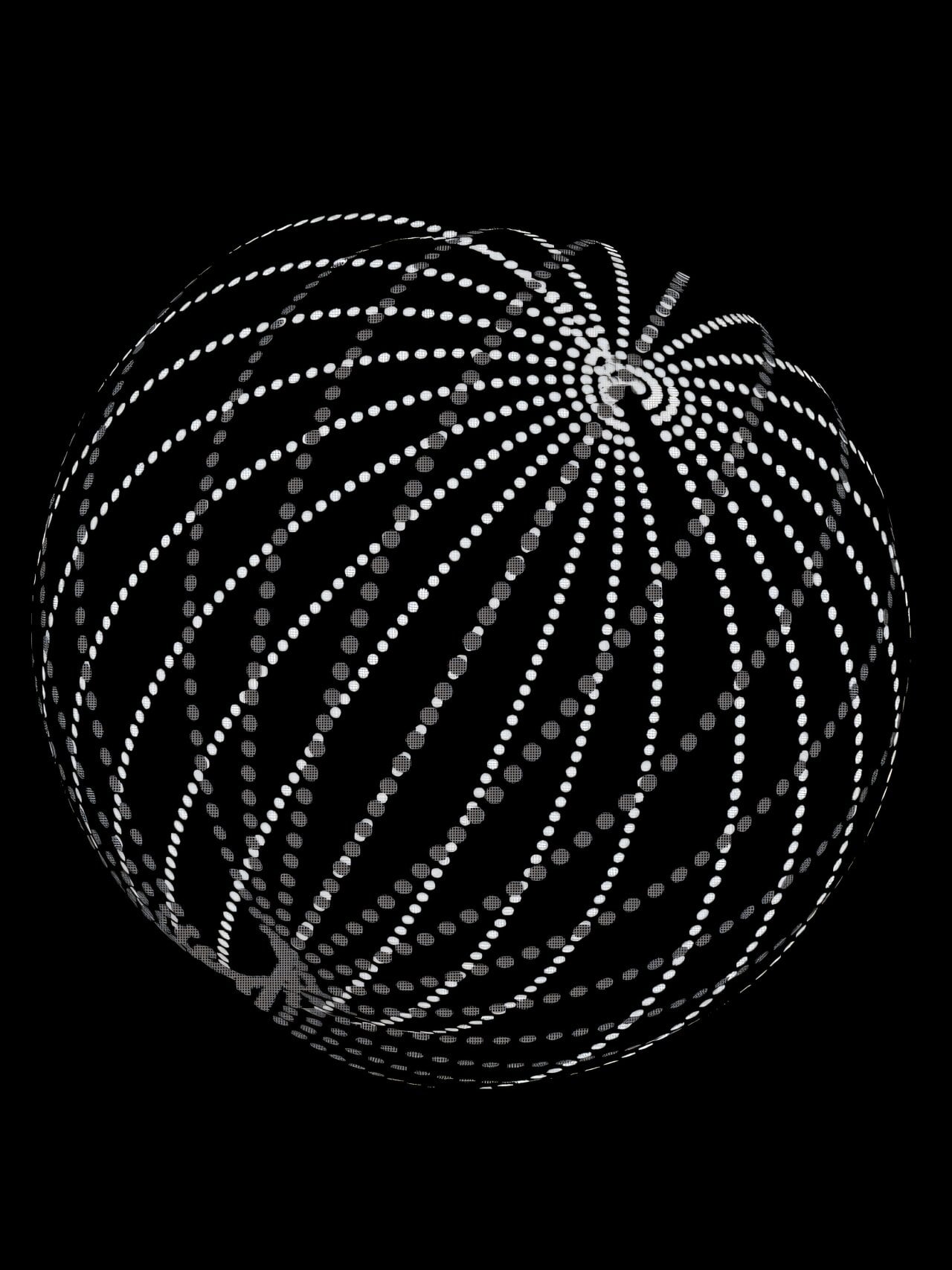
A new technique for detecting Dyson rings, theoretical megastructures designed to harness energy from stars, has been proposed by scientists. The method involves analyzing light curves from pulsars, where the pulsar beam striking a Dyson ring could create detectable features. This approach could help identify advanced civilizations capable of constructing such structures, which are more feasible than Dyson spheres due to lower material requirements. The research is set to be published in the Monthly Notices of the Royal Astronomical Society.

New Research Sheds Light on Black Holes in Milky Way's Largest Star Cluster
science1 year ago

New Research Sheds Light on Black Holes in Milky Way's Largest Star Cluster

New research suggests that the high velocities of stars in Omega Centauri, the Milky Way's largest star cluster, are likely due to a cluster of stellar-mass black holes rather than a single intermediate-mass black hole (IMBH). By combining data on stellar velocities and pulsar accelerations, scientists from the University of Surrey and collaborators have provided evidence favoring the presence of multiple smaller black holes. This finding helps resolve a long-standing debate and advances the search for IMBHs, which could bridge the gap between stellar-mass and supermassive black holes.

SETI's Breakthrough with Cosmic Lighthouses from a Ruined Observatory
science1 year ago

SETI's Breakthrough with Cosmic Lighthouses from a Ruined Observatory

Using data from the now-collapsed Arecibo radio telescope, SETI scientists have studied how pulsar signals are distorted by the interstellar medium, revealing that current models of the universe may need revision. This research, led by Sofia Sheikh, highlights the importance of archived data and its role in understanding cosmic phenomena like gravitational waves. The findings suggest that galactic structures, such as the Milky Way's spiral arms, influence these distortions, which could refine gravitational wave detection methods.

Gravitational Waves Unveil Cosmic Secrets and Black Hole Activity
science1 year ago

Gravitational Waves Unveil Cosmic Secrets and Black Hole Activity

Astronomers using the MeerKAT Pulsar Timing Array have detected a surprisingly loud gravitational wave background, suggesting more supermassive black holes may be orbiting each other than previously thought. This discovery, made by observing 83 pulsars, has led to the most detailed maps of gravitational waves, revealing a 'hot spot' of activity in the Southern Hemisphere. The findings challenge existing theories about the number of supermassive black holes and could provide insights into the cosmic architecture of the universe.

SETI Analyzes Pulsar Signals Using Arecibo's Legacy Data
science1 year ago

SETI Analyzes Pulsar Signals Using Arecibo's Legacy Data

Scientists from the SETI Institute have used archival data from the now-collapsed Arecibo Observatory to study how signals from pulsars, rapidly spinning neutron stars, are distorted as they travel through space. The research focused on diffractive interstellar scintillation (DISS), revealing that pulsar signal bandwidths are wider than current models suggest, indicating a need to revise models of the interstellar medium. This study highlights the ongoing scientific value of Arecibo's data, even after its destruction, in understanding galactic structures and phenomena like gravitational waves.

Astrophysicist Unveils Theory on Crab Nebula's Zebra Stripes
science1 year ago

Astrophysicist Unveils Theory on Crab Nebula's Zebra Stripes

A theoretical astrophysicist from the University of Kansas, Mikhail Medvedev, has proposed a solution to the mysterious 'zebra' pattern observed in the Crab Nebula's radio emissions. By modeling wave diffraction and using wave optics, Medvedev suggests that the pattern is caused by the diffraction of electromagnetic pulses through the pulsar's plasma, which varies in density. This new understanding could enhance the study of pulsars and their magnetospheres, offering insights into their plasma density and distribution.