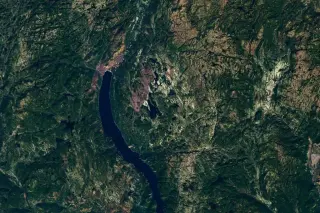
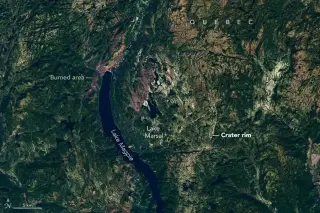
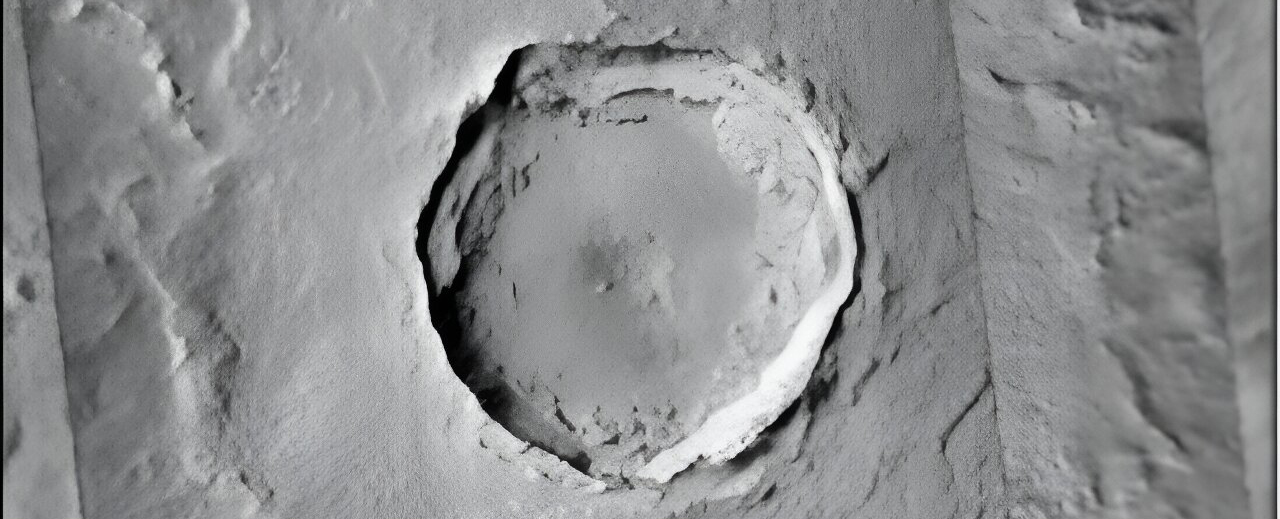
A Quebec amateur astronomer discovered a 25-kilometer impact crater while scouting a campsite via satellite imagery. Geologists confirmed the 390-million-year-old structure, named Uhackatik, by finding shatter cones and impact melt rock during a difficult floatplane expedition.
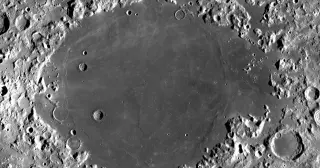
NASA’s Lunar Reconnaissance Orbiter identified McGetchin, the largest newly formed crater in the solar system, created by a 2024 impact. The 222-meter-wide feature, discovered via routine image analysis, is accompanied by a 7-kilometer-wide cold spot caused by decompacted regolith. This rare event, estimated to occur once every 132 years, provides critical data for future lunar missions and surface engineering.
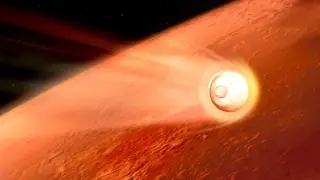
NASA’s Perseverance rover entry vehicle jettisoned ballast and stage fragments that struck Mars, creating five craters. Analysis of these impacts reveals the Martian surface is significantly weaker than standard models predict, with a cohesion strength of about 7 kilopascals.
A 15-mile-wide impact crater in Quebec, dated to 390 million years ago, was confirmed after an amateur astronomer noticed a circular anomaly on satellite maps. The discovery, named Uhackatik, is the first impact crater identified through public reporting, validated by field evidence of shock metamorphism and impact melt.
Mineral dating of rocks from Western Australia’s North Pole Dome using zircon and apatite clocks pins the crater-forming impact at about 3.024 billion years ago, making it the oldest confirmed Archean impact structure on Earth and offering a rare window into Earth’s violent youth; later mineral ages record subsequent geological activity separate from the impact.
A new high-resolution topographic analysis suggests the Zhamanshin impact crater in Kazakhstan is about 26.5 km in diameter—roughly double previous estimates—meaning the energy released could be 7–10 times greater and potentially linked to abrupt environmental changes around 900,000 years ago; erosion and loess conceal outer rings, so further regional climate records are needed to assess any biological or climate effects, with implications for planetary protection and future planetary exploration.
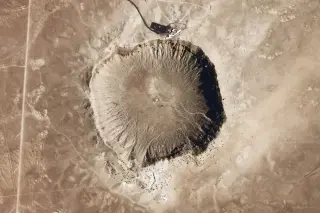
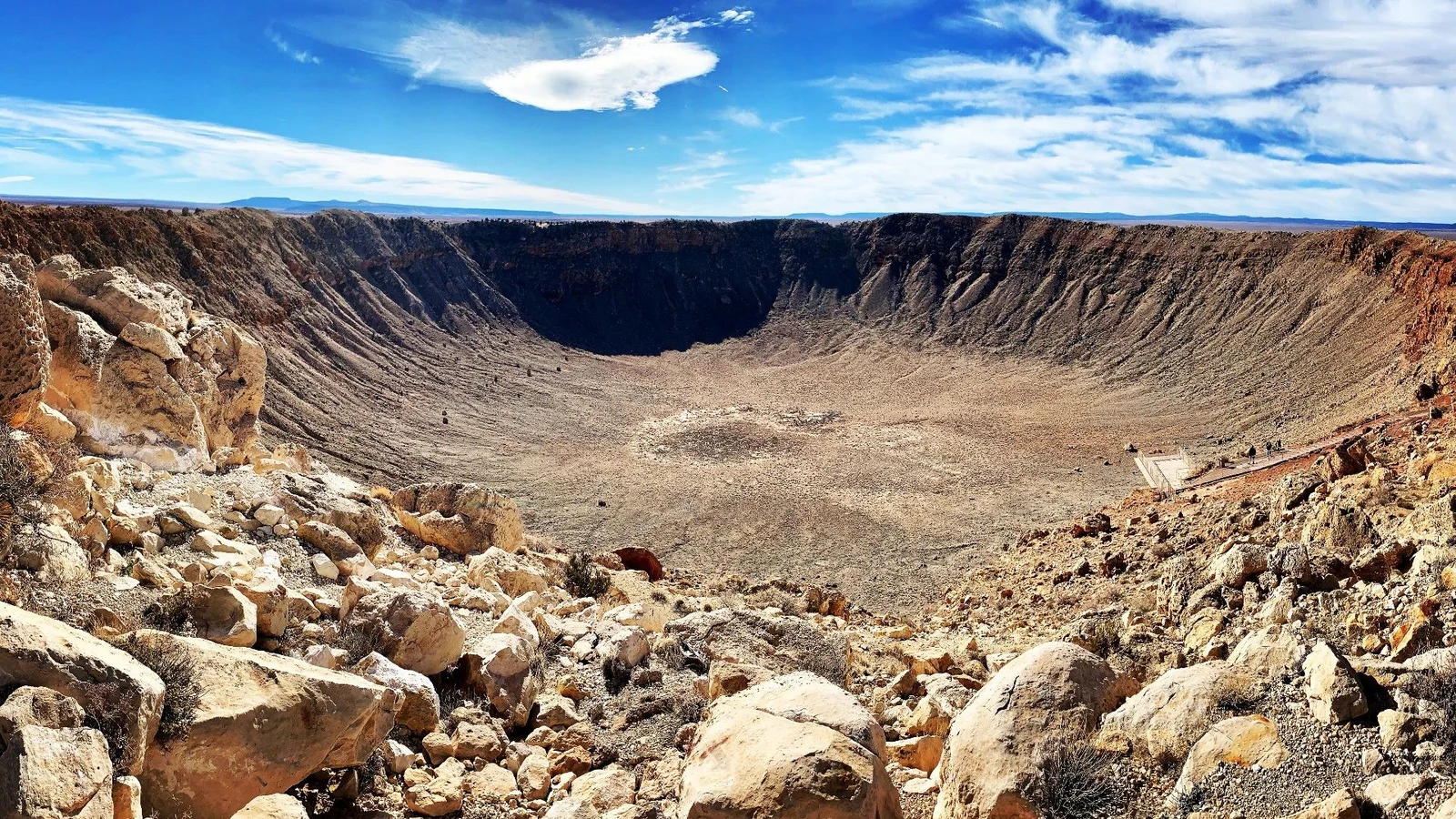
Arizona’s Meteor Crater, formed about 50,000 years ago, remains the best-preserved Earth impact site and a living laboratory for studying impact processes. Ongoing fieldwork, lab analyses, and computer studies—supported by Barringer Family Fund grants—continue to produce new data, with researchers like Dan Durda saying the crater provides new insights every year and climate and geological processes can obscure other craters elsewhere.
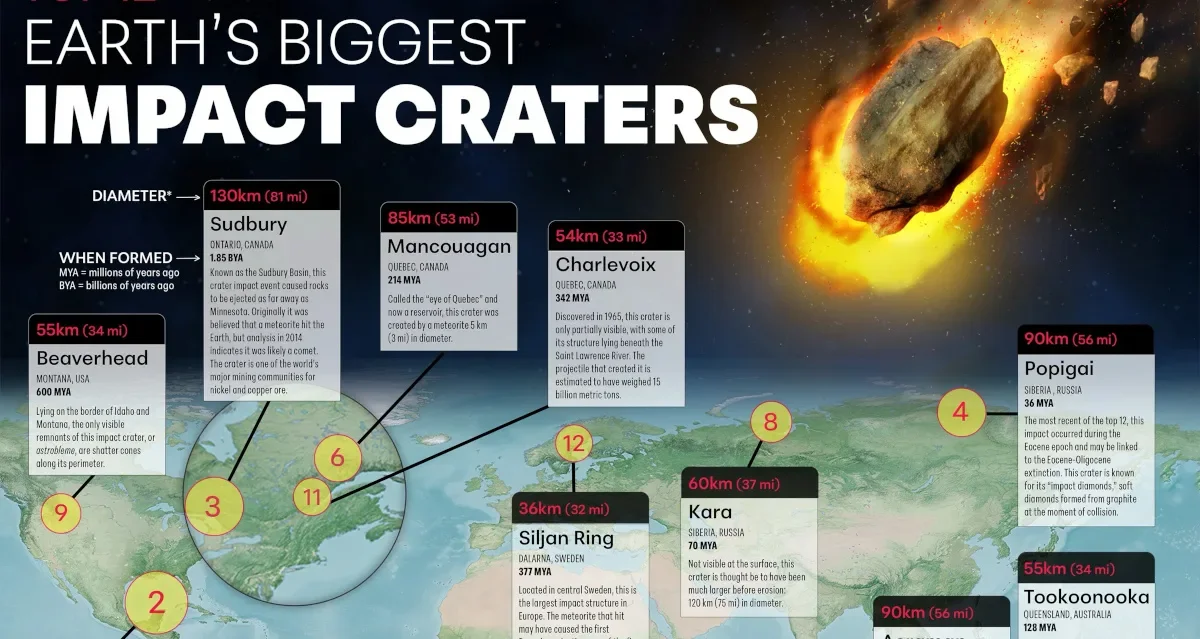
Visual Capitalist maps the 12 largest confirmed Earth impact craters, led by Vredefort (≈160 km) in South Africa and Chicxulub (≈150 km) in Mexico; other entries include Sudbury, Popigai, Acraman, Manicouagan, Morokweng, Kara, Beaverhead, Tookoonooka, Charlevoix, and Siljan. The article notes that crater size doesn’t always predict devastation—impact energy, velocity, angle, and composition are crucial—with Chicxulub likely releasing over 100 million megatons of TNT and triggering mass extinction, while older craters like Sudbury and Morokweng formed long before complex life. Many ancient craters have eroded away, making these 12 especially valuable for studying Earth’s violent history, and some preserve significant mineral deposits and geology from their cosmic origins.
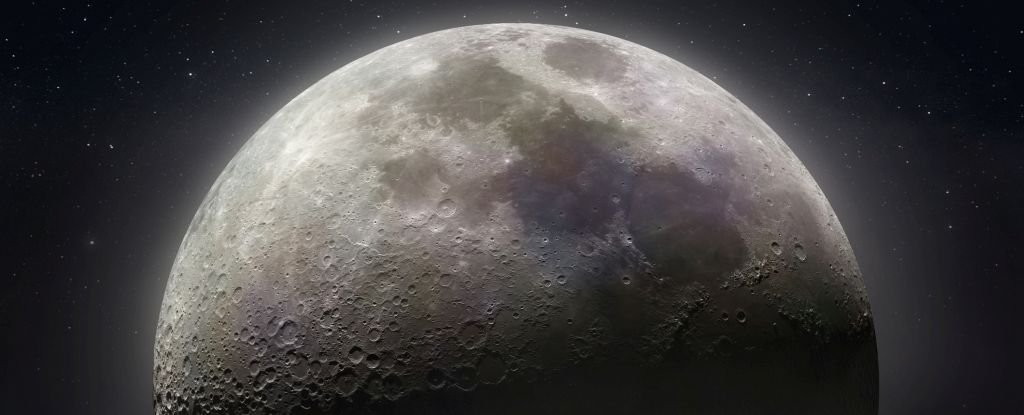
A new study suggests that the Moon's impact craters may contain significant deposits of platinum-group metals and water, making it a promising and more accessible target for space mining compared to asteroids, with potential benefits for resource sustainability and space exploration.
A study reveals that two massive asteroid impacts on Earth 36 million years ago did not cause long-term climate changes. The asteroids, striking within 25,000 years of each other, created significant craters in Siberia and Chesapeake Bay. Analysis of isotopes in marine fossils from that era shows no major climate shifts in the 150,000 years following the impacts. The research highlights the resilience of Earth's climate to such events, though the immediate effects would have been catastrophic on a human timescale.
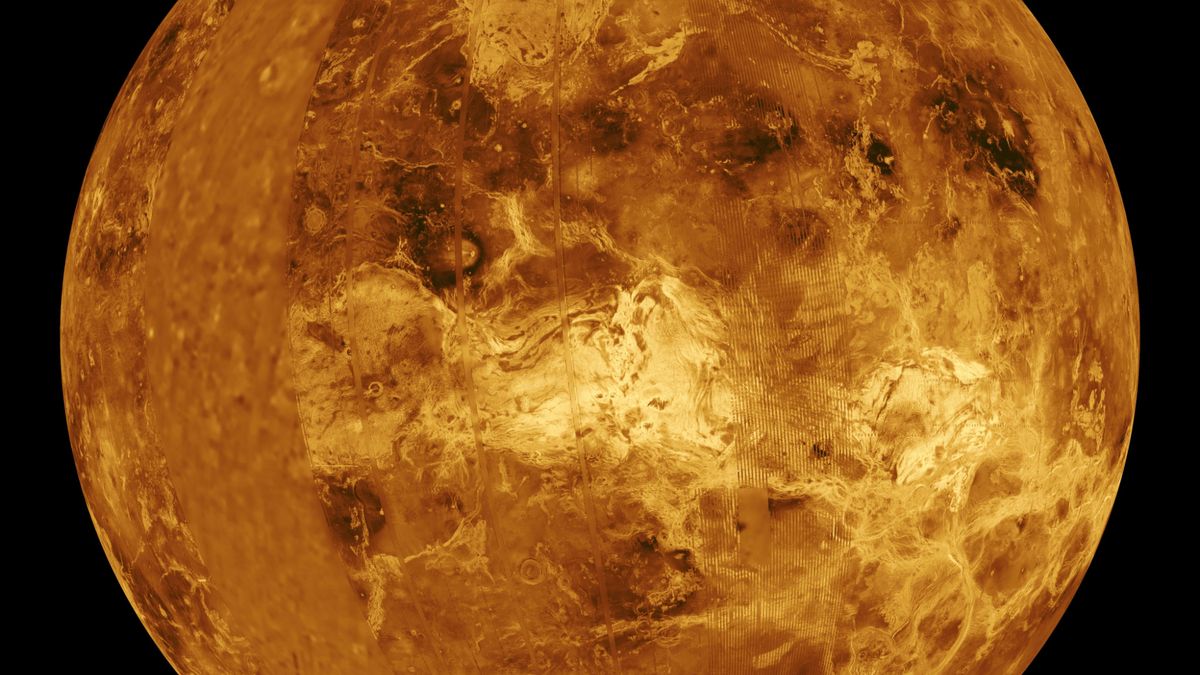
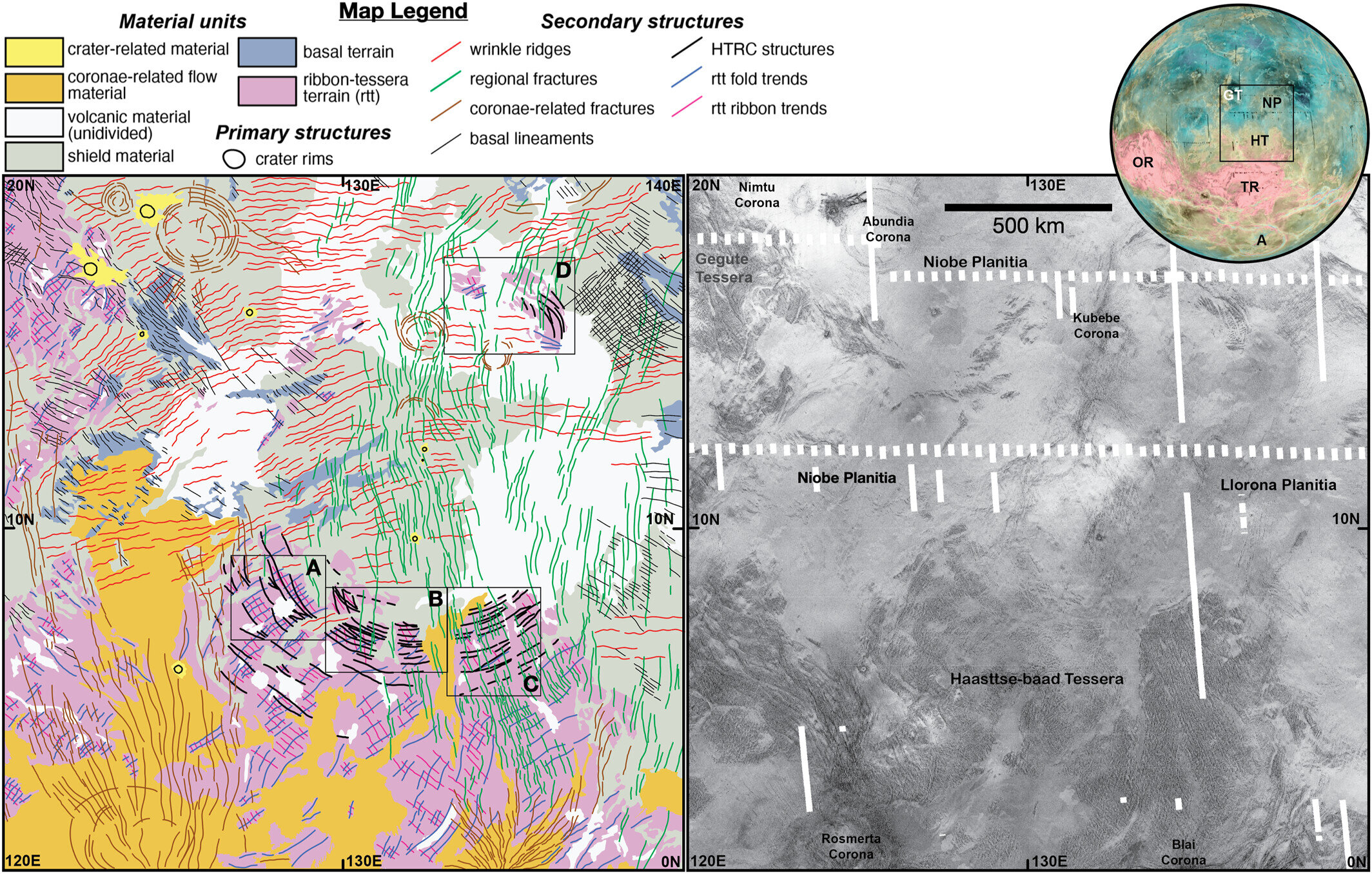
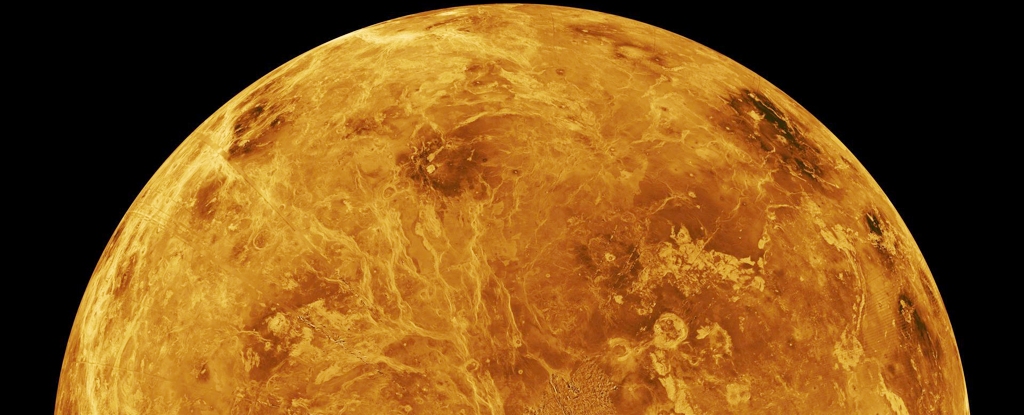
A team of planetary scientists suggests that Venus' tesserae formations, large deformed terrains on the planet's surface, may actually be ancient impact craters. These formations, like the Haastte-baad tessera, could have been created by asteroid impacts that penetrated Venus' thin lithosphere, allowing lava to pool and form the tesserae. The study indicates that these features might provide insights into Venus' geological history, as they could be remnants of impacts from 1.5 to 4 billion years ago. The findings were published in the Journal of Geophysical Research: Planets.
A study by geologists from Universidad Rey Juan Carlos, Lawrence Livermore National Laboratory, and the University of Minnesota suggests that the Haasttse-baad Tessera on Venus was formed by two large impacts early in the planet's history. Using geologic relations and numerical modeling, the researchers found similarities between the concentric circles of Haasttse-baad Tessera and formations on Jupiter's moon Callisto, indicating that impacts caused molten material to deform the crust. The study proposes that two objects, each about 75 kilometers across, struck Venus in the same area, leading to the unique formation.
Scientists have discovered evidence of large impact craters on Venus, known as tessera terrain, which are concentric rings formed by two massive impacts on the planet's thin crust about 3.5 billion years ago. This finding challenges previous assumptions about Venus's geological history and suggests that not all impact structures resemble traditional craters. The study, published in the Journal of Geophysical Research: Planets, provides new insights into the early processes of planetary formation and evolution.
A recent study presented at the 55th annual Lunar and Planetary Science Conference revealed that a single large impact crater on Mars, called Corinto, created over two billion smaller craters up to almost 2000 km away. The crater, located in Elysium Planitia, has an extensive "ray system" and is relatively young, estimated to be around 2.34 million years old. The study used data from the Mars Reconnaissance Orbiter to analyze characteristics of the smaller craters surrounding Corinto, grouping them into five different "facies." This discovery raises questions about the impact processes on Mars and is likely to attract further research.
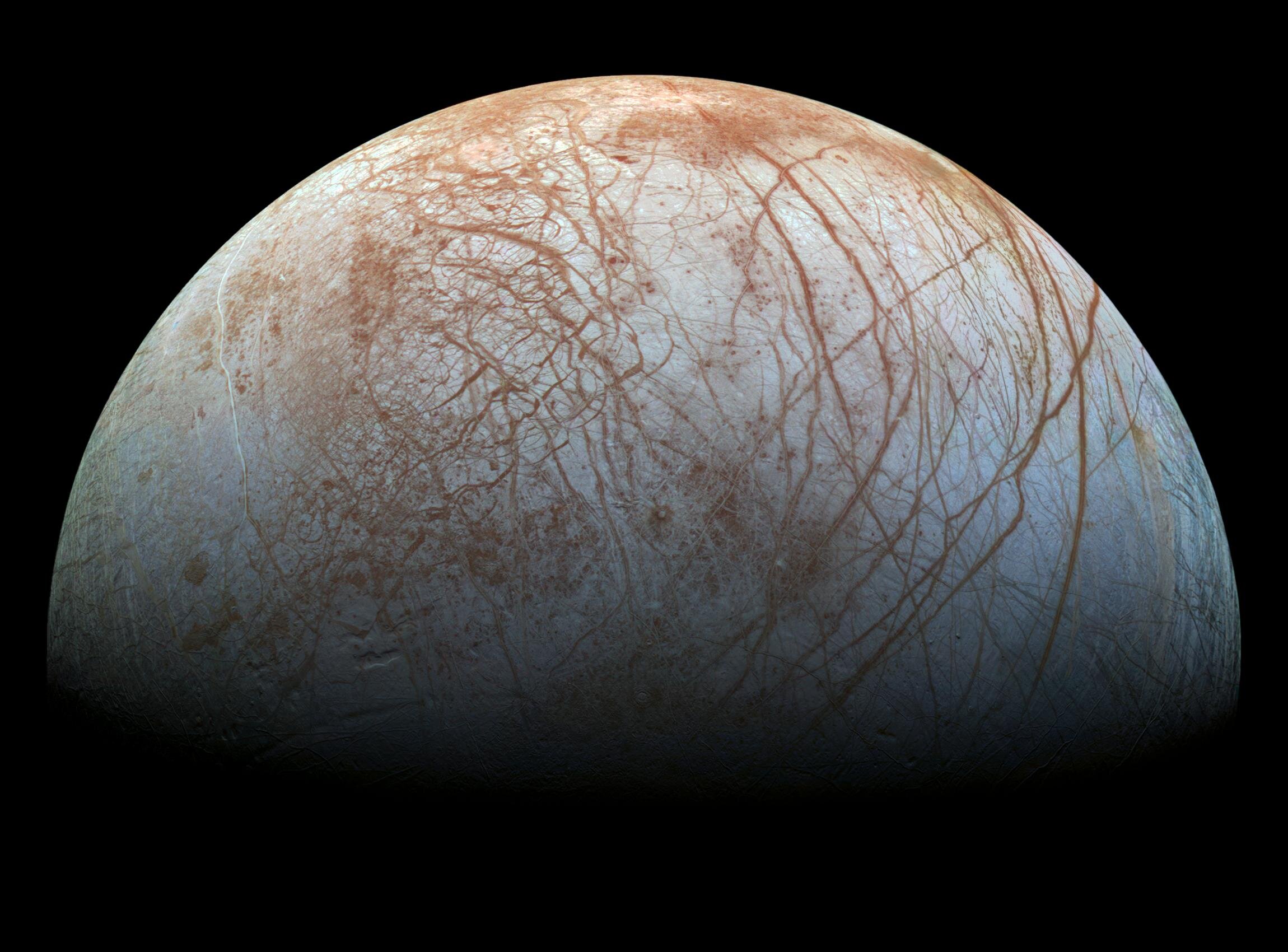
Planetary scientists have used physics and images of impact craters to estimate the thickness of the ice shell on Jupiter's moon, Europa. By studying large craters on Europa's surface, researchers concluded that the ice shell is at least 20 kilometers thick, challenging previous estimates of a thin ice layer over a thick ocean. This finding is crucial for understanding the potential for life on Europa, as the ice shell's thickness influences processes within it and the exchange of material between the surface and the ocean.