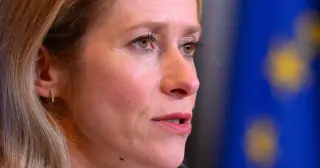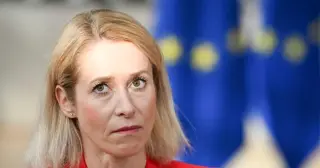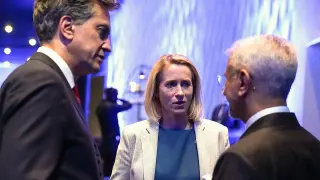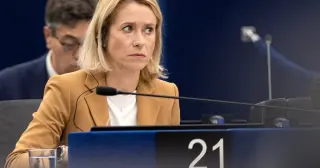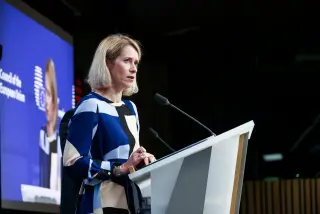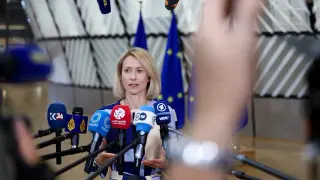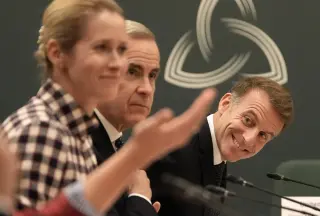
Russia declared EU foreign policy chief Kaja Kallas unacceptable for peace negotiations, warning her participation would derail talks. This follows her exclusion from the official EU negotiating team by leaders in Dublin. While Kallas demands an immediate ceasefire and maximalist concessions from Moscow, some European governments advocate for gradual confidence-building measures, highlighting a strategic divide within the EU.
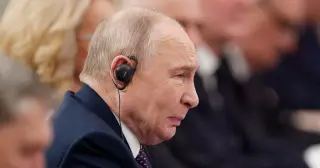
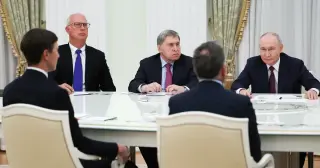
European leaders have settled on a seven-member negotiating team for Ukraine peace talks but remain deeply divided on strategy. While EU chief diplomat Kaja Kallas pushes for a hardline approach demanding immediate Russian concessions, Austria and others favor gradual confidence-building measures. Meanwhile, Vladimir Putin has invited EU representatives to Moscow to clarify their positions, though the Kremlin has not guaranteed a formal seat at the table.
European leaders are alarmed by US proposals to renegotiate Europe’s security architecture, viewing it as a trap that echoes Russian maximalist demands. While Washington seeks a comprehensive deal, Europe insists on a ceasefire first and rejects any role for Russia in defining continental defense. Simultaneously, EU foreign policy chief Kaja Kallas has been excluded from the official negotiating team, highlighting internal divisions over who represents Europe in peace talks.
EU High Representative Kaja Kallas dismissed Russian peace demands as 'absurd' on Monday, arguing Moscow must move first to end the conflict it started. She criticized the Kremlin's tactic of presenting maximalist asks, including full Ukrainian withdrawal from Donbas and NATO retreat to 1997 borders, as a strategy to appear reasonable when they later back down. Although Kallas is not part of the newly formed EU negotiating team, she emphasized the bloc's leverage through sanctions and over €200 billion in frozen Russian assets. The EU has agreed on a team comprising Poland, Germany, Italy, France, and the UK, plus the European Council and Commission, to represent the bloc in future talks. These discussions follow a decision by EU leaders in Dublin and precede a potential meeting between Trump, Putin, and Xi in Shenzhen. While Kallas supports the team's mandate, some foreign ministers remain skeptical of the talks' success, urging increased pressure on Russia instead.
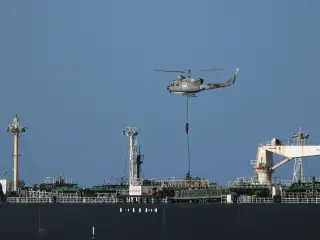
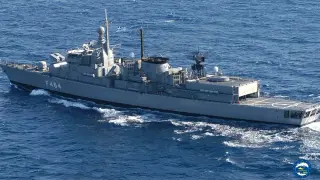
EU naval forces boarded the tanker MV Midag in the Mediterranean on November 13, confirming it was sailing under a false flag. The operation, conducted by the EU mission Operation IRINI, is part of a broader effort to disrupt Russia's shadow fleet. EU foreign ministers are set to approve new sanctions targeting banks and companies supporting this network on November 16.
EU naval forces boarded the MV Midag in the Mediterranean on November 13, confirming it was sailing under a false flag. Kaja Kallas announced the action on November 15, stating the EU will continue disrupting Russia's shadow fleet. New sanctions targeting banks and companies supporting the fleet are expected to be approved by EU foreign ministers on November 16.
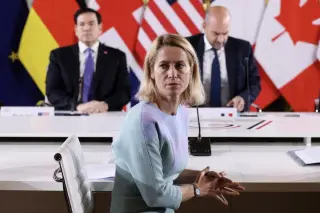
EU foreign policy chief Kaja Kallas warned that Russia is attempting to derail Ukraine peace talks by demanding immediate discussions on European security architecture. She insisted that a ceasefire must precede any broader negotiations, accusing Moscow of setting traps to weaken Europe's position. While the US has asked Russia to propose new security terms, European leaders remain divided on representation, with Kallas asserting her mandate to speak for all 27 EU members against a fragmented approach.
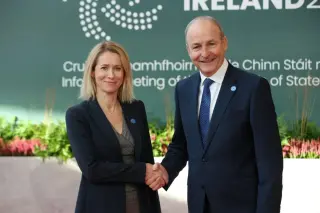
EU leaders in Dublin are debating whether to appoint a single special envoy or a broader team for Ukraine peace talks. Kaja Kallas argues her role as High Representative is sufficient, while António Costa leads a push for a unified 'E5' group. Meanwhile, Russia has revived 2021 demands for NATO to retreat to 1997 borders, complicating US-led negotiations in Abu Dhabi.
Estonian Prime Minister Kristen Michal rejected calls to replace EU foreign policy chief Kaja Kallas with a more Kremlin-friendly envoy, insisting that European Council President António Costa and Kallas already hold the mandate to represent the bloc. This stance emerged ahead of a Dublin summit where leaders are grappling with how to engage in US-mediated peace talks, with some capitals fearing Kallas’s hawkish stance hinders diplomacy while others argue Moscow has no say in Europe’s representation.
EU foreign policy chief Kaja Kallas rejected any US-Russia security deal that excludes Europe, stating that such agreements would not be implemented. She demanded Russian accountability for war crimes, compensation for destruction, and the return of deported children. Kallas emphasized that concessions must come from the aggressor, not the victim, and warned against legal recognition of occupied territories or limits on Ukraine’s military. She noted that Russia is preparing winter attacks on energy infrastructure to force surrender, while the EU disbursed €4.36 billion in support. Polish and Ukrainian officials echoed these demands, insisting that Europe’s participation is essential for any lasting peace.
EU foreign policy chief Kaja Kallas warned that Vladimir Putin’s potential attendance at the December G20 summit in Miami risks normalizing Russian war crimes. This stance follows a contentious G20 ministerial meeting in Atlanta, where European officials refused to pose for a group photo with Russian Foreign Minister Sergei Lavrov due to his sanctioned status. While the US approved 500 Patriot interceptors for Ukraine, Kallas criticized Lavrov for spreading false narratives and called for tougher sanctions, rejecting Pentagon advice to soften rhetoric.
EU foreign policy chief Kaja Kallas accused Russian FM Lavrov of spreading 'lies' at the G20 in Atlanta, where European ministers refused a group photo with him. The US approved 500 Patriot interceptors for Ukraine but warned delivery may take years, while Zelenskyy urged faster support. Separately, four former leaders called on the EU to seize €210 billion in frozen Russian assets to fund Ukraine.
EU High Representative Kaja Kallas has opted for a diplomatic delay rather than immediate action against US sanctions targeting the International Criminal Court (ICC). While nearly 60 MEPs urged the Commission to activate the EU blocking statute to shield the court from US financial measures, Kallas argued that a 180-day implementation window allows for necessary legal analysis and dialogue. This cautious approach contrasts with the aggressive stance of Washington, which has sanctioned nine ICC judges and the chief prosecutor, and with internal EU dissent from far-right factions supporting the US move. The dispute highlights a deepening crisis in international justice, exacerbated by the recent removal of ICC prosecutor Karim Khan and US threats to dismantle the court entirely.
EU ambassadors unanimously approved a record-breaking list of 1,646 new sanctions targeting Russia’s military-industrial complex and political figures on October 7, 2026. The package, which includes 743 individuals and 826 entities, will be formally adopted by foreign ministers on October 12. This expansion brings the total number of sanctioned Russian targets to nearly 4,650, marking a significant escalation in economic pressure against Moscow.
EU foreign ministers are developing an 'emergency security protocol' to coordinate responses to Russian sabotage and hybrid threats that fall below the threshold for armed aggression. The initiative, led by Kaja Kallas and Ursula von der Leyen, aims to fill a gap in current defense structures, which some officials argue are too slow for non-military attacks. This move follows a surge in incidents, including a Russian aircraft breaching Finnish airspace and various arson and cyberattacks across Europe, as officials debate whether new mechanisms will effectively deter Moscow or merely duplicate existing NATO processes.