Tag

Mantle

All articles tagged with #mantle

Neutrinos Sketch Earth's Mantle Heat Map
science18 days ago

Neutrinos Sketch Earth's Mantle Heat Map

A global network of neutrino detectors, including Canada’s SNO+ and China’s JUNO, is measuring geoneutrinos to quantify the heat-producing elements in Earth’s mantle. Early results from SNO+ show western hemisphere fluxes that hint at mantle heterogeneity linked to deep structures like large low-shear-velocity provinces (LLSVPs), but large uncertainties remain. More data and improved geological modeling, and possibly an ocean-bottom detector, could sharpen the map of the planet’s interior heat sources.

Four tech advances unlock the deep ocean's hidden frontiers
science1 month ago

Four tech advances unlock the deep ocean's hidden frontiers

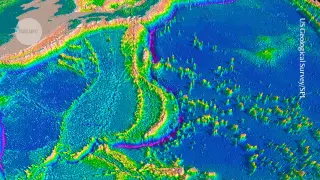
Scientists are unlocking the deep ocean with four key technologies: ocean-bottom seismometers mapping mantle convection; China’s Meng Xiang drilling ship to obtain pristine mantle samples; hydrophones enabling rapid, global tsunami prediction; and repurposed deep-sea cables transforming into a vast seismic surveillance network—together they aim to illuminate Earth’s mantle, plate tectonics and coastal hazards in a region still largely unmapped.

Utah's Hidden Mantle Quakes Rewrite Deep-Earth Tectonics
science2 months ago

Utah's Hidden Mantle Quakes Rewrite Deep-Earth Tectonics

A previously mysterious 1979 Utah quake—deep beneath the crust at about 55 miles down—kicks off new research identifying eight later deep earthquakes in the upper mantle near the Wyoming Craton. Scientists say these mantle quakes are archetypal continental mantle events driven by slow mantle flow around cratonic roots, lack foreshocks/aftershocks, and illustrate a tectonic regime at extreme depths that differs from crustal earthquakes.

Utah Quakes Reveal Surprising Mantle Movements Beneath the Craton
science2 months ago

Utah Quakes Reveal Surprising Mantle Movements Beneath the Craton

Scientists reviewing a 1979 northern Utah quake (magnitude 3.8) and eight later deep earthquakes have confirmed they originate in the upper mantle, dozens of miles below the crust, near the Wyoming Craton. The findings, published in The Seismic Record, suggest mantle flow around the craton triggers these deep continental earthquakes, a type of seismic activity that operates very differently from crustal quakes and may vary greatly in size over geologic timescales, underscoring how much about deep Earth remains to be learned.

Earth’s Hidden Mantle Water May Outsize All Surface Freshwater
science2 months ago

Earth’s Hidden Mantle Water May Outsize All Surface Freshwater

A diamond-hosted ringwoodite inclusion proves water is chemically bound in Earth's mantle transition zone (410–660 km deep). If representative, this hydrated zone could hold multiple times the volume of Earth’s surface oceans, making mantle water a vast, long-term reservoir that participates in the deep water cycle. The water is not liquid at surface conditions and isn’t recoverable on human timescales, but its existence reshapes our understanding of Earth's total water budget and how surface oceans are buffered over geological time.

Deep mantle heat flow explains Indian Ocean gravity dip
science3 months ago

Deep mantle heat flow explains Indian Ocean gravity dip

Scientists modeling Earth’s interior propose a long-lived, hot, low-density mantle upwelling originating beneath Africa drifts east beneath the Indian Ocean, reducing local mass and producing the observed geoid low. The idea, supported by 100-million-year simulations and the Indian plate’s motion, explains why satellite data show a persistent dip in the sea surface, though the interpretation is still debated.

Hidden Deep-Earth Ocean Could Triple Earth's Water
science3 months ago

Hidden Deep-Earth Ocean Could Triple Earth's Water

Scientists report a vast, bound water reservoir about 700 km below the surface, stored in the mineral ringwoodite in the mantle's transition zone. Using seismic data from roughly 2,000 stations and 500 earthquakes, they estimate this deep ocean could contain about three times as much water as all surface oceans, suggesting Earth's water partly originates from within and that the deep cycle helps keep surface oceans stable over geological time.

Mantle Clues Hint at a New African Rift Under Zambia
science3 months ago

Mantle Clues Hint at a New African Rift Under Zambia

Geologists studying the Kafue Rift in Zambia found mantle-derived helium signatures in hot springs, suggesting an active fault boundary and early signs that sub-Saharan Africa may be splitting; while this raises the possibility of geothermal energy opportunities, the researchers caution that data from other segments are needed to confirm a new plate boundary.

1.27-km mantle core uncovers Earth's hidden interior
science3 months ago

1.27-km mantle core uncovers Earth's hidden interior

Scientists pulled a 1,268‑meter section from the Earth’s mantle during JOIDES Resolution Expedition 399, a milestone in Earth science. The mantle rocks show less pyroxene and more magnesium than expected, suggesting more melting in the mantle than previously thought and offering new clues about how magma forms and powers seabed volcanism. The findings also hint that olivine reacting with seawater could produce hydrogen, a potential piece of life’s origin puzzle. The team, led by Professor Johan Lissenberg, will continue analyses, with the study published in Science.

Etna's magma hints at a previously unknown type of volcanism
planet-earth3 months ago

Etna's magma hints at a previously unknown type of volcanism

A new study finds Mount Etna's lava originates from a melt in the mantle's low-velocity zone and rises through a tectonically complex zone at the Africa-Eurasia boundary, producing early silica-rich lava and later alkali-rich lava, suggesting Etna represents a previously unclassified form of volcanism that could be more widespread than scientists previously thought.

Ancient subduction zones could guide a new hunt for rare earth deposits
science4 months ago

Ancient subduction zones could guide a new hunt for rare earth deposits

A Science Advances study links rare earth element formation to fertilized mantle regions created by fluids released at ancient subduction zones; alkaline and carbonatite magmas hosting these elements cluster above these fertilized mantle zones, and a majority of known deposits lie there, offering a targeted strategy for locating large reserves.

Yellowstone's Heat Source Traced to Shallow Mantle, New Study Finds
earth-science4 months ago

Yellowstone's Heat Source Traced to Shallow Mantle, New Study Finds

A new 3D model of Yellowstone and the Eastern Snake River Plain suggests tectonic forces within the lithosphere drive magma generation and migration from the shallow mantle (upper asthenosphere) into a complex plumbing system, rather than a deep mantle plume powering a single giant chamber. This tectonically controlled magma movement could improve eruption forecasting and hazard assessment for the park’s massive caldera, whose last major eruption occurred about 630,000 years ago and is not expected imminently.

Earth’s Deep Mantle Giants Reshape the Height Chart: 1,000-km Structures Beneath Africa and the Pacific
science5 months ago

Earth’s Deep Mantle Giants Reshape the Height Chart: 1,000-km Structures Beneath Africa and the Pacific

A Utrecht University study using full-planet normal-mode seismology reveals two Large Low Shear Velocity Provinces beneath Africa and the central Pacific, rising about 1,000 kilometers from the core–mantle boundary. These thermochemical structures, billions of years old, appear to anchor mantle flow and influence surface tectonics; they are not surface mountains, but if placed at the surface they would extend high into the atmosphere, effectively redefining what counts as Earth's tallest feature.