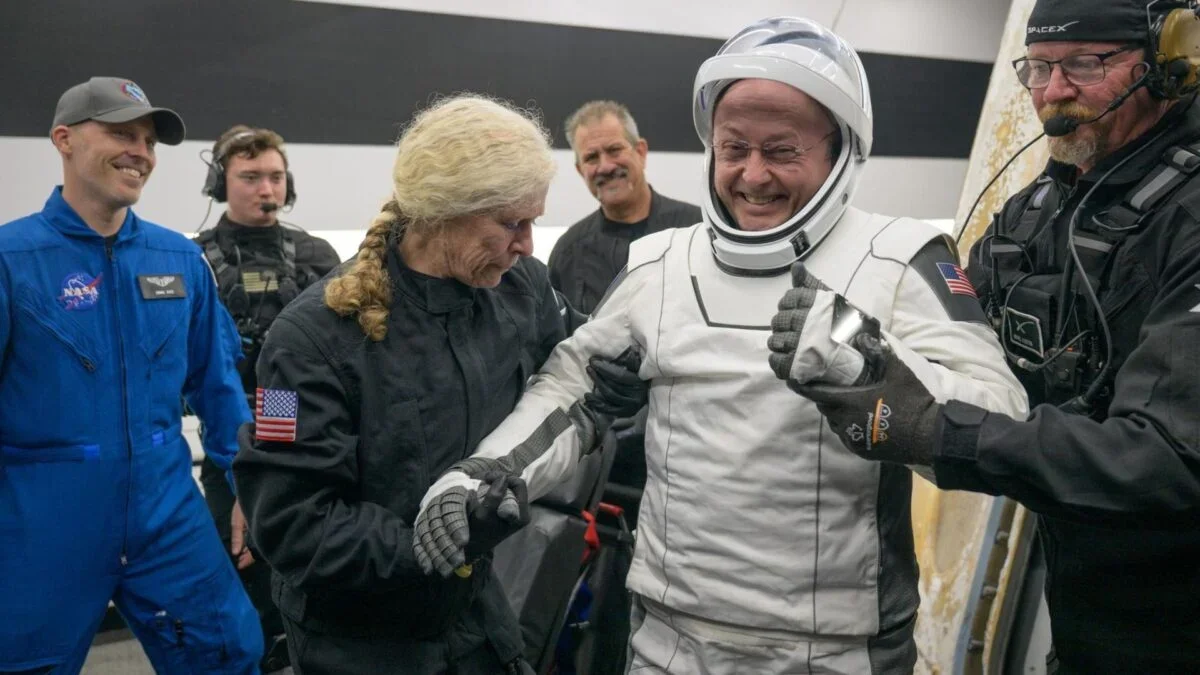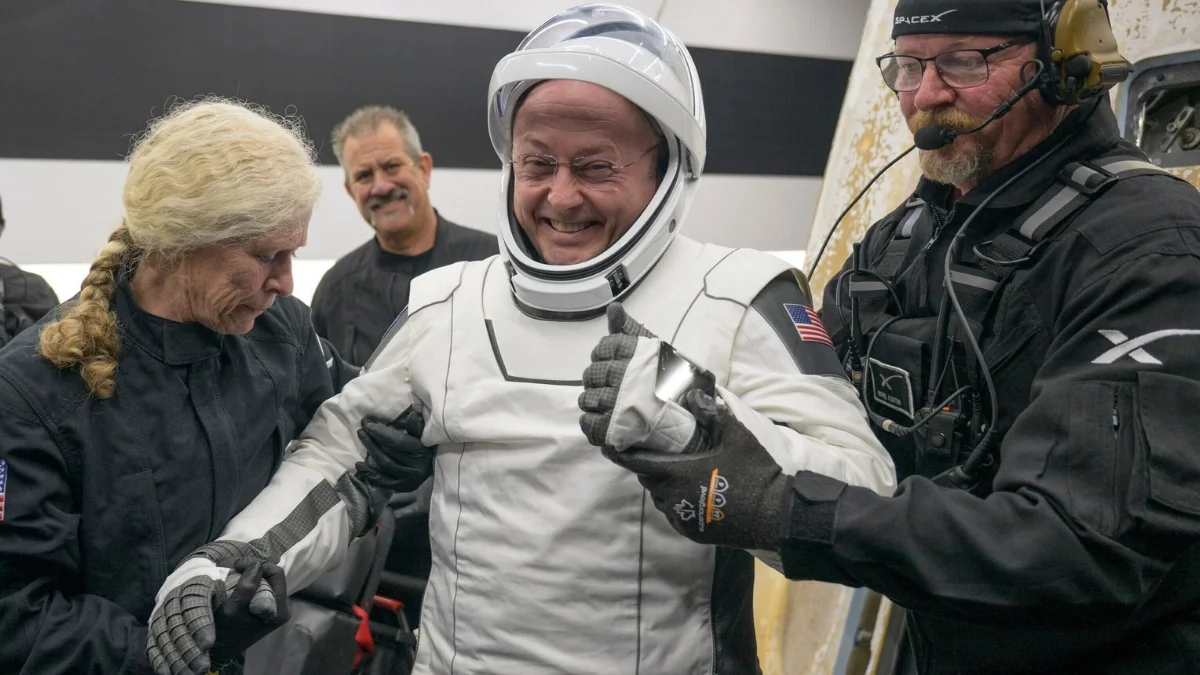
NASA's Crew-11 faced an abrupt on-orbit medical emergency when Mike Fincke suddenly lost the ability to speak during dinner, prompting NASA's first ISS medical evacuation in 25 years; he was returned to Earth after on-board care using ultrasound, and doctors say the cause remains unclear but likely space-related, with researchers planning further investigation.
NASA astronaut Mike Fincke suddenly couldn’t speak during a Jan. 7 meal on the International Space Station; doctors ruled out a heart attack and are continuing to investigate a roughly 20-minute episode that prompted a medical evacuation, the early return of the crew, and the cancellation of a planned spacewalk, with Fincke undergoing tests as NASA reviews for similar incidents.
A veteran NASA astronaut, Michael Fincke, suddenly lost the ability to speak aboard the International Space Station for about 20 minutes, triggering emergency protocols and NASA’s first in-orbit medical evacuation. No cause was identified, highlighting the limits of space medicine and raising concerns about health risks on longer missions like Artemis II.
A U.S. Coast Guard rescue swimmer, Tyler Jaggers, died from injuries sustained during a medical evacuation off the coast of Washington state on March 5, 2026, after a wedding proposal and promotion ceremony honored him earlier.
NASA’s January emergency on the International Space Station led to its first-ever medical evacuation; astronaut Mike Fincke later disclosed he experienced a medical event that required immediate care, while the other Crew-11 members were evacuated to a California hospital. NASA says Fincke chose to self-identify for privacy and to curb speculation, but the exact cause remains private, leaving details of the incident and its implications largely unclear.
In the Survivor 50 premiere, Kyle Fraser was medically evacuated after injuring his leg during the opening immunity challenge; doctors suspected a torn ACL and pulled him from the game. The returning winner had strong early alliances, but his exit leaves his tribe in a difficult position. Reporters later noted that the on-screen jump shown in the episode wasn’t the actual moment of injury.
NASA ended Crew-11’s stay on the ISS after Mike Fincke suffered an unknown medical event on Jan 7—the first medical evacuation in ISS history—cancelling a spacewalk and returning the crew early on Jan 15; Fincke is recovering at Johnson Space Center, and Crew-12 has since docked to replace them for an eight-month stay.
NASA confirmed that astronaut Mike Fincke was the crewmate whose medical issue prompted the International Space Station’s first medical evacuation during a SpaceX mission. Fincke says his condition stabilized thanks to crewmates and ground flight surgeons, and he’s doing well; the exact ailment wasn’t disclosed. An ultrasound used on the station aided the response, and the crisis led to the cancellation of a planned spacewalk. After splashdown and hospital care, the crew returned to Houston. Fincke has 549 days in space across four missions.
NASA astronaut Mike Fincke has publicly identified himself as the ailing crew member whose medical condition prompted the International Space Station’s first medical evacuation. His illness quickly stabilized thanks to crewmates and ground flight surgeons, the mission ended early, and he is doing well now. The station’s ultrasound and other imaging aided the assessment, though Fincke stressed it was not an emergency; the team chose to leverage advanced medical imaging not available on the station.
NASA disclosed that astronaut Mike Fincke experienced a medical issue during SpaceX's Crew-11 mission to the ISS that required urgent attention not available on the station, prompting an early return of all four Crew-11 crewmates—Fincke, Zena Cardman, Kimiya Yui and Oleg Platonov—aboard Endeavour on Jan. 15. The exact ailment was not disclosed, but it necessitated advanced medical imaging on Earth. The Crew-11 return left a skeleton crew aboard the ISS until Crew-12 arrived, and Fincke is recovering at NASA's Johnson Space Center after landing as mission planners adjusted Crew-12's launch to maintain operations.
Four astronauts—NASA’s Jessica Meir and Jack Hathaway, France’s Sophie Adenot, and Russia’s Andrei Fedyaev—arrived at the International Space Station on Feb. 14, 2026, restoring its crew after a January medical evacuation left the station with three. The diverse team will carry out biology, physics, engineering, and technology research, while NASA and partners review contingency plans highlighted by the health scare, the first NASA medical evacuation in about 65 years.
Four astronauts from the US, France, and Russia—Jessica Meir, Jack Hathaway, Sophie Adenot, and Andrey Fedyaev—arrived at the ISS aboard a SpaceX capsule, reconstituting a full crew after a medical evacuation shortened a prior mission; they will stay for about eight to nine months and resume spacewalks and research.
The Rafah border crossing between Gaza and Egypt reopened after a two-day closure, permitting a limited number of Palestinians to travel for medical evacuations (17 evacuees and 27 companions crossing to Egypt, with the same number expected to return). Crossings remain tightly controlled under a brokered deal, with about 50 people allowed to return to Gaza and 50 medical patients leaving per day, amid ongoing U.S.-backed ceasefire talks and Hamas-Israel negotiations. Reports highlighted delays and screening procedures, while EU-led border oversight and continued discussions on security and disarmament framed the broader context.
During the first week of Rafah’s partial reopening, Palestinians faced confusion and logistical delays as far fewer crossed than expected: Israeli officials had hinted that up to 150 could leave Gaza and 50 could enter, but CNN tallies showed just 12 people crossing in each direction on the reopening day and a high of about 40 the following day. Many medical evacuees with prior approvals could not re-enter Gaza, while thousands more in Gaza await permission to travel for treatment. Rights groups reported mistreatment at checkpoints, and the process remains unsettled as the three-way security checks (Egypt, EU border staff, Israel) and AMA/APRC-guided item restrictions are being worked out. Amid the delays, reunions in Gaza were emotional, but the week underscored a slow, disorganized start to what was framed as a humanitarian reopening two years after the crossing closed.
Israel reopened the Rafah crossing for a limited number of Palestinians to cross on foot—50 in each direction on day one—under joint Israeli-Egyptian security screening. The restricted opening could facilitate medical evacuations and limited travel for families, but tens of thousands remain cut off, with around 20,000 waiting for treatment and hundreds dying awaiting evacuation. The move is a small step within a wider, fragile ceasefire framework that envisions governance and security arrangements for Gaza in a second phase.