Tag

Octopus

All articles tagged with #octopus

Oldest 'octopus' fossil reclassified as nautiloid
science1 day ago

Oldest 'octopus' fossil reclassified as nautiloid

A fossil long hailed as the oldest octopus, Pohlsepia mazonensis from Mazon Creek (~311–306 million years ago), has been re-examined with advanced imaging. Using synchrotron X-ray, micro-CT, SEM, and multispectral imaging, researchers found no octopus features (no eight-arm anatomy, no internal shell, no ink sac, no hooks) and no ocular pigments. They identified a preserved radula and dental pattern that match nautiloids, revealing it died, decomposed, and was flattened into mud, preserving soft tissue as two-dimensional stains. This makes Pohlsepia the oldest confirmed nautiloid soft-tissue fossil in the Paleozoic, and the study suggests other Mazon Creek fossils could yield similar revelations.

Ancient fossil labeled oldest octopus debunked: a nautiloid, not an octopus
science1 day ago

Ancient fossil labeled oldest octopus debunked: a nautiloid, not an octopus

A 300-million-year-old fossil once hailed as the world’s oldest octopus has been reclassified as a nautiloid after new analyses, including synchrotron imaging and detailed geochemistry. The researchers found a radula with many rows of teeth inconsistent with octopuses, explaining why the fossil looked octopus-like as it decomposed. Discovered at the Mazon Creek site near Chicago, Pohlsepia mazonensis’ true identity underscores how advanced technologies are reshaping paleontology by revealing hidden anatomy that old methods missed.

Clever Octopus Triggers Tug-of-War with Hidden BRUVS Camera on Tuvalu Reef
science23 days ago

Clever Octopus Triggers Tug-of-War with Hidden BRUVS Camera on Tuvalu Reef

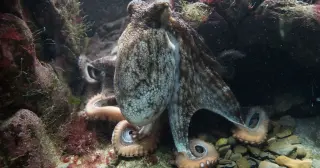
National Geographic Pristine Seas deployed baited underwater cameras on a Tuvalu reef; a day octopus (Octopus cyanea) grabbed the weighted canister, tugged it toward a nearby rock, and used its arms and taste receptors to investigate and try to access the sardines inside, moving a heavy 10–15 kg rig in a display of problem‑solving.

If Humans Vanish, Could Octopuses Rise to Rule Earth?
animals1 month ago

If Humans Vanish, Could Octopuses Rise to Rule Earth?

Earth after humans is explored as a thought experiment: Oxford biologist Tim Coulson suggests that while extinction is inevitable for all species, humans leaving the scene could let other life forms fill ecological roles, with octopuses highlighted as potential civilization-building successors due to their problem-solving abilities and decentralized nervous system—though they’d still face challenges adapting to land; evolution remains unpredictable and intelligence could emerge in surprising ways.

Octopuses Could Dominate Earth After Humans, New Analysis Suggests
science1 month ago

Octopuses Could Dominate Earth After Humans, New Analysis Suggests

Oxford biologist Tim Coulson argues that if humans vanished, octopuses—with their decentralized nervous system, problem-solving skills, and environmental versatility—could be best positioned to build a civilization and survive an upheaval of global ecosystems. While primates and birds show intelligence, limited lifespans and social constraints make them unlikely successors, and octopuses face challenges like short lifespans and the current lack of intergenerational culture. The scenario remains speculative, contingent on long-term evolutionary changes and environmental conditions.

Octopus Arms: Versatile Tools for Complex Behaviors
biology7 months ago

Octopus Arms: Versatile Tools for Complex Behaviors

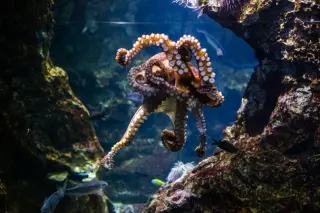
This study investigates how octopus arms facilitate complex behaviors in natural environments, revealing high flexibility, diverse arm actions, and localized deformations that support their ecological adaptability and inspire soft robotics. It highlights the hierarchical organization of behaviors, arm actions, and deformations, demonstrating that octopus arms can perform nearly all actions and deformations across all arms, with some task-specific partitioning, especially between anterior and posterior arms, in various shallow-water habitats.

Octopus Camouflage: A High-Energy Masterpiece
science1 year ago

Octopus Camouflage: A High-Energy Masterpiece

A study by biologists Sofie C. Sonner and Kirt L. Onthank reveals that the rapid color-changing ability of octopuses is energetically demanding, akin to a 23-minute jog for humans. This process involves specialized skin cells called chromatophores, which require significant oxygen consumption. The high metabolic cost may explain certain octopus behaviors, such as hiding in dens to conserve energy. The research highlights the exceptional energetic demands of cephalopod color change, suggesting it is one of the most costly forms of color change in the animal kingdom.