Tag

Interstellar

All articles tagged with #interstellar

Ancient interstellar visitor 3I/ATLAS could be a 10–12 billion-year relic from the Milky Way
space11 days ago

Ancient interstellar visitor 3I/ATLAS could be a 10–12 billion-year relic from the Milky Way

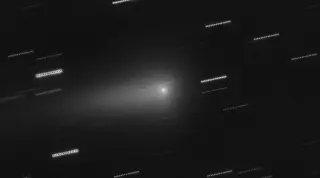
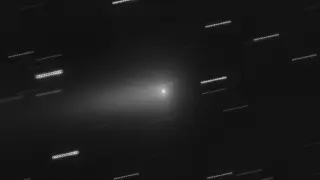
New JWST/NIRSpec analysis of interstellar comet 3I/ATLAS finds an unusually low carbon-13 to carbon-12 ratio and significant deuterium enrichment, implying it formed very early in the Milky Way’s history. Modeling suggests 3I/ATLAS may be 10–12 billion years old, potentially originating from a thick-disk star system, making it one of the oldest interstellar visitors and perhaps a relic from a vanished stellar neighborhood. The age estimate is not yet peer‑reviewed and is available via a preprint, with researchers noting ongoing uncertainty but tantalizing clues about ancient planet formation beyond our galaxy.

3I/Atlas Reveals Methanol-Rich Signature as It Leaves the Solar System
space1 month ago

3I/Atlas Reveals Methanol-Rich Signature as It Leaves the Solar System

Observations of interstellar comet 3I/Atlas show its coma is unusually rich in methanol—up to four times typical levels—along with carbon dioxide and other organics, suggesting formation in a colder or chemically distinct environment. The study, based on ALMA data, indicates methanol (and other gases) may be released from both the nucleus and sublimating icy grains in a hyperactive comet, supporting a natural origin. As it travels away from the Sun at about 60 km/s, 3I/Atlas reinforces that more interstellar visitors are likely to be found with advancing detection capability.

Gosling Leads a Lavish Yet Derivative Space Adventure
film1 month ago

Gosling Leads a Lavish Yet Derivative Space Adventure

Variety’s Owen Gleiberman calls Project Hail Mary a lavish, entertaining space epic: Gosling delivers a relatable, charming performance as a lone scientist and an onboard alien buddy adds warmth, but the movie is overlong and too derivative of Interstellar and other sci‑fi hits, with a padded finale and a formulaic emotional arc that undercuts its buzzy spectacle.

2035 Solar Oberth maneuver could intercept interstellar comet 3I/ATLAS
space1 month ago

2035 Solar Oberth maneuver could intercept interstellar comet 3I/ATLAS

Researchers from i4is propose an indirect intercept to interstellar comet 3I/ATLAS using a Solar Oberth maneuver, launching in 2035 to align Earth, Jupiter, and the comet. Direct Earth-launch missions are unlikely due to late detection and the comet’s high speed, making a flyby the most viable option. The plan could enable revolutionary science about other star systems, but propulsion readiness and long flight times (around 50 years) present major hurdles and DEP/advanced propulsion remain decades away.

Chalamet and McConaughey Reflect on Interstellar Bond and Craft in Texas Town Hall
entertainment1 month ago

Chalamet and McConaughey Reflect on Interstellar Bond and Craft in Texas Town Hall

Timothée Chalamet reunites with his Interstellar co-star Matthew McConaughey at a UT Austin town hall to reminisce about their early days on Christopher Nolan’s space epic, discuss how Nolan shaped their approach to acting, and explore Chalamet’s upcoming projects and Oscar ambitions, all delivered with warmth, humor, and mutual admiration as they share anecdotes and insights into their careers.

Interstellar Comet 3I/ATLAS Emerges Rich in Organics After Solar Pass
space1 month ago

Interstellar Comet 3I/ATLAS Emerges Rich in Organics After Solar Pass

NASA’s SPHEREx telescope observed the interstellar comet 3I/ATLAS erupting after its Sun encounter, releasing abundant organic compounds such as methanol, cyanide and methane along with relatively large fragments. The data suggest a radiation-processed crust and deeper ice reserves were heated, offering a rare glimpse at material formed around another star.

City-Sized Green Comet Eyes Interstellar Exit
space1 month ago

City-Sized Green Comet Eyes Interstellar Exit

Comet C/2024 E1 (Wierzchoś) is brightening as it nears its closest approach to Earth and is on a hyperbolic trajectory that will likely eject it from the solar system, making it another interstellar visitor like 3I/ATLAS. JWST detected significant CO2 in its coma and initial estimates put the nucleus around 13.7 km, thoughSize estimates vary. It passed perihelion earlier in January and will be about 151 million km from Earth on Feb. 17; the emerald iceball will not be naked-eye visible but can be observed with a telescope. Once sent on its interstellar journey, it will drift through the Milky Way for millions to billions of years.

Interstellar Comet 3I/ATLAS Flare Reveals Molecules From Another Star
space2 months ago

Interstellar Comet 3I/ATLAS Flare Reveals Molecules From Another Star

NASA’s SPHEREx infrared telescope observed interstellar comet 3I/ATLAS flare up as it was exiting the solar system in December 2025, revealing a coma rich in water vapor, carbon dioxide and complex organics (including methane, methanol and cyanide) and a pear-shaped dust tail. The observations suggest sunlight penetrated buried ices, triggering a delayed release of materials formed around another star. 3I/ATLAS is only the third confirmed interstellar object, discovered in 2025, with the findings published in February 2026 in the Research Notes of the American Astronomical Society.

Ring-Shaped Sulfur Molecule Detected in Interstellar Space, Linking Space Chemistry to Life's Origins
space2 months ago

Ring-Shaped Sulfur Molecule Detected in Interstellar Space, Linking Space Chemistry to Life's Origins

Astronomers detected thiepine (C6H6S), the largest sulfur-bearing molecule observed in interstellar space, in the G+0.693–0.027 molecular cloud near the Galactic center. By lab-synthesizing the molecule and matching its spectral fingerprint with observations from the IRAM 30m and Yebes 40m telescopes, researchers confirmed its presence and reinforced the idea that complex sulfur chemistry in star-forming regions could lay the groundwork for prebiotic molecules, linking space chemistry to the origins of life. The finding, published in Nature Astronomy, expands known interstellar sulfur chemistry and suggests more complex molecules await discovery.

Large sulfur-bearing molecule found in space hints at cosmic roots of life
science2 months ago

Large sulfur-bearing molecule found in space hints at cosmic roots of life

Astronomers have identified the largest sulfur-containing molecule ever seen in interstellar space—a 13-atom compound called 2,5-cyclohexadiene-1-thione—within a molecular cloud about 27,000 light-years from Earth. The discovery, made using radio telescopes IRAM-30m and Yebes and confirmed by a laboratory-synthesized radio fingerprint, fills a gap between simple space chemistry and the complex molecules tied to life. Researchers say sulfur-bearing molecules may be far more common in space than previously thought and could be delivered to early Earth via comets and meteorites, helping to bootstrap the chemistry that led to life. The finding suggests many more such sulfur-rich molecules could be detected in the future.

2025: A Year of Spectacular Space Discoveries and Images
science3 months ago

2025: A Year of Spectacular Space Discoveries and Images

2025 was notable for the appearance of three significant comets, including the interstellar 3I/ATLAS, which was the third interstellar object observed in our solar system, along with Comet Lemmon and Comet SWAN, each providing spectacular sights and scientific insights, despite some breaking apart or fading after their close approaches to the sun.

Interstellar Comet 3I/ATLAS Nears Earth in Close Approach
science3 months ago

Interstellar Comet 3I/ATLAS Nears Earth in Close Approach

Astronomer Avi Loeb discusses the interstellar object 3I/ATLAS, which recently passed Earth without incident, highlighting its long journey through the galaxy, unique features like a long anti-tail, and the importance of continued space exploration beyond the Moon and Mars. He emphasizes that 3I/ATLAS is likely a natural comet from another star, and underscores the need for vigilance against AI-generated fake content in science communication.

Interstellar Comet 3I/ATLAS Nears Closest Approach to Earth
science3 months ago

Interstellar Comet 3I/ATLAS Nears Closest Approach to Earth

Comet 3I/ATLAS, an interstellar visitor from beyond the Milky Way, made its closest approach to Earth on December 19, coming within 168 million miles, and is now heading back to the outer solar system. Its trajectory suggests it originated from an older, thick disk region of the galaxy, making it potentially the oldest comet observed. Its unexpected brightening near the sun has intrigued scientists, and data from this encounter will enhance understanding of interstellar objects and galactic history.