Tag

Thermogenesis

All articles tagged with #thermogenesis

science-and-health7 days ago

Aging Brown Fat Loses Heat-Producing Flexibility Due to Immune Signaling, Study Finds

Researchers at City of Hope have identified a biological mechanism explaining why older individuals feel colder. Published in Nature, the study reveals that brown fat cells, which generate heat, become less responsive to cold in aging mice due to elevated immune signals. While the drug mifepristone restored some heat production in older mice, the researchers caution that this specific drug is not a viable treatment for humans due to its broad side effects. The findings suggest that age-related metabolic declines, including those linked to obesity and type 2 diabetes, may be reversible if more precise interventions are developed.

Study Identifies Immune Proteins That Diminish Brown Fat Heat Production in Aging Mice
science10 days ago

Study Identifies Immune Proteins That Diminish Brown Fat Heat Production in Aging Mice

Researchers at City of Hope Medical Center identified why older individuals often feel colder: immune cells produce proteins that keep brown fat cells in a low-activity state. In mice, these proteins remained elevated with age, preventing efficient heat generation. The team successfully reversed this effect using the drug mifepristone, suggesting potential future therapies for age-related metabolic issues like obesity and type 2 diabetes, though direct application to humans requires further study.

Immune signals lock brown fat cells into low-heat states, explaining age-related cold sensitivity
science11 days ago

Immune signals lock brown fat cells into low-heat states, explaining age-related cold sensitivity

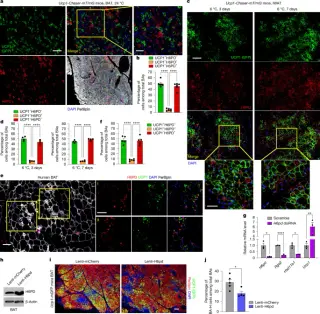
A study in Nature reveals that brown adipocytes exist in two distinct states: high-thermogenic (BA-H) and low-thermogenic (BA-L). Interleukin-1 beta (IL-1β) from immune cells stabilizes the BA-L state by preserving hexose-6-phosphate dehydrogenase (H6PD), which activates glucocorticoid receptors to suppress heat production. Cold exposure triggers sympathetic nerves to reduce IL-1β, allowing cells to switch to the heat-producing BA-H state. In aging mice, elevated IL-1β locks cells in the BA-L state, causing cold intolerance. Blocking the glucocorticoid receptor in aged mice restores heat production and energy expenditure.

SLIT3 Wiring in Brown Fat Boosts Calorie Burning and Heat Production
science8 months ago

SLIT3 Wiring in Brown Fat Boosts Calorie Burning and Heat Production

A Nature Communications study reveals brown fat uses SLIT3 fragments, produced by BMP1, to drive blood vessel and nerve growth essential for thermogenesis. In mice, removing SLIT3 or its receptor PLXNA1 impairs nerve and vascular networks and lowers heat production, while human fat analyses suggest SLIT3 activity may influence obesity and insulin sensitivity, pointing to therapies that increase energy expenditure rather than curb appetite.

Low Methionine and Cysteine Diet Sparks Fat Burning in Mice
health-and-medicine8 months ago

Low Methionine and Cysteine Diet Sparks Fat Burning in Mice

Reducing two amino acids common in animal protein—methionine and cysteine—in mice boosted energy expenditure by about 20% via beige fat, causing weight loss without changing food intake or activity, and was comparable to constant cold exposure, suggesting diet alone could activate fat-burning pathways, though human relevance remains unproven and further work on safety and applicability is needed.

Do Cold Temperatures Boost Calorie Burn? Experts Explain
health-and-fitness11 months ago

Do Cold Temperatures Boost Calorie Burn? Experts Explain

Exposing your body to cold weather can increase calorie burn through shivering and non-shivering thermogenesis, especially below 60-66°F, but factors like wind chill, clothing, and body composition influence the effect. While outdoor cold workouts offer a slight metabolic boost, proper clothing and gradual acclimation are essential for safety and effectiveness.

Unveiling the Power of GDF15: A Breakthrough in Obesity and Diabetes Treatment
health-and-science3 years ago

Unveiling the Power of GDF15: A Breakthrough in Obesity and Diabetes Treatment

Scientists have used a cryogenic electron microscope to unveil the atomic structure of UCP1, a protein found in "good" brown fat that plays a key role in calorie burning and thermogenesis. This breakthrough offers insights into potential treatments for obesity and diabetes by harnessing the activity of UCP1 in brown fat cells to promote weight loss and regulate glucose levels. The research provides the first detailed understanding of UCP1 and its potential for combating obesity and controlling diabetes.