Tag

Prehistory

All articles tagged with #prehistory

25,000-Year-Old Betel Nut Use Reveals Ancient Psychoactive Habit
history26 days ago

25,000-Year-Old Betel Nut Use Reveals Ancient Psychoactive Habit

Scientists analyzing two 25,000–16,000 year-old skeletons from Sulawesi found abnormal tooth wear and chemical traces of arecoline, indicating betel nut chewing as far back as 25,000 years ago—well before agriculture—suggesting ancient people used the psychoactive substance (and possibly for pain relief) long before farming.

Ice-Age cave art links Ireland’s first settlers to Wales via vanished land bridge
archaeology1 month ago

Ice-Age cave art links Ireland’s first settlers to Wales via vanished land bridge

Archaeologists from the Lost Land Bridge Project identify eight southwest Ireland caves with rock art dating back at least 15,000 years, suggesting Ireland’s first inhabitants crossed from Wales across a now-dry land bridge during the Ice Age; AI-assisted analysis helped locate sites, pushing back Ireland’s earliest known habitation by about 5,000 years while keeping exact cave locations private to deter vandalism.

Ancient DNA rewrites the role of women in prehistoric societies
archaeology1 month ago

Ancient DNA rewrites the role of women in prehistoric societies

New ancient-DNA data is overturning the long-held view that prehistoric societies were uniformly male-dominated. Examples include a Stonehenge-era grave once thought to be male that DNA shows belonged to a woman goldsmith, and a Birka Viking burial that proved a woman fought or led with weapons. As genetic research expands, sites like Çatalhöyük reveal female lineages and possible matrilineal inheritance, while Iron Age Britain shows matrilocal patterns and several cases of matrilineal descent. The emerging picture is a regional, time‑slotted patchwork of gender roles—some women held power or fought; others did not—reflecting a more nuanced prehistoric social landscape.

400,000-year-old Levant cave reveals surprising complexity of early pre-human camps
science3 months ago

400,000-year-old Levant cave reveals surprising complexity of early pre-human camps

Archaeologists in northern Israel uncovered a cave near Fureidis dating back about 400,000 years, inhabited by Acheulo-Yabrudian-era hominins. The site yielded hand axes, scrapers and blades along with animal bones, suggesting large groups, use of fire, and complex camp life. Researchers say the find pushes back the timeline for cave use in the Levant and could transform understanding of early human lifeways, though no human remains have been recovered yet.

Green Rocks Reveal Ancient Copper Mining in a High-Altitude Pyrenees Cave
science5 months ago

Green Rocks Reveal Ancient Copper Mining in a High-Altitude Pyrenees Cave

Archaeologists excavating Cave 338 in the Pyrenees uncovered burnt green malachite fragments, hearths, jewelry, and human remains dating roughly 5,500 to 4,000 years ago, suggesting prehistoric people intermittently used the high-altitude cave to process copper rather than merely passing through, challenging the idea that mountains were marginal for ancient economies.

Ancient woodwork predates Homo sapiens by almost half a million years at Kalambo Falls
science5 months ago

Ancient woodwork predates Homo sapiens by almost half a million years at Kalambo Falls

Archaeologists dating well-preserved wood at Kalambo Falls in Zambia report a 476,000-year-old wooden structure formed by interlocking logs with deliberate tool marks, indicating early hominins (perhaps Homo heidelbergensis) shaped wood and planned constructions long before Homo sapiens—rewriting assumptions about the Stone Age and early technology.

archaeology6 months ago

Ancient ostrich eggshell engravings hint at humanity's first geometric grammar

Analysis of 112 engraved ostrich eggshell fragments from Diepkloof, Klipdrift, Apollo 11 and Namibia shows that over 80% display coherent spatial organization—grids, parallel lines and right angles—indicating intentional, systematic thought and suggesting an embryonic visual grammar marking early geometric and abstract thinking about 60,000 years ago.

500,000-Year-Old Elephant Bone Hammer Reframes European Toolmaking
science8 months ago

500,000-Year-Old Elephant Bone Hammer Reframes European Toolmaking

New analyses of a 500,000-year-old elephant bone hammer from Boxgrove, England, using 3D scanning and electron microscopy, reveal deliberate wear and flint residues showing it was a crafted tool used to shape stone, indicating advanced planning by Homo heidelbergensis or early Neanderthals and making it the oldest known elephant bone tool in Europe.

Half‑Million‑Year‑Old Elephant Bone Hammer Unveils Early European Craftsmanship
science8 months ago

Half‑Million‑Year‑Old Elephant Bone Hammer Unveils Early European Craftsmanship

Archaeologists describe a 500,000-year-old hammer carved from elephant bone found at Boxgrove, the oldest elephant bone tool in Europe and likely made by Neanderthals or Homo heidelbergensis; about 11 cm by 6 cm by 3 cm, it shows shaping marks and contains embedded flint fragments, indicating it was used as a soft hammer to knap stone and revealing sophisticated toolcraft in early Europeans.

"Unraveling the 1.6 Million-Year-Old Mystery of Human Language Evolution"
science-and-anthropology2 years ago

"Unraveling the 1.6 Million-Year-Old Mystery of Human Language Evolution"

New research by British archaeologist Steven Mithen suggests that early humans likely developed rudimentary language around 1.6 million years ago in eastern or southern Africa, challenging the previous belief that humans only started speaking around 200,000 years ago. The analysis is based on a comprehensive study of archaeological, genetic, neurological, and linguistic evidence, indicating that the birth of language was part of a suite of human evolution and other developments between two and 1.5 million years ago. The emergence of language was linked to improvements in working memory and was crucial for facilitating group planning and coordination abilities, particularly in hunting and survival. This new research also suggests that some aspects of the first linguistic development 1.6 million years ago may still survive in modern languages today.

"Revised Timeline: Humans' 1.6 Million-Year-Old Language Origins"
science-and-anthropology2 years ago

"Revised Timeline: Humans' 1.6 Million-Year-Old Language Origins"

New research by British archaeologist Steven Mithen suggests that early humans likely developed rudimentary language around 1.6 million years ago in eastern or southern Africa, challenging the previous belief that humans only started speaking around 200,000 years ago. The analysis is based on a comprehensive study of archaeological, genetic, neurological, and linguistic evidence, indicating that the emergence of language was part of a suite of human evolution and other developments between two and 1.5 million years ago. This birth of language represented the beginning of linguistic development, with language gradually becoming more complex over hundreds of thousands of years.

"Revised Timeline: Human Speech Origins Date Back Further Than Previously Believed"
science-and-anthropology2 years ago

"Revised Timeline: Human Speech Origins Date Back Further Than Previously Believed"

New research by British archaeologist Steven Mithen suggests that humans likely began developing rudimentary language around 1.6 million years ago in eastern or southern Africa, challenging the previous belief that language only emerged around 200,000 years ago. The emergence of language was a crucial factor in human physical and cultural evolution, as it enabled greater group planning and coordination abilities, improved working memory, and facilitated the transmission of complex knowledge and skills. The appearance of Broca’s area in the brain, associated with language production and comprehension, was linked to improvements in working memory and sentence formation. This new research also suggests that some aspects of the first linguistic development 1.6 million years ago may still survive in modern languages today.

Ancient Footprints in New Mexico Rewrite History of Human Arrival in America
archaeology3 years ago

Ancient Footprints in New Mexico Rewrite History of Human Arrival in America

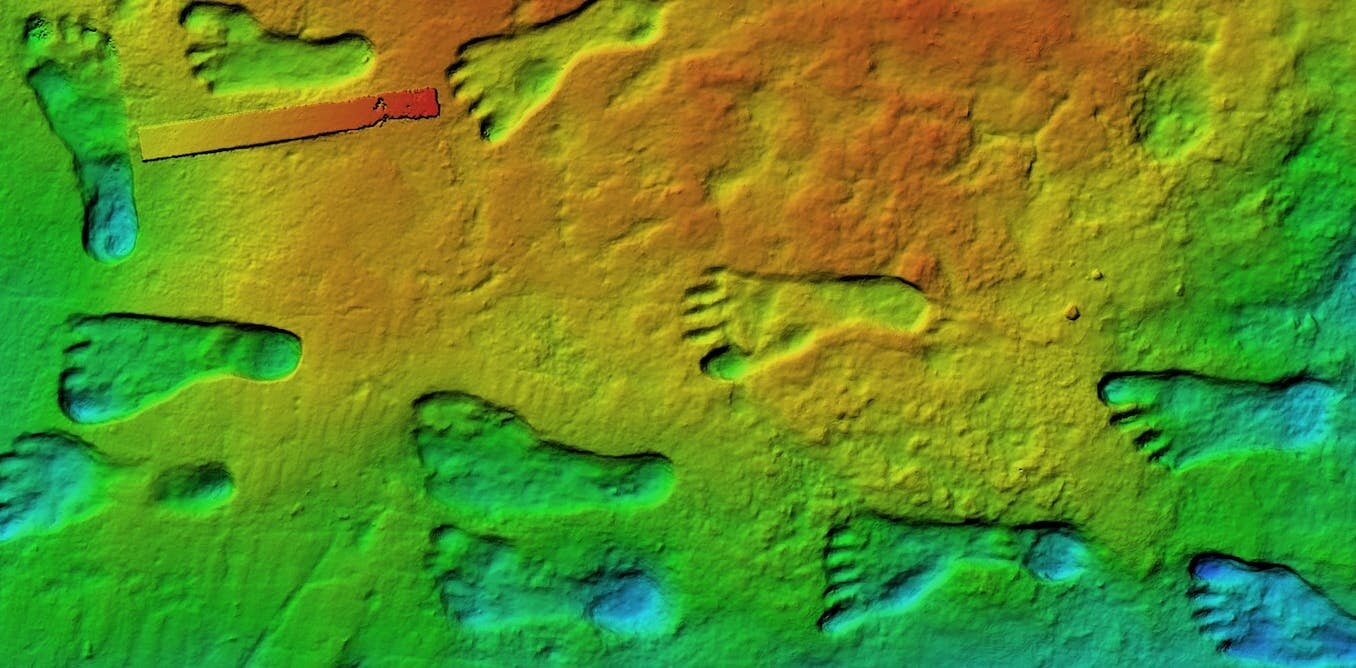
New research using radiocarbon dating and flow cytometry techniques has confirmed that humans settled in America approximately 23,000 years ago, 7,000 years earlier than previously thought. Fossil footprints found in New Mexico were dated to the last Ice Age, challenging the belief that humans arrived in North America as the ice sheets were melting. The study also addressed criticisms of the radiocarbon dating by analyzing pollen grains and using optically stimulated luminescence dating, both of which supported the earlier dates. The findings provide new insights into the prehistory of America and the migration patterns of early humans.