A Baltimore patient with a long history of headaches and brain fog undergoes psilocybin-assisted therapy, illustrating a growing psychedelic medicine movement that could transform treatment and spur a new industry.
In mice, two pre-chemo doses of psilocybin prevented peripheral neuropathy across six chemotherapy rounds by activating receptors on sensory nerves to keep mitochondria moving, preserving nerve function without reducing tumor shrinkage; a non-hallucinogenic analog targeting the same pathway also provided protection, suggesting potential for preventing neuropathy in cancer patients.
A mouse study published in Science found that psilocybin, given before chemotherapy, can prevent chemotherapy-induced peripheral neuropathy by preserving mitochondrial trafficking and ATP production in nerve endings. The protective effect relies on the serotonin receptor 5-HT2A, and a non-hallucinogenic 5-HT2A activator also provided protection. Human trials have not yet proven efficacy, though researchers plan to move toward clinical testing.
Monash University researchers conducted a five-year, open-label study with 62 healthy adults to map brain changes after psilocybin using fMRI, EEG, machine learning and questionnaires. They found a reduction in modular brain organization and a reconfiguration of networks—especially the default mode network—producing a “hidden order” linked to participants’ positive experiences and a sense of unity. The strongest global brain changes occurred when listening to ethereal music and were attenuated by visual input like watching a movie, highlighting the role of context in psychedelic effects. While findings may inform psychedelic therapies, the study lacked a placebo group and involved healthy volunteers, not patients.
A Nature study with 62 healthy adults shows psilocybin reorganizes brain networks across rest, mindfulness-like states, music, and cloud-watching, reducing the usual separation between self and world and revealing an 'embeddedness' signature that correlates with next-day positive changes. Using MRI/EEG and machine-learning mapped patterns, the research highlights context’s role in psychedelic experiences while noting limitations: participants were healthy volunteers, study was open-label and lacked a placebo, and results may not generalize to patients.
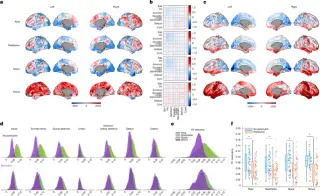
In a large, single-site study, 62 participants underwent fMRI and EEG during rest and naturalistic contexts (meditation, music, movie) before and after psilocybin. The drug reorganizes brain activity into context-aligned, low-dimensional trajectories, increasing global integration in associative regions and decreasing it in sensory areas during eyes-closed states, with eyes-open movie boosting overall synchrony. Machine-learning embeddings reveal a context-dependent state—embeddedness—that correlates with the depth of subjective self-/boundary-dissolution and with next-day mindset change; music amplified effects, while mindfulness training did not alter acute network measures. The work links latent neural order to subjective experience and therapeutic potential by showing how context shapes psychedelic brain dynamics.
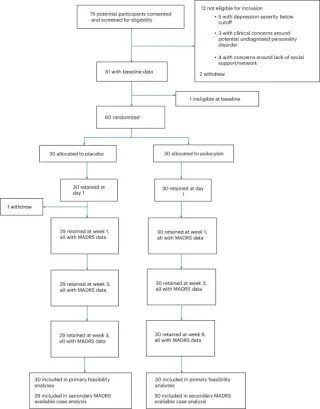
A UK National Health Service–based phase 2 feasibility randomized trial tested a single 25‑mg dose of psilocybin with psychological support versus placebo in 60 adults with treatment‑resistant major depressive disorder. At three and six weeks, the psilocybin group showed large, clinically meaningful reductions on the MADRS compared with placebo (about a 10–13 point advantage) and higher response/remission rates, with improvements in anxiety and well‑being. Adverse events were mostly mild and not clearly linked to the drug, and blinding was imperfect, suggesting expectancy effects contributed to the outcome. Feasibility metrics (recruitment, retention, data completeness) were favorable, supporting larger efficacy trials and consideration of cost‑effectiveness in public healthcare. Overall, the study demonstrates the practicality of delivering psilocybin‑assisted therapy in NHS settings, while recognizing limitations that future trials should address.
A publicly funded randomized trial found that a 25mg dose of psilocybin plus psychological support significantly boosted response (43% at 3 weeks, 56% at 6 weeks) and remission (40% at 3 weeks vs 3% placebo), with effects sustained through six weeks, suggesting psilocybin therapy could help treatment-resistant depression and warrants larger, publicly funded trials in community settings.
A small pilot study of 21 women with long-standing anorexia nervosa found that adding psilocybin (three doses) to intensive talk therapy reduced eating-disorder symptoms and increased motivation to recover for up to a year, though body-mass index did not change and there was no control group; some participants experienced profound shifts while others faced adverse experiences. Researchers caution that results are early and require larger, controlled trials to determine who may benefit and how best to implement this approach.
A study of 28 healthy adults found that a single 25 mg dose of psilocybin increased brain entropy within an hour and, one month later, showed denser neural connections on diffusion tensor imaging. Participants who experienced greater insight after dosing reported improved well-being a month later, suggesting the psychedelic experience may help rewire entrenched thought patterns and inform future mental-health therapies.
A rat study found that a single psilocybin dose (1 mg/kg, given intraperitoneally) reduced the rats’ preference for larger rewards 48 hours after administration, by increasing activity of parvalbumin inhibitory interneurons wrapped in perineuronal nets in the medial prefrontal cortex. This linked change in brain circuitry suggests psilocybin may dampen incentive motivation and alter reward processing, offering insight into potential mechanisms for treating substance-use disorders. Results are preliminary and limited to male rats, with no impairment to attention or basic motor skills observed.
A Japanese-American woman in her 80s with advanced Alzheimer’s showed notable functional gains—recalling personal memories, bladder control, dressing, and spontaneous social interaction—after a five-gram psilocybin session, with additional improvements after a subsequent three-gram dose a month later. Some benefits persisted weeks later, but researchers caution this is early-stage, not a cure, and stress the need for controlled clinical trials.
A published Frontiers in Neuroscience case report describes an 80-year-old woman with advanced Alzheimer's who temporarily regained urinary continence, walking ability, self-care, and conversational capacity after a single five-gram dose of psilocybin-containing mushrooms (with a follow-up three-gram session showing continued improved verbal expression). While the improvements spanned multiple domains and persisted for weeks, researchers caution that this is a single observational case without controls or standardized testing, and not evidence of a cure. The findings suggest dormant brain-network capacities may be temporarily re-engaged by psychedelic-induced neuroplasticity, highlighting the need for formal, controlled trials and safety assessments, particularly in vulnerable older adults; ongoing studies like UC Berkeley's PLASTICITY aim to explore aging brains and neuroplasticity with psychedelics.
An elderly woman with advanced Alzheimer's showed temporary improvements in speech, independence and orientation after psilocybin mushroom sessions. The report is a single case, with no biomarkers or control group, and does not prove a reversal of the disease or establish safety. It raises questions about whether psychedelics can temporarily modify brain-network communication and uncover latent abilities, underscoring the need for controlled research and caution given potential risks for older adults.
An octogenarian with advanced Alzheimer’s showed a temporary return of fluent speech and personal-memory recall about 19 hours after a supervised 5-gram psilocybin dose, with weeks of improved alertness and independence, and a second supervised 3-gram session suggesting further benefit. This is a single uncontrolled case with no biomarkers, so it does not prove efficacy or safety and cannot be generalized; potential mechanisms include 5-HT2A receptor signaling, increased BDNF, dendritic spine growth, and temporary restructuring of brain networks, highlighting the need for controlled trials and caution against unsupervised use.