Tag

Quasar

All articles tagged with #quasar

Milky Way Turbulence Reveals Hidden Structure in Distant Light
astronomy10 days ago

Milky Way Turbulence Reveals Hidden Structure in Distant Light

Astronomers using the VLBA tracked the quasar TXS 2005+403, 10 billion light-years away, as its radio waves were bent by turbulence in the Milky Way's ionized gas. The study finds persistent, patchy distortions rather than simple blur, providing a new probe of the Galaxy’s interstellar medium and informing models of star formation and cosmic-ray propagation.

Rare Quasar Pair Merges in the Early Universe, Illuminating Black Hole Growth
astronomy29 days ago

Rare Quasar Pair Merges in the Early Universe, Illuminating Black Hole Growth

Astronomers confirmed a rare, merging quasar pair at z=5.7 (about 1 billion years after the Big Bang) using ALMA, revealing two massive galaxies connected by a tidal bridge; both host galaxies harbor more than 10 billion solar masses and rapid star formation, signaling intense black hole growth during early mergers, which are expected to form a true binary in ~2.1 billion years and may impact the gravitational wave background.

Distant Black Hole Fades in a Human-Scale Timespan
space2 months ago

Distant Black Hole Fades in a Human-Scale Timespan

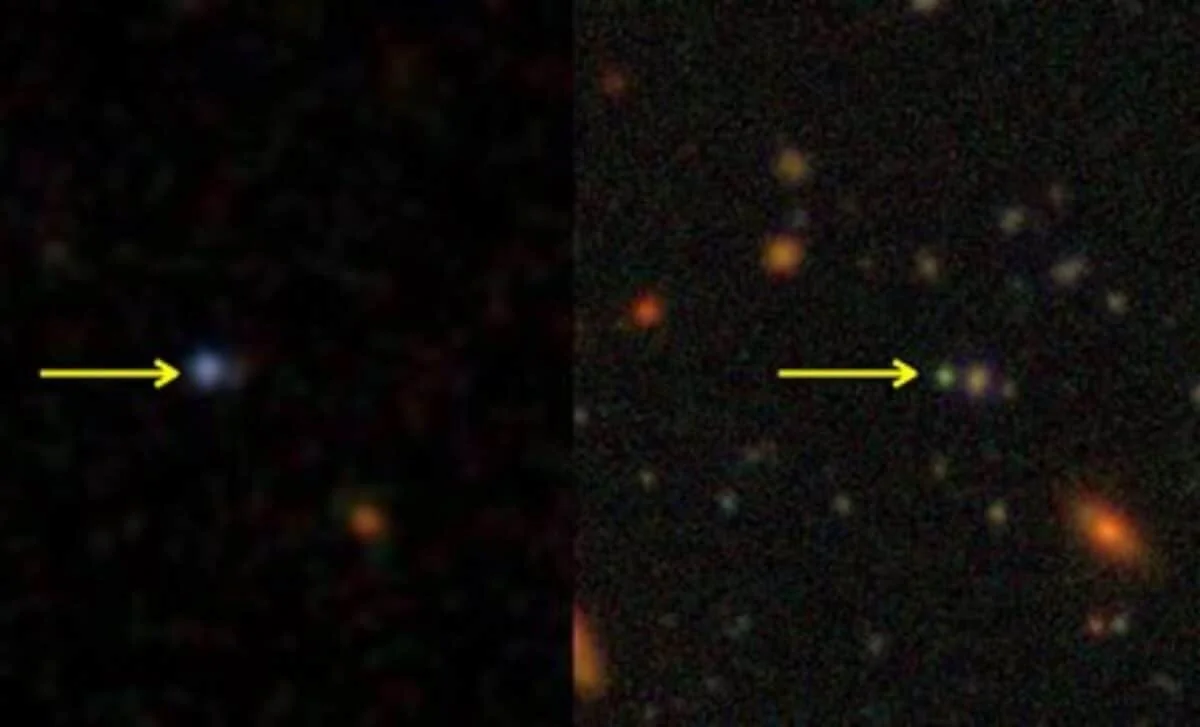
Astronomers tracked galaxy J0218−0036 (about 10 billion light-years away) and found its central supermassive black hole dimmed by about 20x overall and ~50x in the active nucleus from the early 2000s to 2023. Dust obscuration was ruled out, pointing to an intrinsic drop in accretion with the Eddington ratio falling from ~0.4 to ~0.008. The observed e-folding timescale is roughly 2,000 days in the observed frame (~700 days rest frame), far faster than standard models predict, suggesting a change in accretion mode and challenging current black hole growth theories.

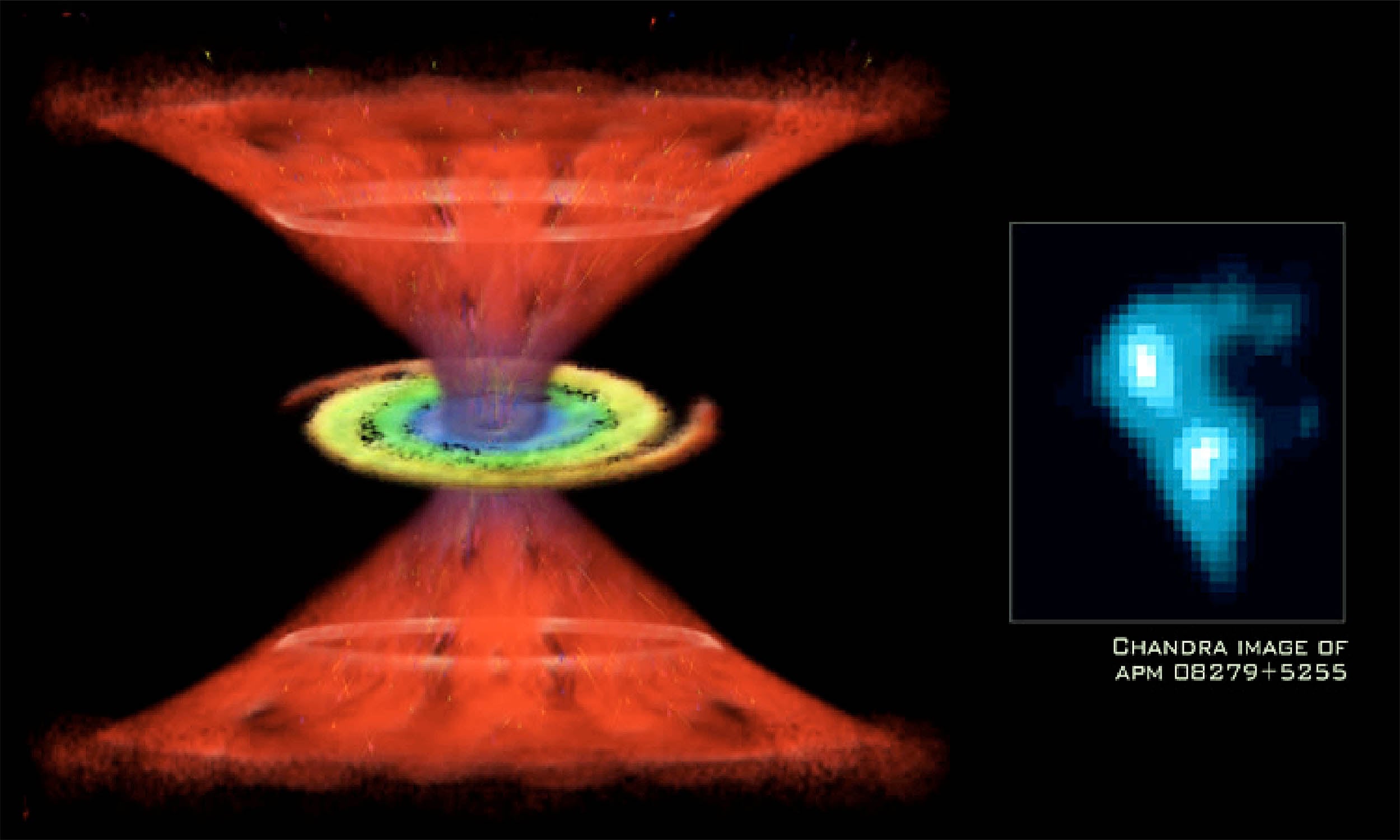
Cosmic water reservoir: distant quasar harbors trillions of oceans
science3 months ago

Cosmic water reservoir: distant quasar harbors trillions of oceans

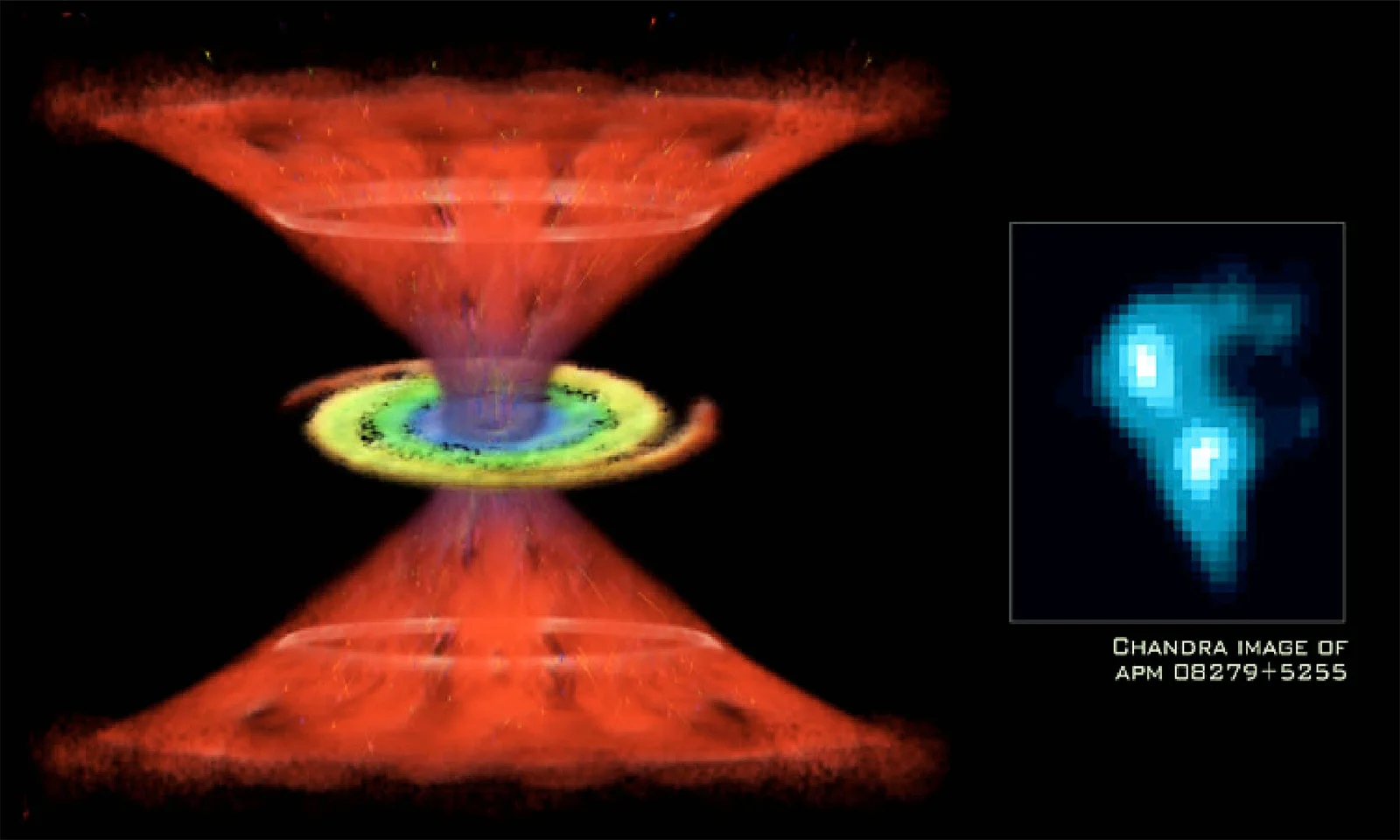
Astronomers report that the quasar APM 08279+5255, about 12 billion light-years away, contains roughly 140 trillion times the amount of water in Earth’s oceans, making it the largest known reservoir of water in the cosmos. Water was detected through multiple emission lines, aided by gravitational lensing that magnifies the source. The finding shows water is pervasive even in the early universe and helps illuminate how black holes grow and galaxies form, with lensing suggesting there may be more such water-rich systems hiding in existing catalogs.

Ancient quasar defies growth rules by 13× the cosmic limit
space3 months ago

Ancient quasar defies growth rules by 13× the cosmic limit

Astronomers studying the distant quasar ID830 find a supermassive black hole actively accreting at about 13 times the Eddington limit, powering gigantic radio jets and a bright X-ray corona. The extreme, short-lived super-Eddington phase challenges standard black hole growth models and supports the idea that early-universe SMBHs grew rapidly, shaping their host galaxies through intense outflows and radiation.

Black Hole Growth Surpasses Scientific Limits, Defying Physics
science7 months ago

Black Hole Growth Surpasses Scientific Limits, Defying Physics

Astronomers using NASA's Chandra X-ray Observatory have discovered a distant quasar with a black hole growing faster than the Eddington limit, shedding light on how supermassive black holes formed early in the universe. The black hole, about a billion times the Sun's mass, is accreting material at a rate 2.4 times the typical maximum, which may explain the rapid emergence of massive black holes shortly after the Big Bang.

Scientists Reveal Smaller Sizes for Supermassive Black Holes
science8 months ago

Scientists Reveal Smaller Sizes for Supermassive Black Holes

A study of a distant galaxy suggests supermassive black holes may be smaller than previously thought, challenging existing models of cosmic growth. The black hole at the core of a galaxy over 12 billion light years away is estimated to be about one billion suns, much less than earlier assumptions, due to intense radiation blowing gas away and limiting its growth.