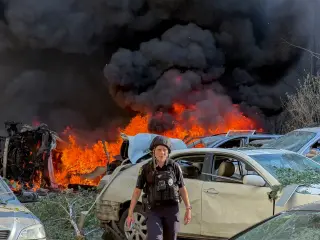
Russia claims Kyiv violated a U.S.-brokered ceasefire, underscoring ongoing tensions in the war as Moscow cites the claim amid commemorations and escalating rhetoric; the excerpt provided covers the accusation but offers few details on the alleged breach.
President Donald Trump announced a three-day ceasefire from Saturday to Monday between Russia and Ukraine to facilitate a 2,000-prisoner swap, mediated by the United States. Zelenskyy quickly expressed support and urged Washington to ensure Russia upholds the deal, noting past truces have fallen apart. Trump framed it as a step toward ending the war, with talks continuing.
The 61st Venice Biennale opens amid geopolitical drama, with Russia resuming its pavilion and Finland limiting participation, as conflicts in the Middle East and other global tensions overshadow the art on display and shape the Biennale’s discourse.
ISW reports that Russia net-lost about 116 sq km of Ukrainian ground in April 2026—the first such loss since 2024—while the Nov 2025–Apr 2026 window shows Russia seizing 1,443.35 sq km but infiltrating an additional 1,716.42 sq km, meaning infiltration areas inflate apparent gains without reliable Ukrainian control. The rate of Russian advances slowed to roughly 2.9 sq km per day in early 2026 versus 9.76 per day in early 2025, with colder/wetter winter weather, ongoing Ukrainian counterattacks, and weather-driven movement limiting tempo. ISW notes continued activity near Novopavlivka and western Zaporizhia, Ukrainian gains in Kostyantynivka-Druzhkivka, and persistent long-range strikes across occupied Crimea and Kherson, while it emphasizes its methodological separation of infiltration from seized terrain.
Amnesty International’s annual report accuses the United States, Israel, and Russia of eroding global human rights, calling their leaders “predators” and warning that authoritarian practices have intensified worldwide, even as protests and legal actions offer some signs of resistance.
Ukrainian long-range drone strikes are forcing Russia’s rear-region authorities to acknowledge the threat and bolster defenses, including plans to guard critical infrastructure in Leningrad Oblast and recruit reservists for mobile fire groups. At the same time, state polls show growing domestic discontent with Putin and the Kremlin, while seaborne oil exports fall due to strikes on port infrastructure. Ukraine continues to enhance its air-defense and drone capabilities, with new interceptor tech and defense cooperation with Germany, amid ongoing fighting across Kharkiv, Donetsk, and southern fronts and a renewed emphasis on long-range strikes against Ukrainian targets.
Meduza argues that the widely cited figure of Russia losing 50,000 soldiers per month is likely a data artifact caused by counting wounded as dead and by a new process that retroactively declares missing soldiers dead to collect benefits. After adjusting for these distortions and for improved data coverage, current irreversible losses appear to be about 27,000 per month (roughly 900 per day), with the 2025 spike driven largely by data artifacts rather than battlefield gains. This challenges Western casualty models that rely on historical multipliers to project current losses.
Two days of Geneva talks among Russia, Ukraine, and U.S. envoys yielded no breakthrough on ending hostilities, prisoner exchanges, or energy-related ceasefires. Ukraine pressed for stronger U.S. pressure and concrete security guarantees; Russia described the talks as tough but constructive and said progress remains limited on political issues. Zelenskyy indicated progress militarily but warned that disputes over eastern territories and Zaporizhzhia persist, with both sides planning to keep negotiating toward a real, sustainable peace. The discussions have drawn attention for political theater around supporters like Donald Trump, and a follow-up session is planned.
A CSIS estimate puts Russia’s end-2025 combat casualties at about 1.2 million (killed, missing, wounded), with total war casualties on both sides near 2 million—far surpassing any major power since World War II. However, many wounded are reintegrated into service and missing data are uncertain, so the publicly visible figures likely understate the true human cost of the war.
A CSIS analysis projects combined Russian and Ukrainian casualties could total up to 2 million by spring, with Russia bearing the majority (~1.2 million casualties and up to 325,000 deaths) and Ukraine at roughly 500,000–600,000 casualties; the conflict has settled into a slow, attrition-driven grind and casualty figures from both sides remain disputed by authorities.
The EU Council has imposed sanctions on 12 individuals and 2 entities linked to Russia's hybrid activities, including information manipulation and cyber attacks against the EU and its allies, as part of ongoing measures to counter destabilizing actions by Russia. These measures include asset freezes and travel bans, targeting Russian military and cyber groups involved in disinformation and cyber warfare, with the sanctions regime in place until October 2026.
At the UN General Assembly, Iran's president stated Iran does not seek nuclear weapons, while Zelenskyy warned of a destructive arms race and Russia's expansion in Ukraine. The meeting also covered issues like Iran's nuclear program, Ukraine's security, and regional conflicts, with global leaders calling for diplomacy and peace efforts.
JD Vance incorrectly claimed that all major wars end with negotiations, citing World War I and II, but his examples were factually inaccurate, especially regarding the outcomes of WWII and WWI, while discussing Russia-Ukraine negotiations.
The Trump administration's Director of National Intelligence, Tulsi Gabbard, ordered a halt to intelligence sharing on Russia-Ukraine peace talks with the Five Eyes alliance, limiting information to publicly available data and internal agency sharing, without explanation. This decision occurs amid ongoing U.S.-brokered peace efforts and heightened tensions among allies, with Gabbard previously involved in Ukraine-related controversies.
Tulsi Gabbard, the director of national intelligence, issued a memo instructing U.S. intelligence agencies not to share information about Russia-Ukraine peace negotiations with Five Eyes allies, raising concerns about potential impacts on international intelligence cooperation and trust among allies.