As winter arrives, many individuals report increased joint pain and stiffness. While the scientific consensus on barometric pressure is mixed, experts agree that cold temperatures thicken synovial fluid and reduce activity levels, exacerbating symptoms for those with arthritis or prior injuries. Healthcare professionals recommend maintaining consistent movement, using heat therapy, and staying hydrated to manage discomfort.

A new study reveals a significant gender gap in diagnosing autoimmune diseases, with women facing an average delay of four years compared to less than a year for men. Researchers attribute this disparity to the dismissal of women's symptoms as psychological or stress-related, particularly when physical tests are inconclusive. The findings highlight a systemic bias in medical care that leaves millions of women without timely treatment for conditions like lupus and rheumatoid arthritis.
Researchers at the Norwegian University of Science and Technology (NTNU) have discovered that Janus kinase (JAK) inhibitors, a class of anti-inflammatory drugs widely prescribed for conditions like rheumatoid arthritis, may inadvertently facilitate the spread of dangerous viruses. The study, published in NAR Molecular Medicine, indicates that these medications suppress specific immune signaling pathways and gene activities that normally protect cells from viral infection. This suppression can leave patients more vulnerable to pathogens such as influenza, SARS-CoV-2, adenovirus, and Rift Valley fever virus. While the drugs are effective for managing inflammation, the findings suggest a significant trade-off: they may compromise innate antiviral defenses, potentially allowing viruses to establish infections and propagate more easily within the body. The researchers recommend caution when prescribing these medications during periods of high viral transmission or for patients with active or latent infections.
Researchers identified obakulactone, a compound from Phellodendri cortex bark, as a potential treatment for rheumatoid arthritis. In rat models, the substance reduced joint swelling and protected cartilage by targeting the protein ACOT1. This mechanism disrupts unsaturated fatty acid metabolism, thereby suppressing inflammatory signaling pathways. The findings suggest a new therapeutic strategy that addresses the metabolic roots of autoimmune inflammation rather than merely suppressing immune responses.
Researchers at University College London have identified a biological mechanism that helps the body stop inflammation, potentially leading to safer treatments for chronic diseases. The study, published in Nature Communications, found that fat-derived molecules called epoxy-oxylipins act as natural brakes on the immune system. By blocking an enzyme that breaks down these molecules, researchers reduced harmful immune cells and pain in human volunteers. This discovery offers a new approach to treating conditions like arthritis without suppressing overall immunity.
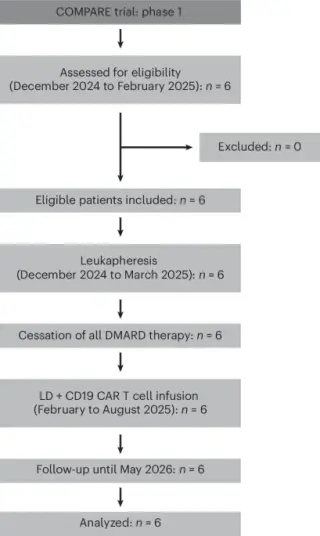
A phase 1 trial at Charité University Hospital in Berlin demonstrated that CD19-targeted CAR T cell therapy can induce medication-free remission in severe rheumatoid arthritis. Six patients with treatment-refractory disease showed significant disease activity reduction, with three achieving sustained remission without drugs. The therapy safely depleted harmful B cells while preserving protective antibody memory, though larger studies are needed to confirm long-term efficacy and safety.
A phase 3 trial found that upadacitinib, a JAK inhibitor used for rheumatoid arthritis, helped 50-54% of patients with severe alopecia areata achieve 80% scalp hair coverage within 24 weeks. The drug is already approved in Europe but awaits FDA review in the US.
A plant-derived compound called obakulactone (OL) alleviates arthritis symptoms and joint damage in a rat model of RA by promoting ACOT1 degradation via the ubiquitin–proteasome pathway, correcting disrupted unsaturated fatty acid metabolism, and modulating immune cells and inflammatory signals. The study identifies ACOT1 as a potential drug target and suggests a new preclinical strategy for RA, though its safety and efficacy in humans remain to be tested.
New Semmelweis University research suggests persistent rheumatoid arthritis symptoms may be driven by sleep disorders, depression, obesity, and smoking even when inflammation is controlled, prompting a model to identify non-inflammatory drivers and guide personalized treatment, with AI-driven subgroups as future work.
A 1985 death of a baby in the hands of neurosurgeon Kevin Tracey propelled him to study inflammation, culminating in the FDA-approved SetPoint System—a small neck implant that stimulates the vagus nerve for one minute daily to dampen inflammation in rheumatoid arthritis patients, offering dramatic relief for many while facing ongoing insurance denials; Tracey sees this as the dawn of bioelectronic medicine and a potential path to other inflammatory diseases.
Rheumatoid arthritis is an autoimmune disease marked by joint pain, morning stiffness, swelling, and fatigue; early diagnosis and treatment with DMARDs and biologics, along with physical therapy, regular movement, sleep, stress management, and an anti-inflammatory diet, can slow progression and protect joints, though symptoms can wax and wane and may include mood changes and other systemic effects.
A Nature Immunology study using spatial transcriptomics reveals that persistent scar formation (fibrosis) and disrupted fibroblast–endothelial signaling in RA joints may drive treatment resistance even when inflammation is controlled, pointing to a new fibrosis-focused therapeutic target for patients who don’t respond to standard therapies.
Obakulactone (OL), a natural compound from Phellodendri cortex, promotes degradation of ACOT1 via the ubiquitin–proteasome system, restoring unsaturated fatty acid balance and reducing inflammation in a rat model of rheumatoid arthritis. The study reported OL lowered inflammatory cytokines and autoantibody markers, shifted macrophages toward anti-inflammatory states, and inhibited synovial fibroblast growth, with direct ACOT1 binding (Kd ~6 μM), suggesting a novel metabolic-targeted approach for RA treatment.
A long-term analysis from King’s College London shows that a 12-month course of abatacept in people at high risk of rheumatoid arthritis can delay disease onset by up to four years, with benefits persisting after treatment ends; strongest effects were in those at highest risk identified by specific autoantibodies, and while the therapy does not permanently prevent RA, early immune modulation may lessen future symptom burden and support preventive strategies, with safety comparable to placebo.
A Flinders University–led study finds methotrexate, a long-used rheumatoid arthritis drug, lowers systolic blood pressure by about 7.4 mmHg in newly diagnosed RA patients compared with sulfasalazine, a reduction that could meaningfully reduce risk of heart attack and stroke. The blood-pressure drop did not track with improvements in joint symptoms or arterial stiffness, suggesting other pathways (such as reduced systemic inflammation) may be involved. Genetic factors may help predict who benefits most, paving the way for personalized therapy, though more research is needed.